
DMOZ is one of the oldest and also the most trusted web directories. It has made its name by having human editors to organize websites. After more than 18 years operating, it's shutting itself down.
Launched on June 5th, 1998, with the name "GnuHoo," and then changed to "NewHoo," it was a rival to the Yahoo! Directory at the time.
DMOZ was acquired by Netscape in 1998 and renamed to Netscape Open Directory. After AOL acquired Netscape, AOL is having full control of The Open Directory. At that time, the Open Directory Project had about 100,000 URLs indexed with contributions from about 4500 editors. On October 5, 1999, the number of URLs indexed by DMOZ reached one million.
On that same year, Google was born. As a search engine that relies on computers rather than humans to scan and organize the web, Google brought the web to the next level by putting websites and relating them according to their relevancy and rank.
As Google took off, human-powered directories that were meant to categorize websites, failed to compete.
Posing huge threats to Yahoo! Directory, Yahoo! switched from human editors to machine-generated results. But that didn't last too long until Yahoo! announced its closure in September 2014.
DMOZ thrives when Yahoo! Directory had faced criticisms as being to difficult for many websites to listed in.
DMOZ announced the closure on its website's home page as seen below:
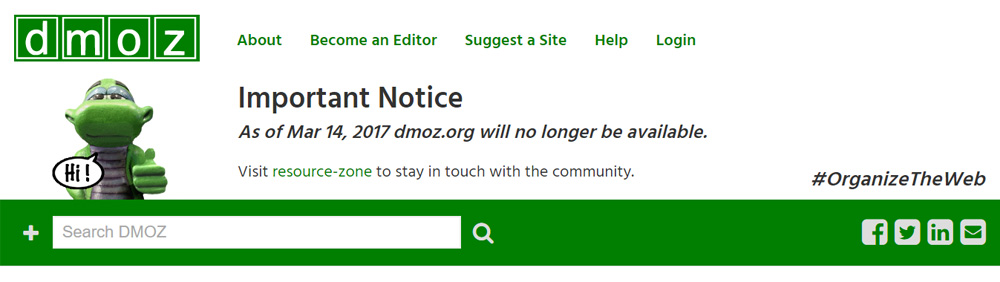
While others in the competition switched or use machines to organize the web, DMOZ continued on. But as search engines become better and better, the once was popular DMOZ started to be a forgotten resource.
Previously, many webmasters and web owners tried to appeal to DMOZ in order to get their rank higher. Because DMOZ is an authoritative website with a good rank and old domain, it's seen as a respectable source.
While DMOZ is shutting down, it's legacy will still live at least for the close future. Its NOODP meta tag, for example, is a way for publishers to tell search engines to not describe their pages using. The tag has become redundant, and will still be on web pages in years to come.
DMOZ was one of the big thing of the internet at some point of its life. And its end is also marking the end of Open Directory era.




















































































































































































































































































