

Google is rolling out an update to Gemini Live that fundamentally changes how the voice assistant interacts with users.
And that is by enabling it to remember details from previous conversations and securely access information from connected applications. Originally announced at Google I/O and building upon recent upgrades to the underlying model, this capability is designed to transform the voice experience from a series of isolated exchanges into a continuous, personalized dialogue.
By leveraging memories across multiple sessions, Gemini Live can recall specific context, such as dietary preferences, long-term hobbies, or important family dates, meaning users no longer have to constantly repeat background information when starting a new conversation.
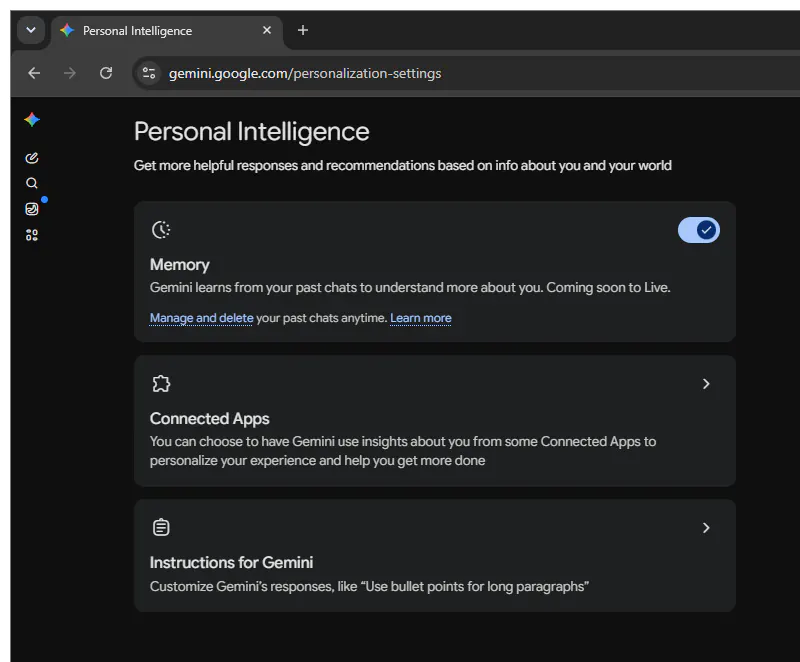
The update is tightly integrated with a broader system framework known as Personal Intelligence, which expands the assistant's awareness across the Google ecosystem.
During live, hands-free voice conversations, Gemini Live can pull data in real time from supported connected applications including YouTube, Google Workspace utilities, and device settings.
This allows the AI to manage multi-step, complex commands and offer highly tailored advice based directly on a user's existing files, emails, or schedules.
When Personal Intelligence is enabled, it supercharges your experience in Gemini by making it more personal, proactive, and powerful.
For example, if you’re looking for hidden gems in a city you’re traveling to, you can get recommendations based on your unique interests and past… pic.twitter.com/AzfCnW9fHK— Google Gemini (@GeminiApp) March 17, 2026
While the assistant can smoothly transition between voice and text interactions while preserving this deeper context, certain features, such as direct integration with Google Messages, are absent from the initial rollout phase.
User control and data privacy remain foundational to how these memory systems function on mobile devices.
Gemini Live strictly adheres to the exact same permission and privacy settings that users establish for their standard text-based chats with Gemini.
Gemini's about page added that Gemini Live can "securely remember key details you mention across different sessions, like dietary preferences, important family dates, or your favorite hobbies, so you don’t have to keep repeating yourself during future chats," provided users have granted the necessary permissions.
The company said the feature follows the same privacy and permission settings users choose when interacting with Gemini through text.
The integration with external apps is entirely optional and turned off by default, giving users the autonomy to explicitly choose which applications to connect.
Furthermore, users can review, modify, or permanently delete stored memories and linked application data at any time through their account settings. The new features are currently rolling out in English for users in the United States, bringing the conversational voice experience to functional feature parity with the main Gemini application.
This evolution addresses a long-standing limitation of voice assistants, which have historically operated with a clean slate each time a user initiated a new session.
By introducing long-term memory, the system can recognize patterns in user preferences and adapt its tone or depth of response accordingly.
For example, if a user previously mentioned planning a trip or managing a specific health goal, the assistant can contextually reference those parameters in future voice prompts without needing an explicit reminder.
This shift from a purely transactional utility to a relational assistant marks a notable progression in how consumers interact with artificial intelligence on a daily basis.
The underlying infrastructure that powers this update relies on sophisticated text analysis and categorization.
When a user shares a piece of personal data during a voice chat, the assistant identifies key pieces of information that possess long-term relevance. This data is then securely indexed in a dedicated personalization profile, separate from the primary training data used for the core language model. This segmentation ensures that a user's private details are accessible only within their specific account and cannot influence the broader behaviors of the AI for other people across the web.
Industry analysts note that adding these capabilities puts the platform in direct competition with other major technology companies striving to build contextual, ambient computing environments.
Further reading: How Google's 'Gemini Intelligence' Wants To Evolve Android By Integrating Contextual Intelligence Into The Mobile Core