
Google has chat apps available, and Hangouts isn't the most popular. While it's availability is almost on any Android devices, the app has been intimated by the various Google products and the more leading chat apps available in the market.
With the fact at hand, Google still has its own plans, and that is certainly to not kill the not-so-popular Hangouts app yet.
On September 23rd, 2016, Google releases version 13 of the app, and with it, Google introduces new goodies. The first and the most prominent in the update is the emoticons. Hangouts v13 has 20 new emoticons to play with. They are:
/algebraic, /dealwithit, /disapprove, /facepalm, /flowerbeam, /happy, /lgtm, /lit, /octodisco, /puppyparty, /shame, /shrug, /success, /sunglasses, /tableback, /tableflip, /that, /this, /wizard and /yuno.
To use the feature, Android users just need to type them. Hangouts will automatically convert the text into their corresponding emoticons.
The update was literally introduced in Hangouts v12. But that version only included one emoticon - the shruggie ¯\_(ツ)_/¯. Hangout v13 brings a whole bunch more of them.
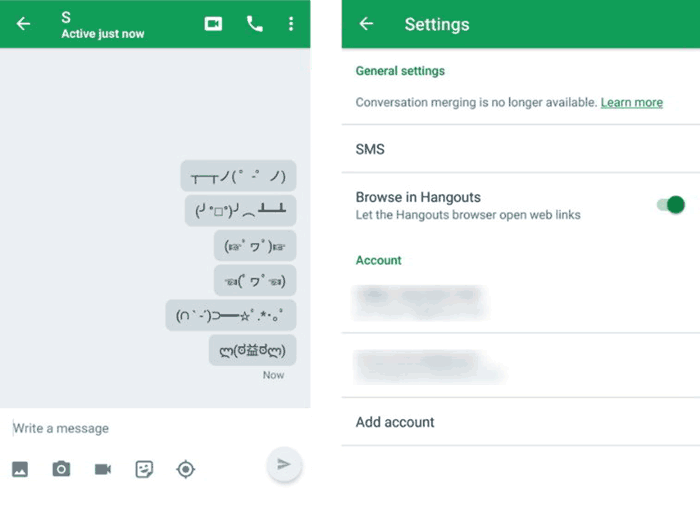
Hangouts v13 also introduces one neat feature, and that is an in-app browser.
On chat apps and other platforms, many users are certainly bothered when they have to switch to a browser in order to see links. The in-app browser is giving back the choice to use Chrome's custom tabs instead of opening links up to a separate browser app.
The feature is nothing new as it's available in many other apps already, including Google+, Facebook and Twitter. Google just took "quite a while" before making Hangouts to have such feature.
The in-app browser is rolling out to users slowly so it isn't initially available for everyone just yet.
With the update, Google is clearly showing that it isn't going to kill Hangouts anytime soon. Although the company has much too many apps, it has recently launched Allo and Duo to compete with Facebook Messenger, WhatsApp, Skype and other notable players in the industry.

















































































































































































































































































