
The large language models (LLMs) war isn't stopping. It's getting fiercer as Google is ramping up its ante.
Since the arrival of ChatGPT in late 2022, its creator, OpenAI, ignited one of the most intense competitions in tech history. What began as a groundbreaking chatbot quickly escalated into a frantic race among giants like Google, Meta, Anthropic, and others to build smarter, faster, and more capable AI systems.
Billions poured into research, new models dropped every few months with incremental leaps in reasoning, coding, and multimodal abilities, and the public watched in awe as AI went from novelty to everyday tool.
Yet amid the text-heavy arms race, image generation quietly became its own explosive frontier, where models like DALL·E, Midjourney, and Stable Diffusion turned wild prompts into stunning visuals, fueling memes, art, and endless social media experimentation.
Google, initially playing catch-up after its own early image tools faced criticism, struck gold in August 2025 with the launch of Nano Banana, an internal codename for what was officially a Gemini-based image generation and editing model (tied to Gemini 2.5 Flash Image).
The quirky name stuck, and users embraced it wholeheartedly.
Now, make way for 'Nano Banana 2.'
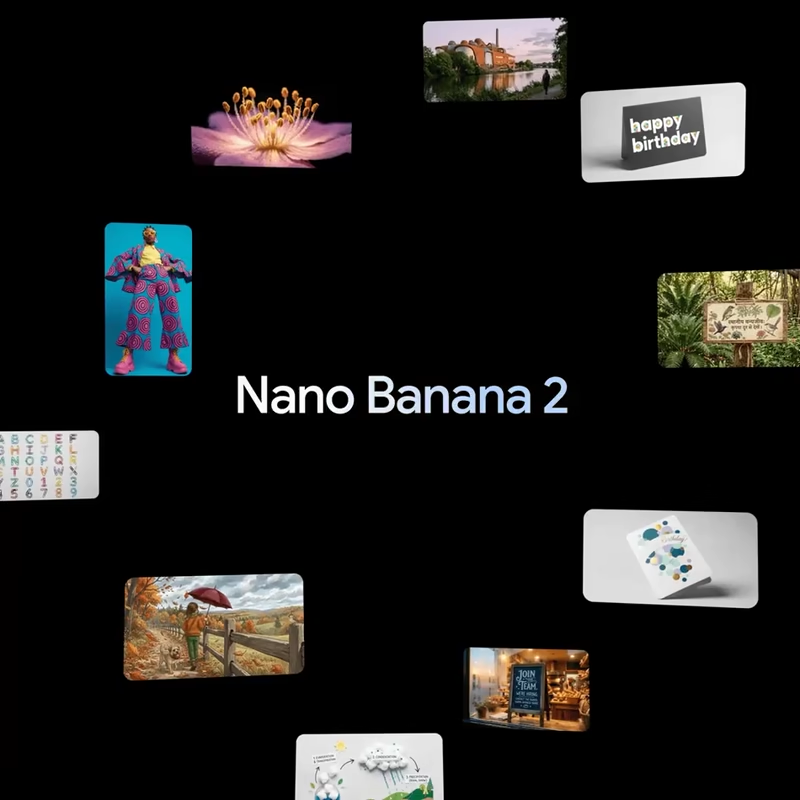
Introducing Nano Banana 2 , our best image generation and editing model yet. Try it now in the @GeminiApp, @GoogleAIStudio and more.
— Nano Banana 2 (@NanoBanana) February 26, 2026
Nano Banana exploded in popularity thanks to its exceptional ability to edit photos realistically, render accurate text in images, follow complex instructions, and deliver high-quality results without the heavy censorship or artifacts that plagued competitors.
Millions flocked to the Gemini app to play with it, especially in creative hotspots, where people reimagined everything from personal photos to cultural scenes. In just days, it attracted over 13 million first-time users to Gemini, generating viral waves of custom figurines, nostalgic edits, and absurd transformations that flooded social feeds.
The best of Nano Banana Pro at the speed of Flash
Nano Banana 2 brings studio-quality creative control and real-world reasoning to image generation.
See Nano Banana 2 in action pic.twitter.com/FQxZxGhSqK— Google (@Google) February 26, 2026
The tool's seamless integration into Google's ecosystem, Gemini chat, Search via Lens, and beyond, made it accessible and addictive, turning casual users into creators overnight.
By November 2025, Google followed up with Nano Banana Pro, dialing up the detail, fidelity, and creative control for even more professional-grade outputs.
And now, Nano Banana 2 fuses the advanced, pro-level capabilities of its predecessor: precise instruction following, superior subject consistency across edits, strong text rendering in multiple languages, and the ability to draw on real-world knowledge plus real-time web-sourced images for accurate depictions.
"Our latest image generation model offers advanced world knowledge, production-ready specs, subject consistency and more, all at Flash speed," said Google in the announcement.
Nano Banana 2 is here.
Our latest image model gives you the power of Pro at the speed of Flash. You can create images with real-world accuracy, add text in many languages, and bring your wildest ideas to life faster with vibrant lighting, richer textures and sharper details.— Google Gemini (@GeminiApp) February 26, 2026
All that with the blistering speed of Gemini Flash.
The result is lightning-fast generation and editing, often in sub-seconds for high-resolution outputs like 4K images, while maintaining or exceeding previous quality benchmarks. It powers rapid iteration, turning rough ideas into polished visuals almost instantly, and excels at tasks like creating infographics from notes, rendering specific real-world subjects accurately, or performing sophisticated photo manipulations.
In Nano Banana 2 you can generate images with new aspect ratios: 4:1, 1:4, 8:1 and 1:8.
Try it with these prompts:
1. A 4:1 panoramic photo I took on my phone, showing the luscious jungle view from my cabin
2. A 4:1 panoramic photo I took on my phone, showing the view from my… pic.twitter.com/U1IyaQWNkT— Nano Banana 2 (@NanoBanana) February 26, 2026
Nano Banana 2 rolled out as the default across the Gemini app (in Fast, Thinking, and Pro modes), Google Search's AI features in over 140 countries, and developer tools via the Gemini API.
Its arrival has only amplified the viral momentum: creators are already pushing boundaries with multi-reference image edits, intricate diagrams, and hyper-realistic alterations that feel eerily lifelike. .
What started as a fun, banana-branded experiment has evolved into one of Google's most impactful AI contributions, proving that in the relentless LLM and multimodal wars, sometimes the most disruptive innovations come wrapped in a playful name and delivered at impossible speeds.
As the competition heats up further, Nano Banana 2 stands as a reminder that accessibility, speed, and sheer creative joy can win hearts, and timelines, just as much as raw parameter counts ever could.
Introducing Nano Banana 2, our best image model yet
It uses Gemini’s understanding of the world and is powered by real-time information and images from web search. That means it can better reflect real-world conditions in high-fidelity.
Check out "Window Seat," a demo… pic.twitter.com/zhe8tC4jCL— Sundar Pichai (@sundarpichai) February 26, 2026