
Google has rolled out a fresh set of anti-theft enhancements for Android devices.
The updates are meant to make stolen phones significantly harder targets for criminals. These updates build directly on the foundational protections introduced in 2024, such as Theft Detection Lock, which uses on-device AI to detect sudden snatch-and-run motions and automatically secure the screen, and Offline Device Lock, which keeps the device protected even without an internet connection.
The company emphasizes a multi-layered approach that protects users before, during, and after a potential theft, recognizing that losing a phone can quickly lead to risks like personal data exposure or financial compromise.
At the core of the new changes are smarter authentication safeguards, primarily for devices running Android 16 and higher.
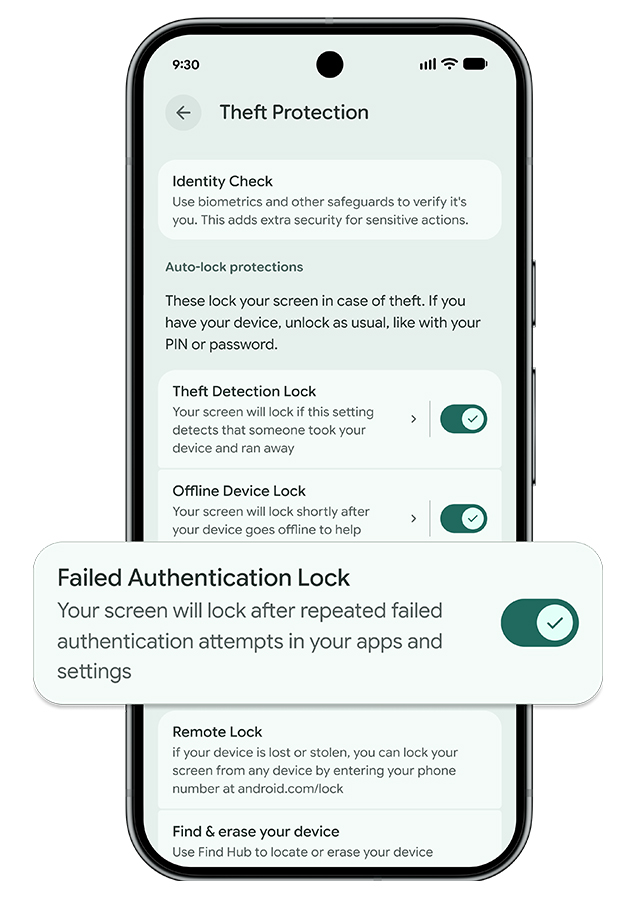
One key improvement, according to Google is a blog post, is to give users more granular control over Failed Authentication Lock, a feature first launched with Android 15 that automatically locks the screen after too many incorrect unlock attempts.
Now, there's a dedicated toggle in the settings menu to enable or disable it entirely, allowing people to tailor the behavior to their needs, whether they're worried about a thief brute-forcing their PIN, pattern, or password, or if they occasionally hand the phone to a family member who might input wrong guesses repeatedly.
To further deter guessing attacks, Google has increased the lockout duration after failed attempts, while smartly ignoring identical incorrect inputs to avoid unfairly punishing legitimate users who might mistype the same thing multiple times.
Another major expansion comes to Identity Check, which originally required biometric verification (like fingerprint or face scan) for sensitive actions when the device is away from trusted locations, such as home or work.
This has now broadened to encompass all apps and features that rely on Android's Biometric Prompt system.
That means third-party banking apps, Google Password Manager, and other critical tools automatically inherit the extra layer of protection. No more relying solely on a PIN override in unfamiliar places, reducing the window for thieves to access sensitive information if they manage to get past the initial lock screen.
For recovery scenarios, Remote Lock has received a useful security boost and is now available across devices running Android 10 and up.
Users can initiate a lock from any web browser via Google's Find My Device service (at android.com/lock or google.com/android/find), but they've added an optional security challenge, such as answering a personal question only the owner would know.
This prevents someone else from maliciously locking users' device remotely, adding peace of mind without complicating the process for genuine owners. In Brazil, Google is taking things a step further by enabling both Theft Detection Lock and Remote Lock by default on new devices, ensuring stronger out-of-the-box protection in a region where theft concerns may be particularly acute.
These enhancements arrive as part of Google's ongoing commitment to evolving Android's security posture, making high-end Pixels, premium foldables, Samsung flagships, and other compatible devices less appealing to thieves who often target phones for quick resale or data exploitation.
With features rolling out immediately to eligible devices, users can check their settings to enable or fine-tune these tools, turning what was once a vulnerability into a much more robust defense.
As phone theft remains a real-world issue that can lead to broader privacy and financial risks, these smarter, user-controlled protections offer meaningful reassurance in an increasingly connected world.






















































































































































































































































































