
 Google started its life, and built its popularity around the web when it created algorithms that crawled the internet. Since then, the company has aimed higher, expanded its business ventures in many places. The internet company is never shy from developing dreams that were once science fiction. Adding to its attempt, the company is developing a system of nanoparticles to detect signs of cancer, heart attacks, and other illnesses.
The company's "moonshot" was first revealed by Andrew Conrad, Google's Head of Life Sciences, and former molecular biologist who previously developed a cheap HIV test that has become widely used. Conrad took to the stage at the Wall Street Journal Digital conference to reveal that Google X is working on a wearable devices that couples with nanotechnology to detect disease within the body.
Google X division is dedicated to make major technological advancement such as self-driving cars and Project Loon. The division that aims to develop "science fiction-sounding solutions", is overseen by Sergey Brin, one of Google's co-founders.
Nanotechnology Inside Your Body
Google's attempt to "enter" the human body is by using a nanotechnology, or "nanotech", This technology is the manipulation of matter in an atomic, molecular, and supramolecular scale. The initial ideas and concepts behind this nanoscience started with a talk entitled "There's Plenty of Room at the Bottom" by physicist Richard Feynman at an American Physical Society meeting at the California Institute of Technology (CalTech) on December 29, 1959. The goal is to manipulate atoms and molecules in such a way that it resembles a product that does specific things. This nanoscaled technology that has a broad range of research and applications has created an industry that worth billions of dollars.
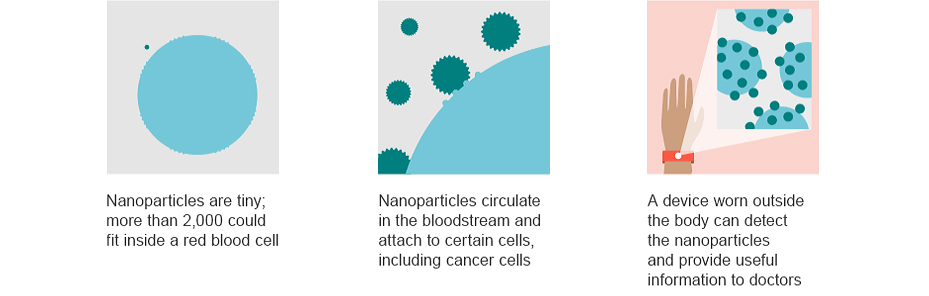
Beside being tailored to seek cancerous cells, these nanoparticles can also programmed so they could find evidence of fatty plaques about to break free from the lining of blood vessels to impending heart attacks or strokes. Furthermore, they can also monitor chemicals in the blood that are linked to other diseases. The technology is still at its early stage, but when it comes to mature, the possibility of nanotechnology to cure illness can certainly improve the way we treat diseases.
The disease-detecting nanoparticles would enter a patient's bloodstream via a swallowed pill. The idea is to identify changes inside a person's body that is administered with the pills, and act as an early warning system. The technology will constantly monitor the blood for unique traces of illnesses, allowing diagnosis long before physical symptoms appear.
Early diagnosis is always seen as the first key in treating a disease. Because when a disease, such as many cancers, can create complications and attract other diseases. And late diagnosis on many cancers have proven to be fatal to some.
"What we are trying to do is change medicine from reactive and transactional to proactive and preventative," said Conrad.
The plan is to test whether nanoparticles that are coated with "magnetized" antibodies can catch disease in its early stages. The tiny particles are essentially programmed to spread throughout the body after the pills are ingested. The person can then make use of the nanoparticles that are released inside the body by using a wearable device that tracks the nanoparticles' activity via light and radio waves. The device can then tell what is going on inside the body.
The researchers at Google have also explored ways of using magnetism to concentrate nanoparticles in a single area.
"Think of it as sort of like a mini self-driving car," said Conrad with a reference to Google X's self-driving car project. "We can make it park where we want it to."
With this early diagnosis, patients can monitor their body on a daily basis without needing to go to a doctor or taking samples. This can minimize cost and time, increasing efficiency. And according to Conrad, patients can also upload the data to the cloud or elsewhere, and send it to a doctor when needed.
"Every test you ever go to the doctor for will be done through this system," said Conrad. Google’s Andrew Conrad told the Journal. "That's our dream."
Google has employed professionals in this nanoparticle project. This include those from astrophysics, chemistry and electrical engineering.
The diagnostic project that is being led by Conrad, is marking Google's further attempt to dive into the medical sector, following its work on glucose-measuring contact lenses, the acquisition of a Lift Labs that developed utensils to counteract tremors caused by Parkinson's disease, the development of glucose-measuring contact lenses for patients with diabetes, and its venture in Calico, an anti-ageing research company, and 23andMe, which offers personal genetic-testing kits.
"We're trying to stave off death by preventing disease. Our foe is unnecessary death," Conrad added.
This project can evolve both science and technology in to a new era. Conrad was hopeful that we'd be seeing this technology in the hands of every doctor as soon as possible. He also mentioned that his team has explored ways of not just detecting abnormal cells but also delivering medicine at the same time.
Health as a Privacy Issue
Despite its ability to diagnose, cure, and prevent diseases, health is something people are not fond to talk about. Health issues, just like any personal information, is private and must be secured. Google has stumbled into problems when the company handled sensitive information to the U.S. government.
Although Google is developing the technology to aid doctors and patients, issues may arise for those privacy-minded individuals. This is because Google's background as a web indexing machine that track websites and users, provider of one of the most popular targeted ads, owner of social profiles with Google+, provider of cloud storage, Android, and many more. These are the sources that concludes Google to have too much information already.
Google answers this concern by saying that the company would not collect people's medical information or attempt to commercialize it. Instead it would license the technology to partners who would bring it to doctors and their patients as prescription medical devices, not consumer devices. And this is the initiative part where Google is trying to expand beyond online advertising into new areas.
And because the company's core business is growing strong, shareholders are not worried that the tech giant is gambling on this technology advances. So no matter how much privacy issues may arise, this technology can certainly be a life saver.