
In most workplaces the tools that keep projects moving have multiplied over the years until the average team spends as much time switching between them as actually working.
Chat lives in one place, code reviews in another, automated scripts somewhere else, and the newest arrivals, the AI agents that write patches or dig through logs, often sit in their own isolated windows.
Context gets lost, decisions scatter across screenshots and half-remembered threads, and the more agents a group adds the harder it becomes to keep a single coherent record of what happened and why.
'Buzz' is an attempt to put those pieces back together.
Created by Block, the company founded by Twitter co-founder Jack Dorsey, Buzz is essentially a workspace where people and AI agents occupy the same rooms, share the same history, and operate under the same rules of identity.
According to its Github page, when using Buzz, every message, reaction, code patch, review comment, workflow step, or git event is recorded as a cryptographically signed event in one continuous log.
That log lives on a Nostr relay that a team can run itself or use through a hosted service.
Because the events are signed, both humans and agents carry portable identities that travel with them; an agent is not a temporary bot attached to a single account but a participant with its own key, memberships, and audit trail.
Channels can be created for feature branches so that CI results, discussion, and merge decisions stay in the same place.
Workflows can be written in simple YAML and triggered by messages or reactions. Search covers the entire history rather than forcing people to hunt across separate tools.
The interface is meant to feel familiar to anyone used to modern team chat, yet underneath it treats agents as first-class members rather than plugins.
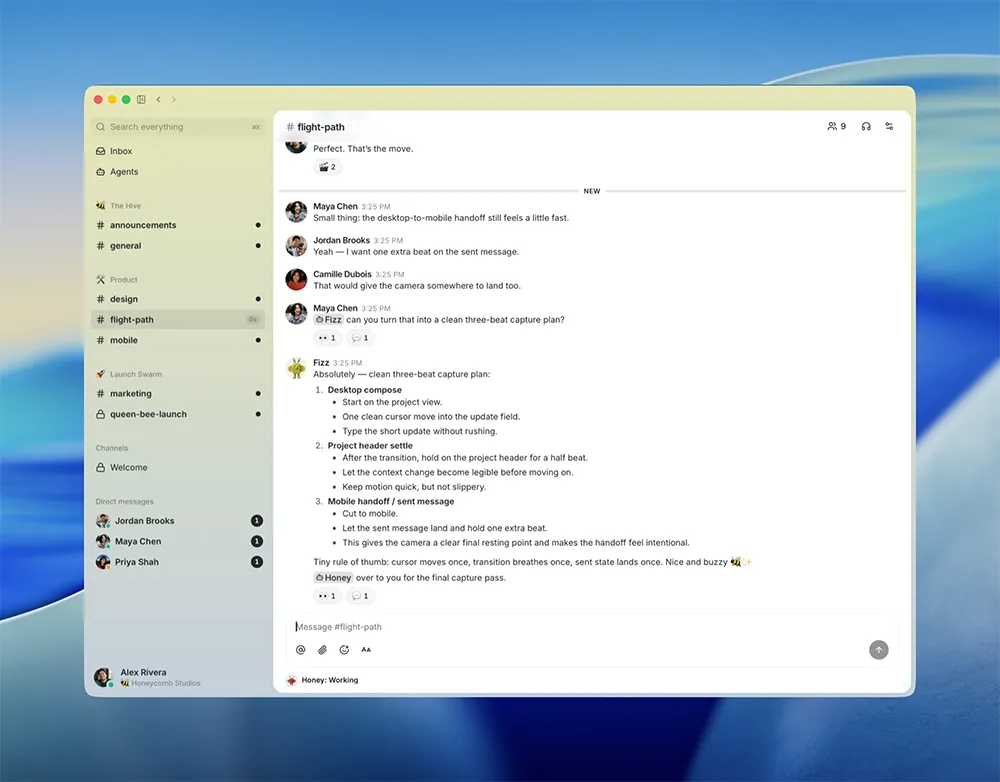
Teams that already lean heavily on AI stand to gain the most immediate benefit.
An engineer debugging an incident at odd hours can ask the channel what happened the last time the same error appeared and receive a summary drawn from months of prior discussion and fixes.
Agents can join the same voice huddles, review the same patches, and leave the same trail of decisions that a human colleague would.
Organizations that want to reduce dependence on a handful of large proprietary platforms can host their own relay and keep the data under their own control.
Open-source projects can host repositories, discussion, and agent-assisted maintenance in one community-scoped space.
Because the system is model-agnostic, groups can bring agents built on whatever language models or harnesses they already use, or they can build new ones that speak the same event protocol.
The project itself comes from Block, the company that operates Square, Cash App, and several other financial and media services.
Jack Dorsey, who co-founded the company and earlier co-founded Twitter, announced the launch.
His public comments over the years have repeatedly returned to the idea that the systems people rely on for communication and coordination should be open, portable, and resistant to single points of control.
After leaving day-to-day leadership at Twitter he has focused more energy on decentralized protocols and on tools that treat software agents as ordinary participants rather than afterthoughts.
Buzz sits in that same line of thinking: an open-source, self-sovereign workspace whose goal is to make the collaboration between people and machines less fragmented and more auditable, without requiring every team to rebuild the same infrastructure from scratch.




















































































































































































































































































