The fierce competition in the large language model space has intensified dramatically. And where there is demand, there is chance for monetization
Since the arrival of ChatGPT, OpenAI suddenly pushed generative AI into the mainstream consciousness. What began as a research lab's experimental chatbot quickly exploded into a cultural phenomenon, drawing hundreds of millions of users who marveled at its ability to write essays, code, brainstorm ideas, and hold remarkably human-like conversations.
This rapid adoption set off an arms race among tech giants and startups alike.
As usage skyrocketed, so did the demands on OpenAI's infrastructure. Training and running these massive models requires enormous computational power, with electricity bills and GPU costs running into the billions annually. Initially sustained by massive investments from Microsoft and others, OpenAI relied heavily on premium subscriptions like ChatGPT Plus and enterprise deals to generate revenue.
Yet the vast majority of its user base, reportedly over 90% in some estimates, stuck with the free tier, enjoying generous access without paying for anything.
As models keep leaping forward in capability, context length, multimodality, and cost efficiency, the real competition has shifted toward who can make powerful AI accessible to the largest number of people without bankrupting themselves on compute. ChatGPT still leads in sheer cultural reach and weekly active users, but sustaining free access at that scale has become a growing challenge as inference costs soar.
This imbalance created mounting pressure: how could the company continue funding cutting-edge advancements, scaling servers for peak demand, and eventually turning a profit while keeping AI accessible to as many people as possible?
The answer is: advertisement.
We’re starting to roll out a test for ads in ChatGPT today to a subset of free and Go users in the U.S.
Ads do not influence ChatGPT’s answers. Ads are labeled as sponsored and visually separate from the response.
Our goal is to give everyone access to ChatGPT for free with… pic.twitter.com/S9BV24uJLb— OpenAI (@OpenAI) February 9, 2026
Rumors of advertising had swirled for years. However, Sam Altman never really liked them. In fact, he occasionally described ads as a potential "last resort" or something the company might explore thoughtfully.
But the financial realities of AI development made it increasingly inevitable.
By late 2025 and into 2026, with weekly active users reportedly approaching or exceeding 800 million and valuation discussions soaring toward hundreds of billions, OpenAI needed diversified revenue streams beyond subscriptions and API usage fees. The company hired executives with deep advertising experience, including Meta veteran Fidji Simo, signaling a serious intent to build an ad business.
In mid-January 2026, OpenAI made it official.
Alongside rolling out its lower-cost "Go" subscription tier at $8 per month (offering expanded features like messaging, image creation, file uploads, and memory), the company announced plans to test advertisements in the U.S. for users on the free and Go plans. Higher tiers, like Plus, Pro, Business, Enterprise, and Education, would remain ad-free, preserving a premium, uninterrupted experience for paying customers.
The goal, OpenAI emphasized, was to subsidize broader access: ads would help fund more powerful free and low-cost options, reduce usage limits for non-paying users, and support ongoing improvements to the underlying models.
Now, the ads are finally rolling out, starting as a limited test for logged-in adult users in the U.S.
They appear clearly labeled as "sponsored" at the bottom of ChatGPT responses, triggered by contextual relevance to the current conversation.
Ads, for instance, can suggest a product or service that aligns naturally with what the user is discussing.
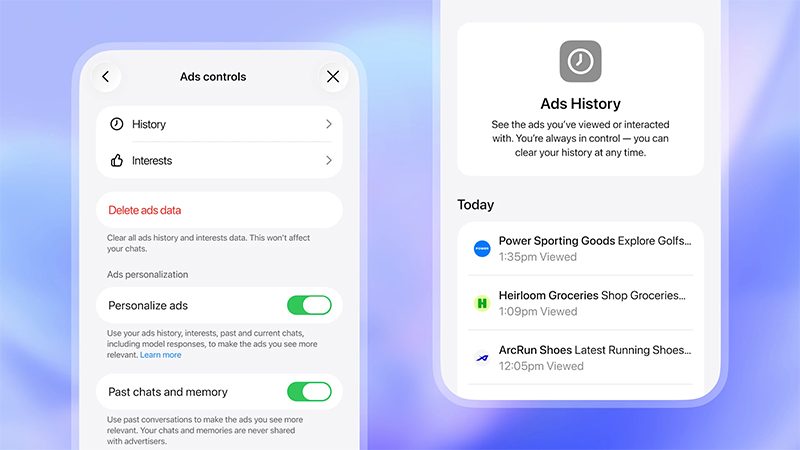
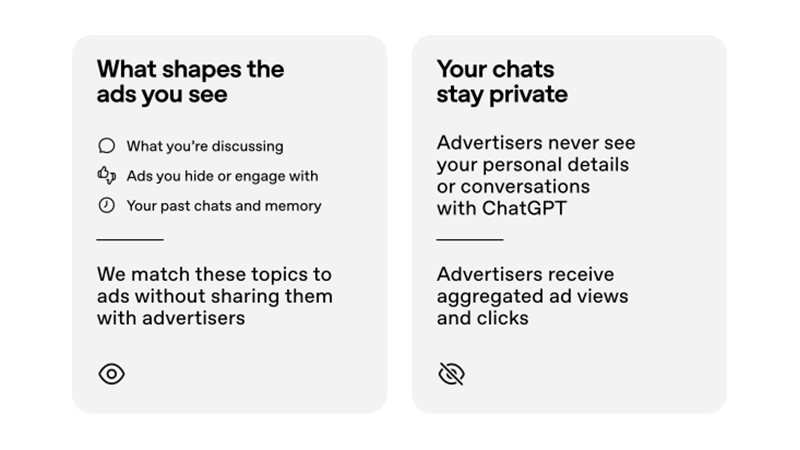
OpenAI has been adamant about safeguards: ads do not influence or alter the core responses from the model, user conversations and data are never sold to advertisers, and personalization can be turned off.
Sensitive topics like health, mental health, or politics are excluded, no ads show for users under 18 (or where age is predicted), and people can dismiss ads, provide feedback, or learn why a particular one appeared.
Early partners include major names like Adobe (promoting tools like Acrobat and Firefly) and agencies such as WPP and Omnicom.
This shift has sparked mixed reactions.
Some see it as a pragmatic evolution, akin to how Google monetized search or Meta built its empire on targeted ads, potentially unlocking billions in revenue. Projections suggest advertising could start at low billions in 2026 and scale dramatically, perhaps reaching tens of billions by the end of the decade if OpenAI captures even a fraction of its enormous audience.
Others worry about the intrusion into what has felt like a clean, utility-focused tool, fearing it could erode trust or turn intimate conversations into another ad-targeting opportunity.
Rivals like Anthropic seized on the moment with cheeky Super Bowl ads highlighting their "no ads" stance, prompting Altman to push back publicly.
As the test unfolds and feedback rolls in, OpenAI's advertising experiment represents a pivotal chapter in the company's maturation from idealistic research outfit to full-fledged tech powerhouse.
Whether it becomes a seamless part of the experience or prompts users to upgrade en masse remains to be seen, but in the high-stakes LLM wars, monetizing the free tier effectively could prove decisive in sustaining long-term leadership.






















































































































































































































































































