There is something oddly weird about receiving emails about a novel originally written in 1897.
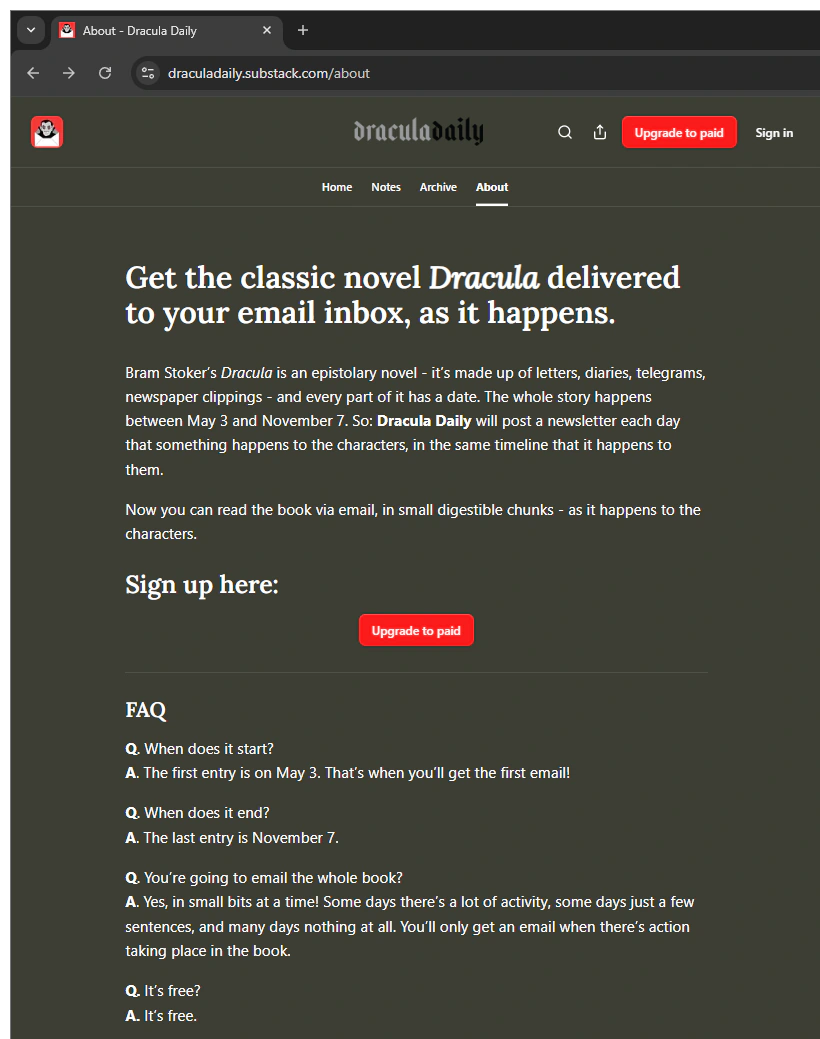
And yet that is exactly what 'Dracula Daily' does, turning Bram Stoker's Dracula into a slow, unfolding experience that arrives in subscribers’ inboxes one dated entry at a time. The idea is not to read the story straight through, but to follow it as if it were happening now, synced to the exact calendar dates in the novel.
In a way, it feels less like reading a book and more like subscribing to a feed.
Some days bring long, detailed journal entries. Other days bring nothing at all.
That silence is part of the design.
The free newsletter first ran in 2021 through Substack, and has repeated each year since.
In the original novel Bram Stoker wrote, Dracula is not a traditional narrative with a single voice guiding readers from beginning to end.
Instead, it is built entirely out of documents.
Diaries, letters, telegrams, newspaper clippings, even recorded voice transcripts all come together to tell the story. This epistolary format reflects a world that was rapidly changing at the end of the 19th century, when new technologies were reshaping how people communicated across distance. The novel feels fragmented because it was meant to.
That fragmented structure feels unexpectedly familiar now.
Dracula Daily does not change that structure.
It simply restores its pacing.
Because every entry in the book is tied to a specific date, the story can be released in real time.
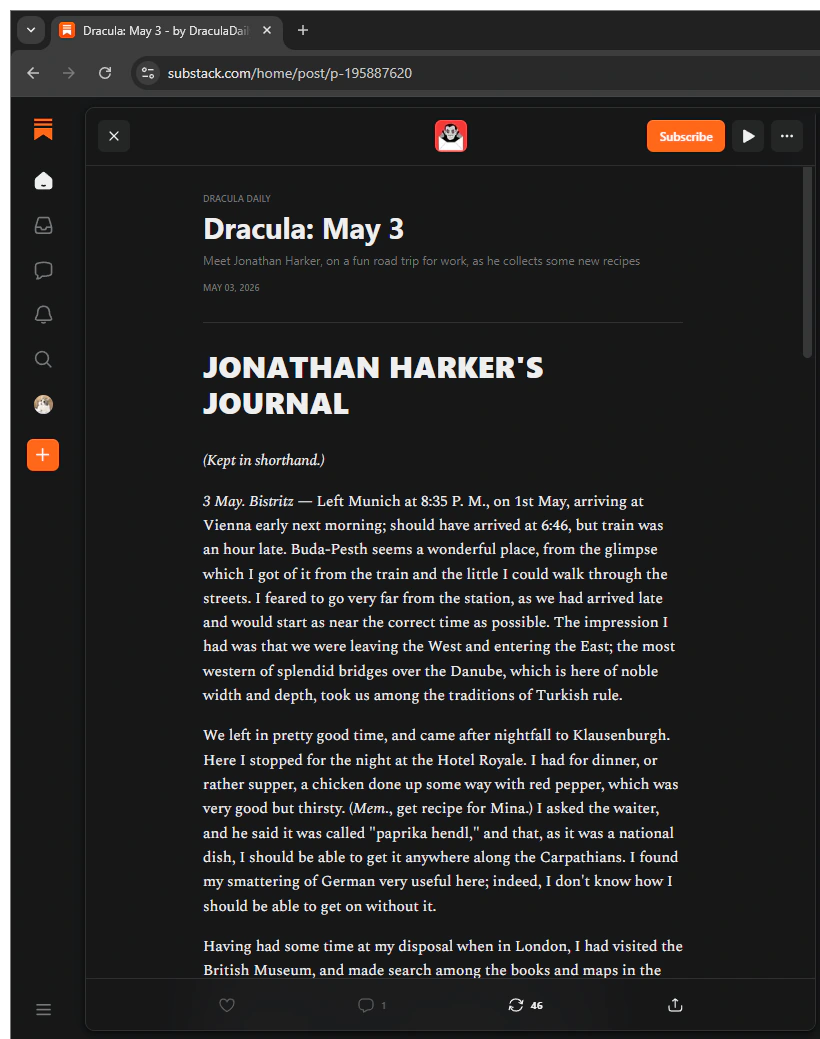
When one of the protagonists, English solicitor Jonathan Harker, begins his business trip to stay at the castle of a Transylvanian nobleman, Count Dracula, the date is May 3. This means subscribers receive his journal on May 3. Then, when nothing is written for days, they experience that gap too.
The result is less like reading a finished book and more like following a timeline that updates unpredictably, where the absence of information becomes part of the experience.
However, Dracula Daily does rearrange certain portions to match their in-novel dates.
For example, a ship captain's log covering several days is reproduced in a newspaper article all at once in the novel, but Dracula Daily instead sends each day of the captain's log in real time. It also keeps the novel's epilogue in the same year, despite taking place seven years later in the original text.
This format reveals how modern the novel already is.
The last entry falls on November 7 because that is the date of the final events in Dracula itself.
What looks like an old Gothic story is actually structured in a way that closely resembles how information moves on the internet.
Each document functions like a post. Each perspective adds another layer to a shared narrative. No single character has the full picture, so the truth emerges gradually through accumulation, much like threads, timelines, and scattered updates that only make sense when pieced together.
Reading Dracula this way highlights how similar its structure is to the way people already consume information online. Fragmented, delayed, and often incomplete.
At the same time, the core of the story remains rooted in the anxieties of its era.
While Dracula is far from being the first vampire in fiction, there is no doubt that it is the most influential.
The novel and its characters have been adapted for film, television, video games, and animation more than 700 times, with nearly 1,000 additional appearances in comic books and on stage. In 2015, Guinness World Records named Count Dracula the most portrayed literary character, noting he had appeared almost twice as often as Conan Doyle's Sherlock Holmes.
Related: Irene Adler Makes Sherlock's Episode Topped BBC's iPlayer In 2012
Vampires as a concept go much further back, rooted in European folklore for centuries before Stoker ever wrote his novel. Stories of blood-drinking spirits, revenants, and undead creatures existed across Eastern Europe, particularly in places like Transylvania, long before they were written into literature.
Stoker was also building on earlier literary vampires. The Vampyre by John Polidori introduced the idea of the aristocratic, charismatic vampire, less of a monster and more of a social predator. Decades later, Carmilla by Sheridan Le Fanu explored a more intimate and psychological kind of horror, where the vampire is both alluring and unsettling.
Dracula pulls from both.
Count Dracula carries the aristocratic presence of Polidori's Lord Ruthven, while also echoing the eerie intimacy and creeping dread found in Carmilla. What Stoker does differently is scale. He expands these ideas into a broader narrative, adds structure and rules, and places the vampire in direct conflict with a modern, rational society trying to understand and stop him.
It was Dracula that ultimately defined the modern vampire. It is also a story about fear of the unknown, fear of outsiders, and fear of a past that refuses to stay buried.
Count Dracula arrives from Eastern Europe into England, bringing with him something ancient into a society that sees itself as modern and rational. That tension between old and new, between control and invasion, still resonates in different forms today.
Reading it slowly makes those themes more visible. When readers are forced to sit with the quieter moments, the long descriptions, and the gaps between entries, the sense of unease builds gradually. The horror is not just in dramatic confrontations, but in the creeping realization that something is wrong long before anyone can fully explain it.
Created by web designer Matt Kirkland, the idea for Dracula Daily came to him while reading the novel for the first time in 2020 and giving periodic updates to his daughter about "what's happening in Dracula."
Dracula Daily first ran in 2021, gaining more popularity each year.
Kirkland does not modify the content of the novel, which is now in the public domain.
Dracula Daily is not rewriting Bram Stoker's work, nor reinventing the novel, nor modernizing its language. It is simply aligning the story with how people already consume information, in fragments, over time, with pauses in between.
What feels new is not the story, but the way it fits so naturally into the logic of the internet.
In the end, receiving these emails does not just make Dracula easier to read, but reframes it. Instead of a static novel, it becomes something closer to a live narrative, unfolding in real time, shaped as much by waiting and gaps as by what is actually written.






















































































































































































































































































