Minecraft is a game that proves simplicity can outshine complexity when creativity takes the spotlight.
Created by Markus “Notch” Persson and released by Mojang Studios in 2011, this blocky sandbox universe has evolved into one of the most influential games of all time. Despite its pixelated graphics, the game offers a world that feels limitless, one where imagination is the only true boundary. Whether players are building a towering castle, mining deep underground for rare ores, or surviving their first night against monsters, Minecraft gives them the freedom to create their own story.
The nature is that, all of the game constructed from cubes, and everything can be mined, crafted, built, or destroyed.
And at its core, Minecraft is about exploration, survival, and creation.
All of these are contained within a world that is immensely big.
And one player somehow managed to reach the edge of it, after 14 years and traveling 12 million blocks.
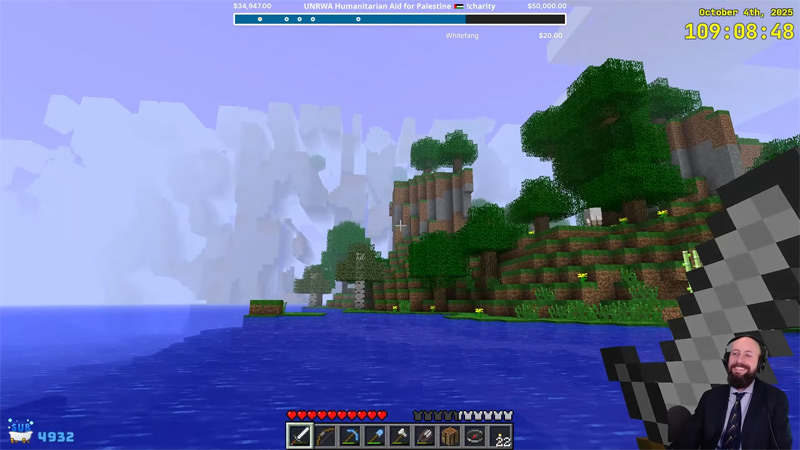
Technically, a Minecraft world is virtually infinite, but only measurable terms.
In the original, unpatched versions of Minecraft Beta (specifically before version 1.8 in 2011), the measurable world is 12 million blocks. Beyond that point, at around 12,550,821 blocks from the world’s center (0,0), there is what players call "The Far Lands," a region where the terrain generation begins to break down due to mathematical precision errors, specifically the Perlin noise algorithm.
When players reached this point, the smooth rolling landscapes of Minecraft warped into chaotic, jagged, almost alien formations.
Mountains stretching to the sky, caves twisted into impossible geometry, and terrain floating in midair.

In The Far Lands, the Matrix fails, and as a result, the landscape turns glitchy.
There are surreal distortions, where physics no longer apply.
It looked less like a bug and more like an abstract art piece rendered in pixels, where the game’s procedural generation breaks down and warps the world structure, appearing as a giant wall of mish-mashed terrain.
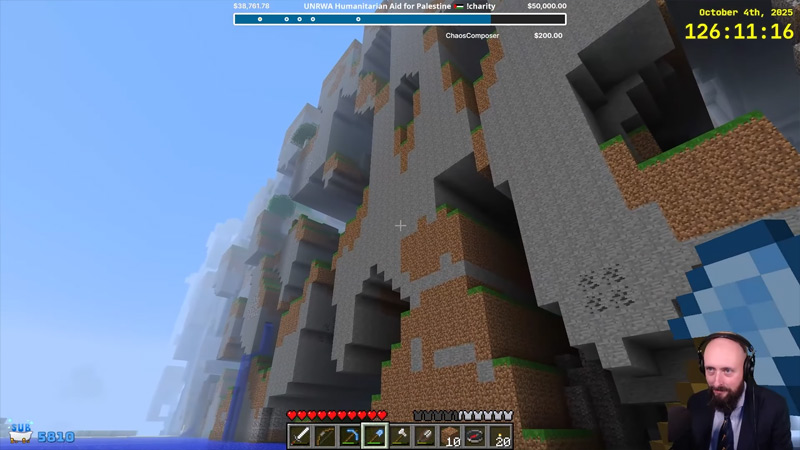
A few players managed to get to this place, and most did so through teleportation commands or creative mode flight in older versions of Minecraft (pre-Beta 1.8).
A few adventurous players in the early 2010s managed to get there legitimately using minecart highways.
But a YouTuber called KurtJMac has completed what should be considered one of gaming’s longest journeys: walking from to the Far Lands in Minecraft, a goal he began chasing over a decade ago in his 'Far Lands or Bust' series.
The content creator first launched the challenge in March 2011 using Minecraft Beta 1.7.3, with the series since becoming a fundraising effort, raising around $500,000 for various charities.
The entire journey has been documented on Kurt’s YouTube channel, with the first video in the series being uploaded March 2011.
Kurt’s efforts have been officially recognized by Guinness World Records, which awarded him the record for most money raised by a charity walk in a video game (individual).
Reaching that point by foot without cheats or shortcuts is a feat that only a single-digit number of players are believed to have achieved.
Now with over 800 episodes on YouTube and hundreds of hours streamed on Twitch, Kurt hasn’t said what he plans to do next, now that his 14-year journey has come to an end. But a break from Minecraft probably isn’t out of the question.
"This, however is not a finale or a goodbye! Kurt has no intent to stop playing in the Far Lands or Bust world after October 4th. There are many more glitched landscapes and curiosities to explore around and beyond the Far Lands that should keep us busy for months... and perhaps years to come!" said Kurt in a post on his website.
In Minecraft, players start in a randomly generated world made entirely of cubes, with each one representing a resource to be gathered, crafted, and shaped.
But what makes Minecraft truly special is its ecosystem of creativity and community. With its unique crafting system, players can combine simple resources to make tools, weapons, machines, and even functioning computers through its redstone circuitry, which is a kind of in-game electrical system. This endless tinkering has led to breathtaking builds, from real-world landmarks recreated block by block to entire fantasy worlds imagined by players.
Beyond that, Minecraft has expanded into education, teaching children logic, programming, and problem-solving in ways traditional classrooms rarely can.
Over time, Minecraft has become much more than a game: it has become part of pop culture, a form of digital expression, and a shared experience across generations.
Millions of players log in daily, joining servers that host mini-games, roleplaying worlds, and global collaborations. Its gentle music and simple design create a peaceful atmosphere that contrasts sharply with the chaos of modern gaming, making it both nostalgic and soothing.
In the end, Minecraft’s genius lies in its balance of simplicity and depth.

In Minecraft, there is no fixed goal, whatsoever. There is no linear storyline, or things that players must follow. Minecraft is just an infinite world waiting for players to shape.
It’s a universe where creativity feels boundless, where children and adults alike can lose hours building, exploring, and dreaming. And perhaps that’s why, more than a decade after its release, Minecraft continues to inspire, reminding the world that the most powerful tool in any world, virtual or real, is imagination itself.
It's worth noting that in a Minecraft's fandom wiki page, it's said that the actual edge of Minecraft, which is the farthest end of the world beyond The Far Lands, aka. the "world border," is located 30 million blocks away on the X and Z axes.
To put it in perspective, the total area of a full Minecraft world is around 3.6 billion square kilometers, or about seven times larger than Earth.
This was likely done to make The Far Lands inaccessible to players without modifying the game.
At that scale, Minecraft's world is not just a game world; it’s an entire universe, waiting to be shaped one block at a time.
It's also worth noting that it took Kurt 14 years to finish, when in fact, he did everything in about 70 days of playing Minecraft non-stop.
The 14 years reflect the real world process of progressing, filming, editing, and uploading the episodes.






















































































































































































































































































