Humanity has traveled through the most rugged land, the highest seas, and also through the air and the space.
But even as the most advanced species on planet Earth, humans have little knowledge to what lies underneath their feet. They have little clue to what lurks in the darkest oceans.
Because of this, the term "Bloop" was made to represent a carnivorous animal so huge that could make even the largest Antarctic blue whale (Balaenoptera musculus) a snack in its menu.
Whereas the largest blue whale, which is also the biggest animal on the planet ever, can weigh up to 180 tons (approximately 33 elephants) and reaching up to 30 meters in length, a Bloop could be at least 50 meters long, with speculations that it could also be more than a hundred meters in length.
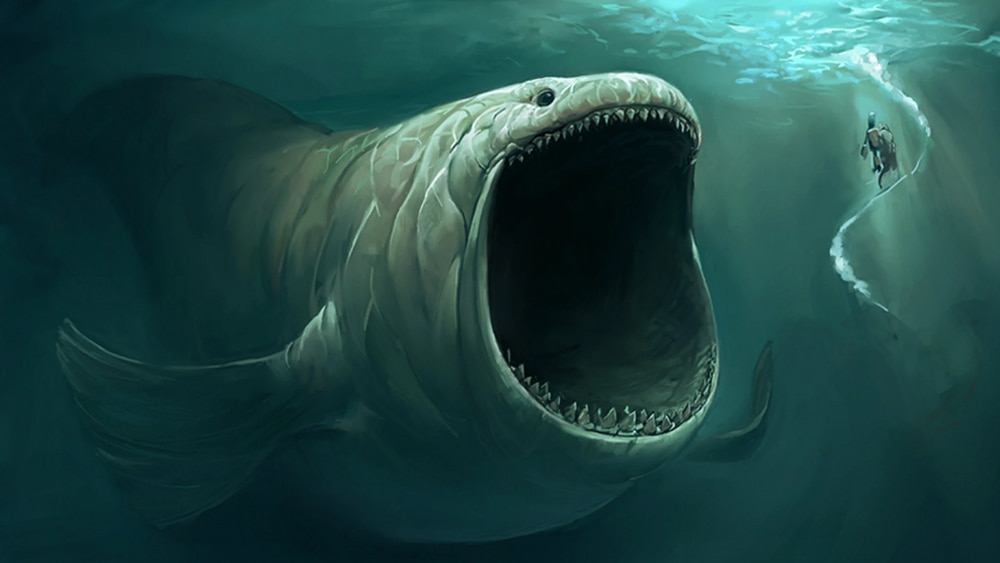
If that isn't intriguing enough, the mouth it has, according to artist description, is extremely uncanny.
And since the first depiction of the animal, the internet has helped made it viral. And since then, the monster lives on.
It all began in 1997, when the U.S. National Oceanic and Atmospheric Administration (NOAA) detected an ultra-low-frequency and extremely powerful underwater sound coming from a remote point in the south Pacific Ocean west of the southern tip of South America.
The sound was detected several times by the Equatorial Pacific Ocean autonomous hydrophone array, which is a system developed as an autonomous array of hydrophones that could be deployed in any oceanographic region to monitor specific phenomena.
While its primary use is to monitor undersea seismicity, ice noise, it can also detect submarines and marine mammal population and their migration.
In this case, the "bloop" sound is consistent with the noises generated by icequakes in large icebergs, or large icebergs scraping the ocean floor.
According to the NOAA description, it "rises rapidly in frequency over about one minute and was of sufficient amplitude to be heard on multiple sensors, at a range of over 5,000 km."
However, several articles in the years that followed the news popularized one suggestion that said the Bloop might have been the sound of an unknown animal due to the "organic" nature of the noise.
NOAA's Dr. Christopher Fox said that he didn't believe its origin to be man-made, such as a submarine or bomb.
While the audio profile of Bloop does resemble that of a living creature, the source was a mystery both because it was different from known sounds and because it was several times louder than the loudest recorded animal, the blue whale.
After NOAA stated that it's pretty sure that it wasn't an animal, but only the sound of a relatively common event - the cracking of an ice shelf as it breaks up from Antarctica.
However, when people who visited NOAA's website for more information, NOAA's website was undated and without a source.
"Was the Bloop from secret underwater military exercises, ship engines, fishing boat winches, giant squids, whales, or a some sea creature unknown to science?" the website's web page said.
This elevated online conspiracies, with many people started theorizing what the animal could be.
And artists representation of this cryptid animal, is a large, long marine creature with humongous mouth and sharp teeth.
Later, in an interview, NOAA and Oregon State University seismologist Robert Dziak confirmed that the Bloop really was just an icequake.
According to him, the theory of a giant animal making noises loud enough to be heard across the Pacific was more fantasy than science.
Despite the animal-like sound, Dziak explained the NOAA's findings, to confirm that "the frequency and time-duration characteristics of the Bloop signal are consistent, and essentially identical, to icequake signals we have recorded off Antarctica".
"We began an acoustic survey of the Bransfield Strait and Drake Passage in 2005 which lasted until 2010. It was in analysis of this recent acoustic data that it became clear that the sounds of ice breaking up and cracking is a dominant source of natural sound in the southern ocean. Each year there are tens of thousands of what we call 'icequakes' created by the cracking and melting of sea ice and ice calving off glaciers into the ocean, and these signals are very similar in character to the Bloop."
According to the data, it's "extremely unlikely" that the sound is animal in origin.
He pointed out to how the sound started the controversies.
Dziak said that the misperception of the animal origin sound of the Bloop was probably caused by the way the sound is played back. Typically, recordings are made at 16 times normal speed, which makes it sounds like an animal vocalization of some sort. However, when the sound is played in real-time, it has more of a 'quake' sound to it, similar to thunder.
According to Dziak, NOAA's hydrophones can pick up weird sounds that "can be attributed to major sound categories; geophysical (submarine volcanoes or earthquakes), weather (storms, waves, wind), anthropogenic (ships, airguns), ice (sea ice, iceberg groundings), and animals (cetaceans, fish)."
Anything else is usually just some kind of electronic interference with the signal.
In another web page, NOAA has uploader other spectrogram sounds of ice movements.
In yet another web page, NOAA said that "no further Bloops have been heard since 1997, although other loud and unexplained sounds have been recorded."

Regardless, Bloop lives on.
The biggest reason of them all, is the fact that humanity has yet to properly map the entire oceans and their populations.
Oceans are vast area of water, and their deep trenches and reefs are home to various and many weird, unearthly creatures. Most of the oceans' area are still unexplored by humans (more than 95%, according to the NOAA).
With more than 10,000 new species are discovered every year, there is always a chance for Bloop is one of those that isn't yet discovered.
Animals of the sea and grow so large than land animals can, because the buoyancy of an aquatic animals allows their weight to be efficiently dispersed.
Even with all of their muscles, the weight of an animal as large as a whale would make it impossible to survive out of the water.
The weight of its own body would not even allow it to inflate its own lungs without struggling.

















































































































































































































































































