Wars are waged with weapons, but victories are won with strategy. And between the East and the West, it's always about who dominates whom.
And in modern warfare, wars aren’t only about firepower but also about who controls information. What the latter means, whoever control the flow of information, can have an advantage.
This time, China reveals that it has developed an advanced saw that among other uses, can also cut through the most fortified undersea data cables anywhere on Earth at depths of up to 4,000 meters.
The development of this technology comes amid growing concerns that Chinese vessels may be targeting subsea infrastructure, posing a threat to both civilian and military communications in times of crisis.
China watchers have raised alarms over the device’s potential for more aggressive applications, particularly given the Chinese government's authority to compel private companies to cooperate. This has fueled fears that U.S. military communications across its Pacific network, including key bases in Guam, could be vulnerable to disruption.
Only a select few advanced nations possess the capability to cut subsea cables in ultradeep waters.
This is why such technology is typically kept as a closely guarded state secret. However, a published research paper shed light on a new development from China, detailing how a specialized submersible diamond saw is designed for "marine resource development" at extreme depths and pressures.
The study, authored by Hu Haolong of the China Ship Scientific Research Centre (CSSRC), was published in the peer-reviewed journal Mechanical Engineer.
"Enhancing marine resource development capabilities, advancing the blue economy and building China into a maritime powerhouse constitute critical components of realizing the Chinese dream," Hu explained in his paper.
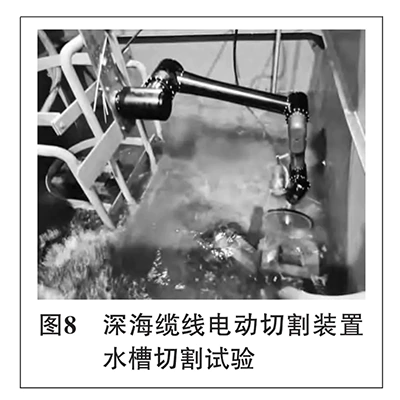
The device resembles a robotic arm with a mounted circular saw.
Engineered specifically to operate at depths of thousands of meters, the saw is designed to function at the depths of the Pacific abyssal plain, where numerous subsea cables lie.
These cables, spanning the Pacific, form the backbone of global internet infrastructure, carrying about 95% of international data traffic, including phone calls, internet data, and private network communications.
Read: China Wants to Spy On Nations Through Undersea Internet Cable, Taiwan Said
Internet cables are resilient and tough.
Despite having a relative small diameters, these cables are designed to sustain the immense pressure of the water at the depth of the oceans, and can withstand a tensions of 20-70 tonnes before showing signs or breaking.
These fiber-optic cables are usually protected and shallow waters since they're more susceptible to damage from human activities, natural disasters, and environmental factors. Methods of protections include burying them under the seabed, adding layers of steep armoring, placing concrete mats, and more.
To further reduce risks, authorities designate restricted zones and monitoring systems around critical cable locations. "No-anchor" or "cable protection" zones are established to prevent ships from dropping anchors near cables. Additionally, real-time surveillance using sonar, underwater drones, and sensor networks helps detect potential threats and enables quick responses to avoid damage.
However, in the open waters, including in depths beyond 2,000 meters, data cables are typically left exposed.
The thing is, diving to that kind of depths is costly and impractical.
And here, Hu's robotic saw is encased in titanium to endure the immense pressure at 4,000 meters, or twice the depth of existing subsea communication infrastructure, Featuring a saw with six-inch diamond blades, the saw has demonstrated the ability to slice through steel-armored cables of up to 60mm in controlled lab conditions at a speed of 1,600 rpm.
What's more, the device can be integrated seamlessly with China's advanced crewed and uncrewed submersibles, such as the Fendouzhe and Haidou series, marking a significant leap in underwater capabilities.

CSSRC functions as a research arm of the state-owned China State Shipbuilding Corporation (CSSC), the world’s largest shipbuilder and a crucial supplier to the Chinese Navy.
While its primary focus lies in hydrodynamics and civilian applications such as seabed mining and salvage operations, CSSRC also conducts research in militarily significant areas, including shock and explosion resistance and underwater vehicle technology.
This dual expertise has fueled concerns that the newly developed tool could serve more than just civilian purposes.
Designed as a compact, cable-cutting machine, the technology has the potential to disrupt global maritime power dynamics, raising alarms over its possible strategic use.
The unveiling of this device marks the first time a nation has publicly disclosed such a capability, despite its official purpose of supporting civilian salvage and mining operations.
Notably, China has seen a surge in patent filings for tools specifically engineered to efficiently and cost-effectively sever subsea cables—further intensifying speculation about its intentions in the underwater domain.

At this time, there are hundreds of undersea cables stretching over 800,000 miles across the ocean floor quietly and efficiently carry 99% of international communications.
With China's new cutting tool, it has the capacity to disrupt around 95% of international data traffic, including phone calls, internet data, and private network communications.
In other words, the tool can make global communication, commerce, and government systems come to a screeching halt.
Chinese embassy spokesperson said that: "We oppose unfounded attacks and smears against China. This tool, developed by China independently, is used in marine scientific research. The U.S. and some European countries also have similar technology. China attaches great importance to protecting undersea infrastructure and has been and will continue to work with the international community to protect undersea cables."






















































































































































































































































































