A new study found that quantum computers have dramatically lowered the bar for what it would take to break one of the most widely used encryption standards in the digital world.
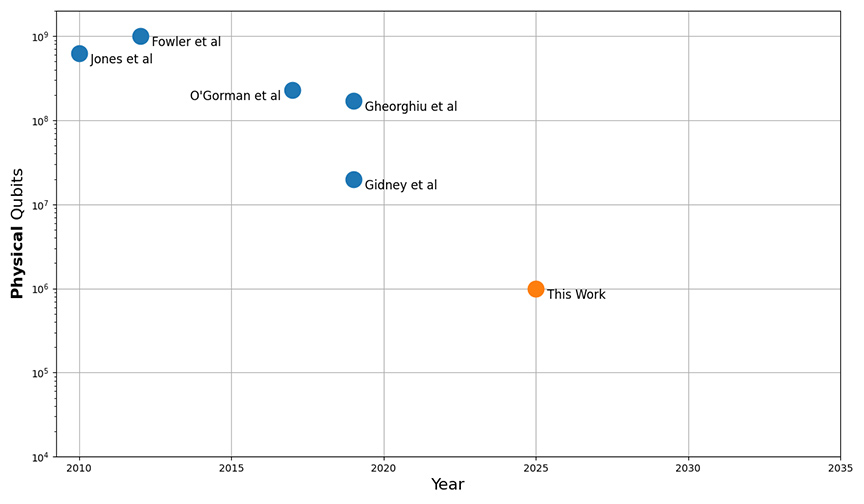
According to research by Craig Gidney, a prominent scientist at Google Quantum AI, a 2048-bit RSA key—a staple of modern internet security—could potentially be cracked in less than a week using a quantum computer.
"I estimate that a 2048-bit RSA integer could be factored in under a week by a quantum computer with fewer than one million noisy qubits," Gidney wrote.
This new estimate represents a massive shift in expectations.
Back in 2019, Gidney himself projected in a research published on arXiv that such an attack would require around 20 million qubits, placing it firmly out of reach for the foreseeable future. This time, the updated research—also published on arXiv—suggests that quantum threats to public-key cryptography may be closer than previously imagined.
The implications are far-reaching.
RSA, named after its inventors Ron Rivest, Adi Shamir, and Leonard Adleman, is one of the most widely used encryption systems in the world.
Developed in 1977, RSA introduced the concept of asymmetric cryptography—a revolutionary idea at the time. Unlike symmetric encryption, which uses the same key for both encryption and decryption, RSA uses a pair of keys: one public and one private. This approach made secure communication over the open internet possible, even between parties who had never met before.
At the core of RSA lies a mathematical problem known as prime factorization.
The system generates two large prime numbers, multiplies them together, and uses the result as the basis for the public key. While multiplying primes is easy, reversing the process—determining the original primes from their product—is incredibly difficult for classical computers. This one-way function ensures that, although anyone can encrypt a message using the recipient's public key, only the holder of the corresponding private key can decrypt it.
Because of this, RSA underpins the security of countless modern digital systems.
It secures websites (via HTTPS), validates digital signatures, protects emails, and plays a critical role in VPNs, banking systems, and government communications. Its strength lies not only in mathematics but in trust—it’s been tested, analyzed, and refined over decades. Yet, this trust rests on a fragile assumption: that no computer can efficiently solve the prime factorization problem.
Quantum computers aren't traditional computers.
Using Shor’s algorithm, a sufficiently powerful quantum computer could break RSA by factoring large numbers exponentially faster than classical machines.

It's worth noting here is that, Bitcoin doesn't use RSA.
Instead, it uses 256-bit elliptic curve cryptography (ECC), which is significantly more secure than 2048-bit RSA keys.
ECC relies on the mathematical properties of elliptic curves over finite fields, specifically the Elliptic Curve Discrete Logarithm Problem (ECDLP). This problem is significantly harder to solve than the integer factorization problem that RSA relies on. This allows ECC to provide an equivalent level of cryptographic strength with much shorter key lengths.
The thing is, quantum threats scale nonlinearly, meaning that research like Gidney’s compresses the timeline by which such attacks become feasible.
What this means, ECC can also be broken by Shor’s algorithm, if a capable quantum computer is given enough time.
Shor's algorithm, a 1994 breakthrough by Peter Shor, allows quantum computers to factor large numbers and solve discrete logarithms exponentially faster than classical computers. This directly undermines both RSA and ECC encryption, as their security relies on the very mathematical problems quantum computers can now efficiently crack.
The underlying principle that allows Shor's algorithm to crack both is its ability to efficiently solve the "period-finding" problem. Both the Integer Factorization Problem and the Discrete Logarithm Problem (including its elliptic curve variant) can be mathematically transformed into instances of the period-finding problem.
Shor's algorithm leverages the quantum Fourier transform, a quantum computing primitive, to find the period of certain mathematical functions much faster than any known classical algorithm.

However, to reach to that state, quantum computers need to progress further, in order to increase their cubit counts, and have improvements in their quantum algorithms.
There is also the needs to have a tighter hardware-software integration and better error correction strategies.
These steps are critical in narrowing the gap toward practical quantum advantage.
RSA was a marvel of digital architecture—elegant, dependable, and deeply embedded in our connected lives. I still is a powerful and reliable cryptography.
But as quantum dawn approaches, this stalwart guardian may soon be outmatched.
Gidney’s revised estimate is likely to reignite urgency around the global push for post-quantum cryptography.
It's also worth noting that Craig Gidney statement is based on calculations and math, and that no such hardware exist at this time.
But Gidney is proving that the technology is steadily closing the gap.






















































































































































































































































































