When Elon Musk took to his platform X, formerly Twitter, to announce that his AI venture, xAI, was planning to launch a new online encyclopedia called Grokipedia, he made it clear that he believed the time had come for a "massive improvement" on the reigning knowledge platform: the Wikimedia Foundation’s Wikipedia.
Musk has long been critical of what he calls "Wokipedia," an encyclopedia he believes is tainted by liberal bias and rigid editorial gatekeeping.
And now, the time has finally come.
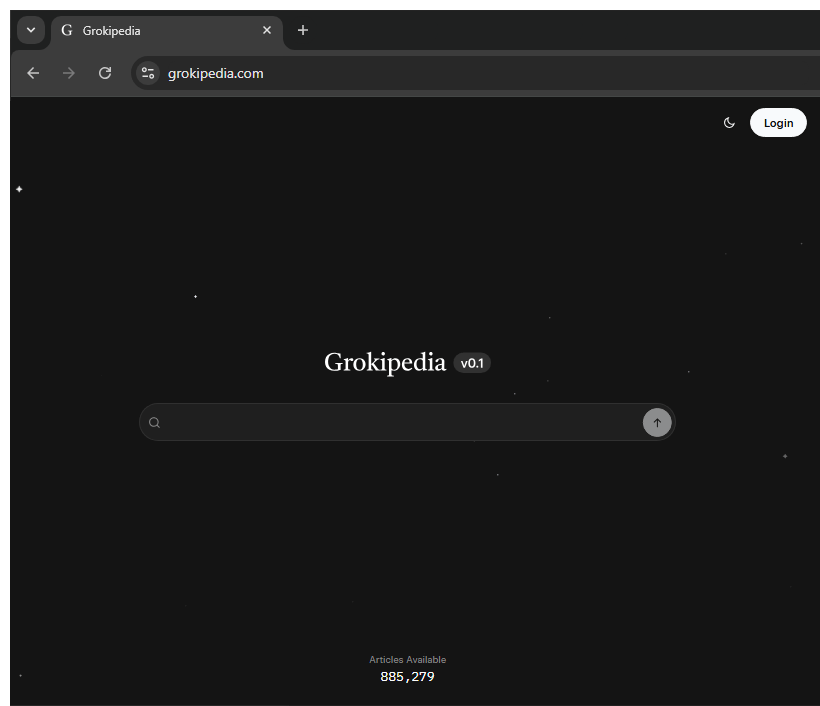
Musk has formally introduced 'Grokipedia,' confirming that the website went live on October 27th as version “0.1,” offering roughly 800,000–900,000 articles in its earliest state.
The site features a minimalist dark-themed homepage, a simple search bar, and declares itself powered by AI rather than the traditional volunteer-editor model used by Wikipedia.
Musk frames the project as more than just an encyclopedia. Behind the scenes, Grokipedia is part of xAI’s broader mission to "understand the Universe."
He contends that by relying on AI-driven generation and "faculty for maximum truth-seeking," Grokipedia can correct what he sees as lapses in Wikipedia’s model, by selective sourcing, anonymous editors, and ideological consensus.
But the rollout was not without controversy. Several early investigations found that many Grokipedia pages appear to have been adapted from Wikipedia, sometimes nearly verbatim.
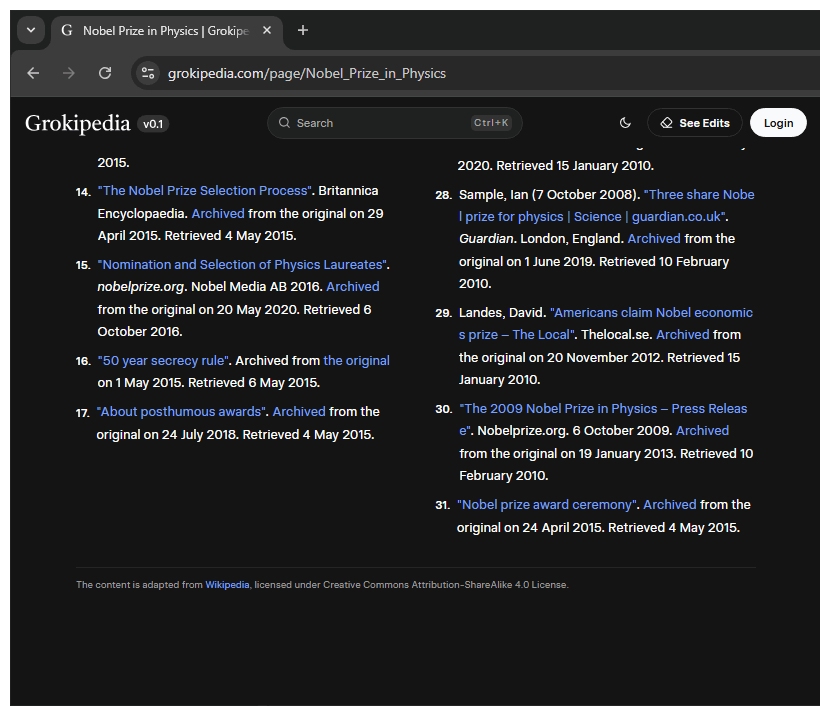
“The content is adapted from Wikipedia, licensed under Creative Commons Attribution-ShareAlike 4.0 License,” reads a disclaimer at the bottom of some, but not all, entries, including the one for the Nobel Prize in physics.
But more critically, there are notable differences in the way certain topics are presented, which often shows marked conservative viewpoints on subjects like slavery, gender, transgender issues, and media bias.
For example, one article alleges that pornography accelerated the AIDS epidemic, while another links social-media use to a rise in transgender identity.
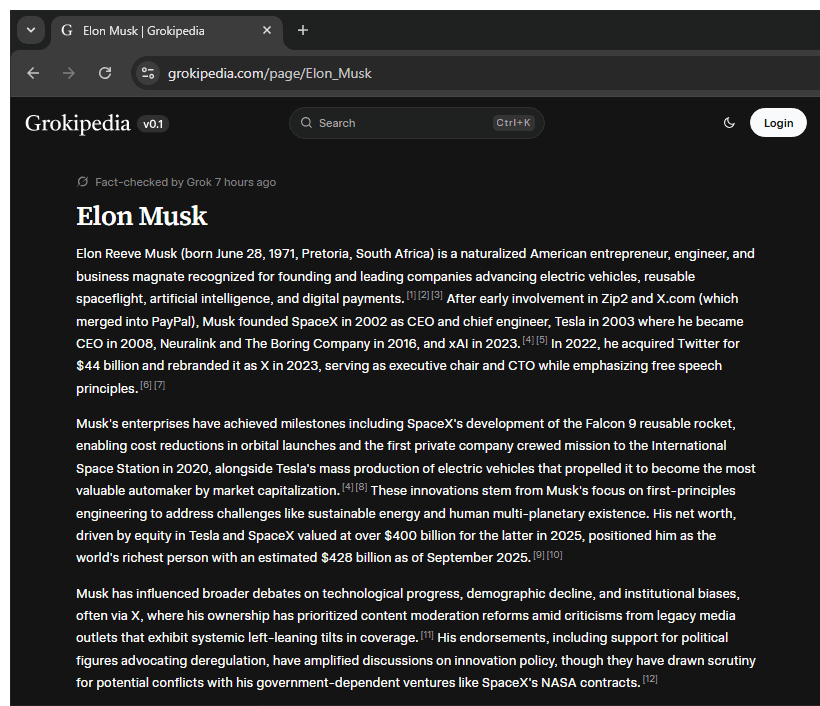
There are also concerns surrounding Grokipedia’s entry for U.S. President Donald Trump, which omits references to his acceptance of a luxury megajet from Qatar and his promotion of a Trump-themed cryptocurrency token or meme coin, both of which are mentioned in Wikipedia’s entry under conflicts of interest.
Meanwhile, Grokipedia’s entry for Musk himself also omits any mention of his viral hand gesture at a January rally that many historians and politicians viewed as a Nazi salute.
https://t.co/op5s4ZiSwh version 0.1 is now live.
Version 1.0 will be 10X better, but even at 0.1 it’s better than Wikipedia imo.— Elon Musk (@elonmusk) October 28, 2025
This is a detail that Wikipedia includes in several paragraphs.
Observers, including Wikipedia co-founder Jimmy Wales, have voiced skepticism.
Wales noted that AI models still struggle with nuance and are thus prone to bias or error. Others warn that replacing or supplementing a human-community edited encyclopedia with a corporate-driven AI may create new risks of unchecked bias.
By comparison, Wikipedia currently hosts 7.1 million articles in English and ranks among the world’s top 10 most visited websites, dwarfing older rivals such as Encyclopedia Britannica.
The Wikimedia Foundation, which operates Wikipedia, said that it is still studying how Grokipedia functions.
“Wikipedia’s knowledge is — and always will be — human,” it said in a statement. “Through open collaboration and consensus, people from all backgrounds build a neutral, living record of human understanding — one that reflects our diversity and collective curiosity. This human-created knowledge is what AI companies rely on to generate content; even Grokipedia needs Wikipedia to exist.”
https://t.co/op5s4ZikGJ is fully open source, so anyone can use it for anything at no cost
— Elon Musk (@elonmusk) October 28, 2025
“Many experiments to create alternative versions of Wikipedia have happened before; it doesn’t interfere with our work or mission.”
As for end users, Grokipedia raises several questions. Will it truly deliver more "truth" — or simply offer a different ideological lens? How will its AI-generated material hold up under scrutiny, citation demands, or corrections? And how will it evolve beyond its "version 0.1" phase?
In short, Elon Musk launched Grokipedia because he believes Wikipedia has lost its balance. But whether Grokipedia can restore that balance, or tip it even further, remains an open question.
The goal of Grok and https://t.co/op5s4ZikGJ is the truth, the whole truth and nothing but the truth.
We will never be perfect, but we shall nonetheless strive towards that goal. https://t.co/j8bJf7c4Hl— Elon Musk (@elonmusk) October 28, 2025






















































































































































































































































































