It took a year, thousands of dollars, and a mix of desperation and daring for 31-year-old Muhammad Abu Dakha, a Palestinian from Gaza, to pull off what reads like a scene from a thriller.
His escape from his war-torn homeland, now reduced to rubble, was not aboard an overcrowded smuggler’s boat or hidden in the back of a truck. Refusing to gamble on the same perilous routes that had failed so many before him, he chose instead to take matters into his own hands: straddling a second-hand Yamaha jet ski and skimming across the Mediterranean Sea with two of his friends.
The Mediterranean Sea is semi-enclosed, and in the summer, the water tends to be calmer, the temperature warmer, and the weather more predictable.
But still, traveling kilometers upon kilometers of open water on a jet ski is not something anyone would normally attempt. This is what Dakha and his friends first thought, until they managed to convince themselves otherwise.
In a twist that anchors this odyssey firmly in the twenty-first century, his guide wasn’t an experienced trafficker who had been in business for years, a seasoned sailor who could navigate the waters with his eyes closed, or a world-class navigator who knew the sea like the back of his hand.
It was OpenAI’s ChatGPT.
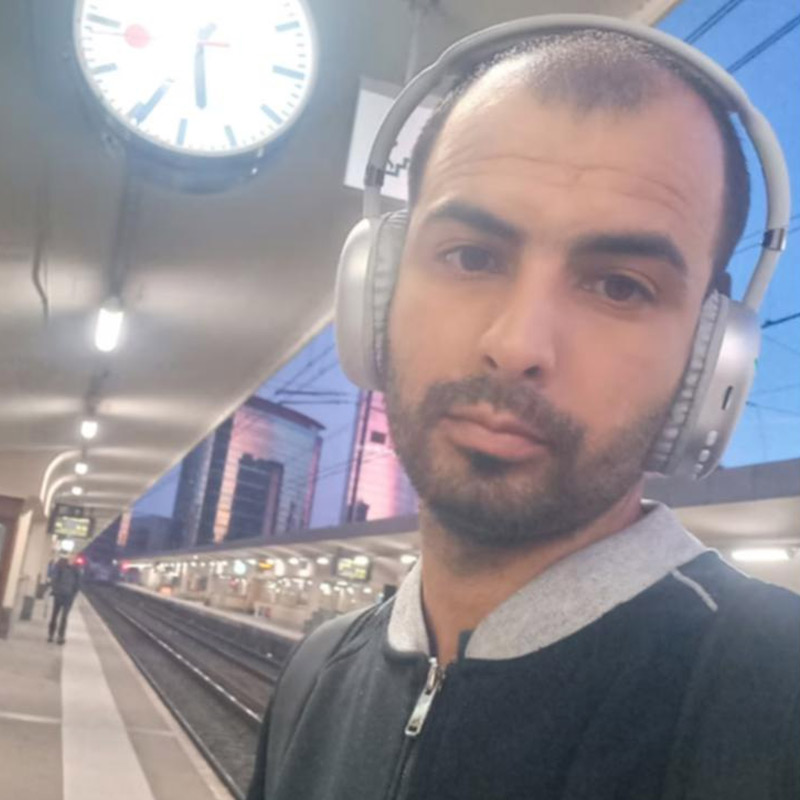
Abu Dakha’s journey began in the shattered streets of Gaza, where Israel’s nearly two-year war with Hamas had killed tens of thousands and left his livelihood in ruins. Once the owner of a modest internet café, he suddenly had nothing except the will to survive.
His first escape attempt came in April 2024, when he crossed into Egypt through the Rafah border. It cost him $5,000 and ended in a disappointment. Desperate for a safer path, he tried taking a flight to China, hoping asylum would come swiftly. For a moment, it seemed possible, until bureaucracy, rejection, and endless delays crushed that hope.
After months of frustration, he abandoned the plan and returned to Egypt, looping through Malaysia and Indonesia before setting his sights on Libya.
But Libya was no refuge.
For countless migrants, it is a purgatory, a place where dreams of Europe are swallowed by traffickers, exploitation, and false promises. Dakha tried ten times to cross with smugglers, and ten times he was betrayed, cheated, or stranded.
That’s when he decided to gamble everything on his own ingenuity.
With another $5,000, he bought a second-hand Yamaha jet ski through a Libyan marketplace. Another $1,500 went into a GPS, a satellite phone, and life jackets. The plan was reckless, almost suicidal but it was his.
From al-Khoms, Libya, the Italian island of Lampedusa lay 350 kilometers across the Mediterranean. A daunting distance, but far less than the impossible thousands of kilometers he would have faced had he attempted such a journey directly from Gaza.
Still, even 350 kilometers of open sea on a jet ski was insane.
And yet, it was the madness that offered him his only chance.
Muhammad Abu Dakha wasn’t alone. Two younger Palestinians, Diaa, 27, and Bassem, 23, joined him.
But what cemented their will to brave the open sea, was ChatGPT.
The three used the AI to calculate the most critical part of their voyage, like the fuel requirements for the 350-kilometer trip from al-Khoms to Lampedusa, and whatever supplies they might need during the journey. The AI gave them the information they needed to set off on August 17, 2025.
Together, they towed a small dinghy stocked with supplies, braving the open sea.
For twelve hours, Abu Dakha clutched the jet ski, cutting across waves under the blazing sun. At one point, a Tunisian patrol boat gave chase, but the trio managed to evade it, adrenaline pushing them forward.
Yet even with AI’s help, reality hit them hard: fuel ran dry just 20 kilometers from their destination.
Abu Dakha said that he drove the jet ski for about 12 hours, non-stop.
Stranded and exhausted, they placed a desperate satellite call.
When they thought their hope had run out, a rescue team came in the form of a Romanian patrol boat on a Frontex (European Border and Coast Guard Agency) mission, which pulled them aboard and delivered them to Lampedusa on August 18.
Their arrival stunned authorities.
UNHCR officials in Italy called the journey "pretty unique."
According to the UN, thousands of migrants are exploited by traffickers who promise spots on the boats, and data shows that at least 47,000 boat migrants managed to reach Italy till September in this year alone, mostly starting their final journeys from Libya and Tunisia. While migrant crossings by dinghy or overloaded fishing boats are already tragic daily realities; a jet ski braving the Mediterranean was almost unheard of.
For Abu Dakha and his companions, it was both a gamble and a triumph. powered a unique mix of courage, desperation, and a prompt typed into an AI chatbot.
The story didn’t end in Lampedusa.
From the migrant center, Abu Dakha and his friends were transferred to Sicily, then placed on a bus bound for Genoa. But true to the spirit of their escape, they refused to stop there.
Slipping away, Abu Dakha boarded a low-cost flight to Brussels, then hopped trains to Germany, where a relative picked him up.
Now, in the quiet town of Bramsche, he waits as his asylum application is reviewed.
Behind him in Gaza, his family lives in a tent camp in Khan Younis. His home is rubble, his business long gone. His wife and two children, aged four and six, one of them with a neurological condition requiring medical care, remain trapped in a tent camp in Khan Younis.
"That’s why I risked my life on a jet ski," he said.
With no job or income, Abu Dhaka is placed in a local center for asylum-seekers.
By seeking asylum, Abu Dhaka hopes that he can bring over his wife and two children, aged four and six.
"Without my family, life has no meaning."

This was not just a story of flight. It was the collision of war, technology, and raw human determination.
"It was a very difficult journey, but we were adventurers. We had strong hope that we would arrive, and God gave us strength," said Bassem, who did not share his surname.
Muhammad Abu Dakha’s escape was as much a symbol of Gaza’s desperation as it was a testament to the lengths one man will go to for the hope of safety. A jet ski. A satellite phone. And ChatGPT whispering calculations into the void of the Mediterranean.

















































































































































































































































































