
When a company grows too big and too fast, external challenges can escalate just as quickly—often with serious consequences.
Regulatory scrutiny tends to intensify, especially if the company starts to dominate a market or edge into monopolistic territory. Governments and watchdog agencies may launch antitrust investigations or impose compliance demands that slow progress and strain legal resources. Public perception can also shift; what was once seen as a scrappy innovator may be viewed as a corporate giant threatening competition and consumer choice.
Competitors may rally—either by innovating more aggressively or through strategic partnerships—to push back against the rising giant.
Meanwhile, market expectations grow steeper, with investors demanding consistent performance, leaving little room for error. Supply chains, partners, or even entire industries may begin to resist or renegotiate terms in response to the company’s expanding influence, further complicating operations.
OpenAI—the poster child of Large Language Models (LLMs) and the company that ignited the generative AI revolution with ChatGPT—now finds itself at a crossroads, forced to choose a path it must continue to follow.

As a part of restructuring OpenAI, the company said in an announcement:
"We made the decision for the nonprofit to retain control of OpenAI after hearing from civic leaders and engaging in constructive dialogue with the offices of the Attorney General of Delaware and the Attorney General of California."
OpenAI was originally born in 2015 as a non-profit, with a mission noble: to ensure artificial general intelligence (AGI) benefits all of humanity. However, in 2019, it embraced a "capped-profit" model, allowing investors to earn returns up to 100 times their investment.
The company had outlined plans in December, saying that it would help OpenAI "raise more capital than we’d imagined," and remove the restrictions imposed on the startup by its current nonprofit parent.
In late 2024, OpenAI proposed transitioning to a public benefit corporation (PBC), potentially removing profit caps and diluting nonprofit oversight.
That proposal sparked questions about how OpenAI would ensure equitable asset distribution between its nonprofit and for-profit entities, and how it would reconcile commercial growth with its altruistic mission.
"This framework keeps us very close to where we are now," said Bret Taylor, chairman of OpenAI’s board. CEO Sam Altman characterized the arrangement as a workable middle ground: “It satisfies investors enough to keep funding us at the level we believe is necessary."
Critics argue that the for-profit pivot jeopardizes OpenAI's commitment to safety and ethical AI development. The fear is that profit motives might overshadow the imperative to develop AI responsibly. Being a for-profit could lead to compromised safety protocols, especially if the nonprofit board loses control over critical decisions.
OpenAI's evolution has also seen a decline in transparency. Details about models like GPT-4 are scant, a stark contrast to its earlier open-source ethos. This opacity raises concerns about accountability and the potential for unchecked AI deployment.
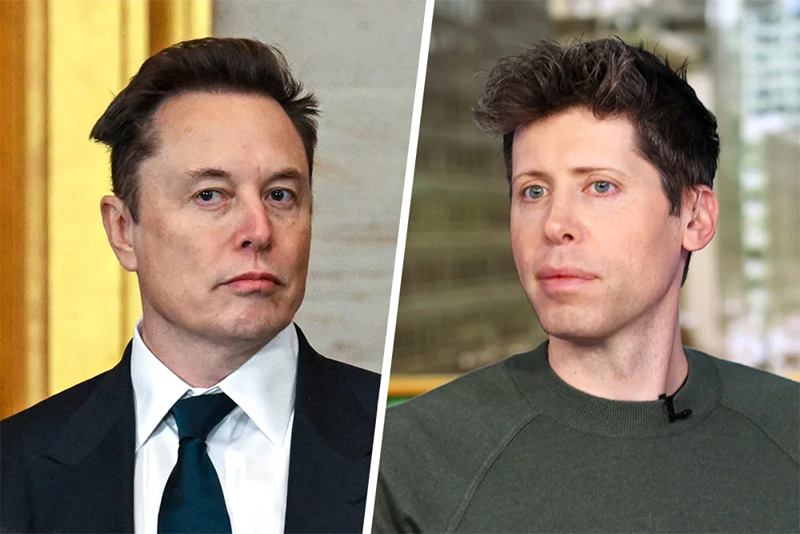
Elon Musk, a co-founder and early benefactor, voiced his displeasure, asserting that OpenAI's shift betrayed its foundational principles, alleging that the company has veered from its original mission of advancing AI for the benefit of humanity.
.
He likened the transformation to funding a rainforest conservation group, only to see it morph into a lumber company. Musk's concerns culminated in a $97.4 billion acquisition bid, which OpenAI rebuffed, further fueling the controversy.
Facing mounting pressure, OpenAI has little to no choice, and is literally forced to abandon its plan to become a for-profit entity.
Under the revised plan, OpenAI's for-profit subsidiary shall still transition into a public benefit corporation (PBC), a structure that allows the pursuit of profit alongside a commitment to public good, but despite this change, the nonprofit parent organization retain control by holding a significant equity stake and appointing the board of directors.
Read: OpenAI Becoming Closed Source And For Profit, Is The 'Opposite Of What I Gave The Money For'
4 facts about our structure:
-OpenAI will continue to be controlled by the current nonprofit
-Our existing for-profit will become a Public Benefit Corporation
-Nonprofit will control & be a significant owner of the PBC
-Nonprofit & PBC will continue to have the same mission— OpenAI (@OpenAI) May 5, 2025
This arrangement aims to balance the need for substantial capital to advance artificial general intelligence (AGI) research with the organization's foundational mission to benefit humanity.
But the move still sparks criticisms, particularly from the attorneys general of California and Delaware, who are examining the implications of the new governance model.
Legal experts suggest that while the PBC structure may facilitate fundraising, it introduces complexities regarding asset transfers, intellectual property ownership, and potential conflicts between profit motives and the nonprofit's mission.
The commotion about OpenAI trying to be a for-profit stems from a perceived departure from OpenAI's altruistic roots, replaced by a pursuit of profit that many fear could compromise the ethical development and deployment of AI. The debate continues, as stakeholders grapple with balancing innovation, ethics, and financial sustainability.