It has been some time since the world first witnessed an AI-powered news program.
Back in 2018, China unveiled two AI news anchors, considered the first of their kind. The following year, Xin Xiaomeng was introduced as the world’s first AI-based female news anchor. Then, in 2020, China revealed another milestone: the first-ever 3D AI-powered news anchor.
These innovations were designed to deliver the news around the clock, 24 hours a day, 7 days a week, without pause.
The motivation was simple: overcome human limitations. Unlike humans, who tire quickly and need food, rest, and sleep to perform at their best, AIs, which are essentially computers, don’t suffer from fatigue. They also don’t have personal lives, emotions, or distractions outside of work.
Given enough resources, AIs can function indefinitely, offering endurance that far surpasses even the most capable human anchors.
Now, Russia wants a taste of that same technological advantage, but with a Russian twist.
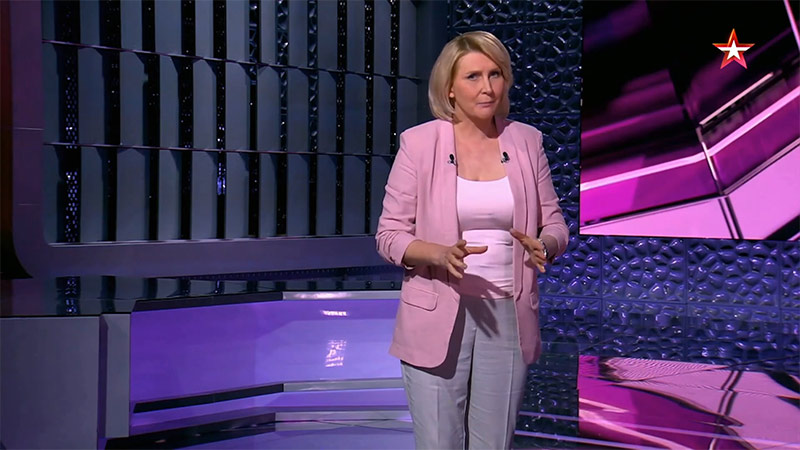
Russia’s defense-ministry channel Zvezda has quietly moved past novelty into something sharper: a weekly program it bills as created by artificial intelligence, fronted by an avatar called "Natasha," and packaged as satire but designed to be watched, shared, and talked about.
The program, promoted under names translated as "PolitStacker" or "Politukladchik" (Политукладчик), presents itself as an AI that selects topics, generates scripts, and narrates them via a digital host modeled on a real journalist, Natalia Borisovna Metlina.
According to its promotional materials, it promises that the AI will "select, analyze, and comment" on the week’s political absurdities, and the finished broadcast stitches together deepfake sketches of world leaders into campy, often grotesque tableaux.
They include French president Emmanuel Macron in hair curlers and a pink robe, U.S. president Donald Trump bragging about ending the Russia-Ukraine war by building a Moscow casino with golden toilets, as well as Ursula Gertrud von der Leyen, president of the European Commission since 2019, breaking into a Soviet pop song while cutting steel on a factory floor.
The show first came to wider attention not because a network announced it to the world but because machines noticed it.
It was Kalev Leetaru, who was at the time working with Google-backed The GDELT Project and the Internet Archive's TV news archive, found the program while his systems indexed and flagged broadcasts.
Tasked to monitor broadcasts, prints, and web from all over the world, Leetaru stumbled upon the videos, and realized that program is similar to a standard government-funded propaganda. But instead of some traditional broadcasts, this one stood out in the metadata since it showed up as an AI-produced program.
The discovery showcases how AI tools are now being used both to create media and to find it.
This, is literally a feedback loop in which machines expose and amplify what other machines make.
And this Russian experiment is only the latest chapter in a longer history of automated anchors and digital presenters.
From AI news anchors from China, which astonished viewers due to how realistic they can can be and how lifelike motion they have, Russia goes a step beyond that, and make it part of an entertainment.
However, this Zvezda's program lacks in its ability to render real-looking humans, and sometimes, the sketches are badly rendered.
On other times however, they're indeed eerily convincing.
Regardless, the effect is the same: mainstreaming a new stylistic palette for state television.
Where earlier deepfakes tended to circulate as isolated internet curiosities, here, the technique is embedded into an editorial format that looks and feels like ordinary television.
Experts warn that even if the program’s current tone is parody, its regular airtime and state backing lower the bar for future uses that could be far less jocular and far more misleading. The danger isn’t only that one clip fools a viewer; it is that a state network uses novelty to normalize synthetic manipulation so that the threshold for deploying AI-made persuasion in news and commentary becomes trivial.
This is for a reason: the content of politstacker is purposely designed to be ridiculous and grotesque, which is part of its rhetorical power: parody makes it easy to claim "it’s only satire," even as the visuals and narratives prime audiences to accept bizarre.
For example, in one of the scenes, Natasha said that her job is to put "political nonsense" into people’s heads "like candies in a box." The intro shows candies wrapped with the faces of Donald Trump and Ukrainian president Volodymyr Zelensky.
But this simplified caricatures of foreign leaders and events, and that rhetorical slippage from comedy to normalization to persuasion is what worries media scholars and technologists.
As Leetaru puts it when he first flagged the series, the production looks like a leap from novelty to normalized practice that could be a tipping point.














































































































































































































































































