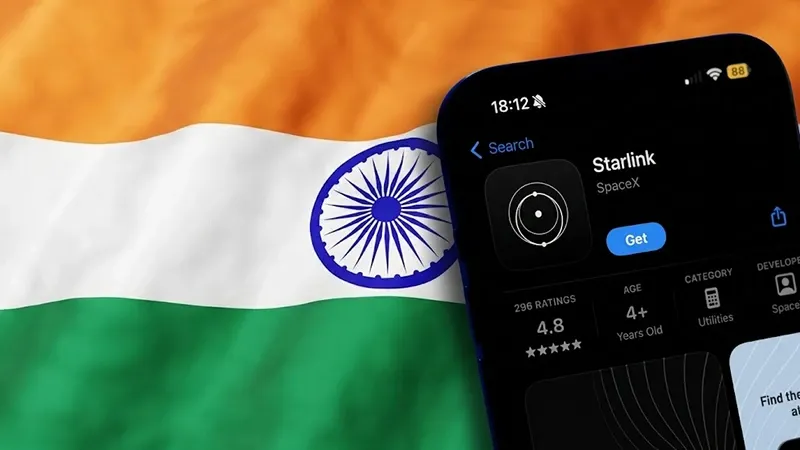
Starlink has spent years seeking commercial entry into India.
While the company has the resources and the satellites already overhead, it must still obtain the licenses, security clearances, foreign investment approvals, and spectrum assignments required under Indian law before it can offer commercial service.
The effort has stretched across more than four years of applications, refunds, partial approvals, and infrastructure builds, yet commercial service remains unavailable.
Indian rules require every satellite operator to clear security reviews, investment checks, and spectrum allocation before terminals can be switched on for paying customers, and those steps have not been completed for Starlink or for the two other licensed providers.
Then came the oligarchs.
Starlink first attempted to sell its satellite internet service in India in late 2021 by opening pre-bookings before it held any operating license.
Indian authorities ordered the company to issue refunds to more than 5,000 customers who had signed up.
The company then submitted a formal application for a Global Mobile Personal Communication by Satellite license in November 2022. The Department of Telecommunications granted that GMPCS authorization in June 2025, and India's space regulator, IN-SPACe, authorized the Gen-1 constellation the following month. Provisional spectrum for testing was allocated later in 2025.
By early 2025 Starlink had also signed memoranda of understanding with Reliance Jio and Bharti Airtel to distribute the service once the remaining approvals arrived.
The company states that it has already built 20 gateway sites containing hundreds of antennas, implemented India-specific security controls, and committed to keeping Indian user data inside the country.
It has further signed letters of intent with the state governments of Maharashtra, Gujarat, and Meghalaya.
Then, finally on 7 October 2026, Lauren Dreyer, Vice President of Starlink Business Operations at SpaceX, addressed the India Mobile Congress in New Delhi.
She said the company had spent roughly five years working with Indian regulators and telecom operators, that the ground infrastructure and local operations were already in place, and that Starlink stood ready to help achieve Prime Minister Narendra Modi's stated goal of 100% connectivity across the country.
She noted that the service could reach remote villages, mountains, and islands where extending fiber or mobile towers is difficult, and that portable terminals could restore communications after floods, earthquakes, or storms.
Dreyer expressed the hope that the remaining government processes would be finished so that the next time she addressed the Congress, Starlink would be authorised and ready to begin service, adding that people could get connected within minutes rather than years.
But again, commercial operations still require completion of security assessments, foreign-direct-investment clearance, and formal spectrum assignment.
The spectrum usage charge, set around 4 to 5% of adjusted gross revenue with incentives for rural coverage, was still awaiting final Union Cabinet approval.
Security agencies have raised questions about operational control of terminals, data flows, and how the company would respond if foreign governments issued competing demands during a crisis.
Hours after Dreyer’s remarks, Elon Musk quoted a post that listed remaining rural connectivity gaps, including more than 11,000 villages still without 4G coverage as of May 2026 and substantially lower internet subscription density in rural areas than in urban ones.
He wrote that Starlink was being blocked by certain "oligarchs" in order to maintain their monopolistic chokehold on the Indian people, invited readers to guess who they were, and called the situation a crime against the people of India.
While Musk did not name any individuals. multiple news organizations interpreted the comment as directed at Mukesh Ambani of Reliance Industries and Jio and at Sunil Bharti Mittal of Bharti Enterprises and Airtel.
Jio and Airtel together account for the large majority of India’s broadband subscribers, with reports citing figures above 80% or roughly 910 million connections.
Their satellite affiliates, Jio Satellite Communications and Bharti-backed Eutelsat OneWeb, are the other two companies that hold GMPCS licenses.
All three hold the same class of Indian license and, according to the government, remain at broadly the same stage of security review before any of them can receive commercial spectrum.
On 8 October the Ministry of Communications issued a statement noting that a social-media post had suggested the satellite-communications framework was being applied in a discriminatory manner.
The ministry called that suggestion baseless and misconceived.
It stated that a fair and non-discriminatory authorization process applies to all operators and that security assessments are under way for all three licensed entities.
Once an individual licensee completes the assessment it may proceed to seek spectrum assignment.
Neither Airtel nor Jio issued an immediate public comment on Musk’s post.
As of that date none of the three licensed satellite operators had begun commercial service in India.

Starlink works by placing thousands of satellites in low Earth orbit, a few hundred kilometers above the surface, so that a small dish at a user's location can lock onto a passing satellite and send data onward through ground gateways.
The lower altitude keeps latency far smaller than older geostationary systems that sit nearly 36,000 kilometers out, which is why the service can support video calls and ordinary broadband rather than only basic messaging.
But having satellites already overhead and gateways already built does not by itself allow service to start.
Indian rules require each operator to finish security assessments that cover data localization, the ability to disable terminals, and responses to lawful requests, then to obtain foreign-investment clearance and an assigned slice of spectrum whose pricing is still moving through cabinet processes. Those steps have produced repeated delays.
The sequence shows how licensing, security reviews, investment approvals, and spectrum assignment can keep a network that is technically ready from reaching users for years.