In the age of smartphones and endless social feeds, private moments have a way of escaping the rooms where they happened and traveling farther than anyone involved ever intended.
What begins as a closed exchange between people with unequal power can suddenly become public property, shared, judged, and punished by strangers who never knew the full context.
Entertainment industries have long contained these imbalances, with those who control roles and opportunities often holding quiet leverage over those still trying to enter the frame.
When digital recordings enter the picture, the imbalance does not disappear. It simply changes shape and gains speed.
Something similar unfolded in Egypt in early 2019.

Two young actresses, Mona Farouk and Shaimaa al-Haj, found themselves at the center of a rapidly spreading online scandal after explicit videos of them began circulating across social media platforms and adult websites.
The footage, reportedly recorded several years earlier in an apartment in El-Mohandessin district near Lebanon Square (Agouza) area of Cairo, linked to a well-known film director and then-member of parliament named Khaled Youssef.
The videos showed the two women completely naked, dancing, engaging in sexual acts with themselves, and also sexual intercourse with a man.
According to statements they later gave investigators, the material captured them performing together and complying with demands that included acts local media described as deviant.
Both women said they had entered into unofficial customary marriages with Youssef around 2014, and had gone along with his requests in the hope of receiving roles or career support in Egypt's competitive film industry.
Egyptian authorities moved quickly once the videos gained traction online.
Farouk and al-Haj were arrested by the Egyptian security/morals police in February 2019 and charged with committing a flagrant/scandalous act, public indecency, inciting debauchery/immorality, and related offenses under Egypt's Law 10 of 1961 on combating prostitution and public morals (including via internet "advertising").
In other words, charges include public indecency, inciting immorality, and related offenses under the country's strict public-morals laws.
Both women then recorded video statements that circulated widely, mostly through the Egyptian outlet Dot Masr.
In a video, Farouk appeared emotional and in tears as she described how Youssef had been a longtime friend of her father's. She said she later fell in love with him and entered into an unofficial marriage that her family knew about.
On the day the video was filmed. she went to his apartment near Lebanon Square, found al-Haj already there, and the two women argued.
According to her account they drank alcohol, she was unaccustomed to it, and she claimed she was not fully conscious when the sexual acts were recorded.
She said Youssef filmed them and later told her his phone had been stolen. She also spoke about the severe personal consequences that followed, including family rejection, threats, her mother’s hospitalization, and her brother losing his job.
As for al-Haj, she gave similar video interviews around the same dates.
She stated that she too had been in an unofficial marriage with Youssef and that the footage was shot in the apartment where she was living with him at the time. She claimed she was not fully aware during the filming and only learned that day that he was also involved with Farouk.
She apologized to the public and her family, described both women as victims, and repeatedly asked people to show them mercy and cover for them. She mentioned that she had stepped away from acting years earlier after her father’s death and was unsure whether she would return.
In all, the two women spent roughly four months in detention, including time in a women's prison, before a court ordered their release pending further investigation in June of that year.

Youssef was outside Egypt at the time of the arrests, visiting his wife and daughter in Paris.
He did not release a comparable detailed video interview addressing the explicit content of the recordings. Instead, his public responses that month consisted mainly of short posts on Instagram and Facebook, a phone interview with outlets including BBC Arabic, and written statements.
In those statements, Youssef denied having fled Egypt, saying he had already been in Paris visiting his family before the arrests. He described the scandal as a politically motivated campaign linked to his opposition to proposed constitutional amendments that would extend President Abdel Fattah el-Sisi's tenure.
He also criticized Egyptian media for circulating allegations that he said were not contained in the official investigation records.
The most direct public accounts came from the two women, who released video statements in February 2019.
Many of the original full-length clips have since been removed or restricted on major platforms because of their sensitive content. As a result, they now survive mainly through news archives, older social media posts, and secondary reports.
Youssef's defense also raised several legal arguments, including statute-of-limitations issues because some of the videos were several years old, the existence of urfi marriage contracts, and the fact that the women themselves had not published the recordings.
Authorities ordered technical examinations of the videos and their locations as part of the investigation.
At the time, Youssef was also a member of Egypt's parliament and therefore held parliamentary immunity, adding another legal dimension to the case.
Following the news, other women were also drawn in as similar videos surfaced, including businesswoman Mona al-Ghadban (who also claimed an earlier urfi marriage to Youssef, roughly 2010–2014/15 and others such as media figure Rana Huwaidi.
A 2015 complaint by lawyer Osama Abdo Zahran (claiming dozens of CDs/flash drives of videos involving Youssef and many women, alleging systematic exploitation for roles) was referenced in coverage but did not produce a public resolution in the 2019 reporting
But still, no formal public charges against him in connection with the videos were widely reported, and by 2021 Egyptian sources indicated he was not listed as wanted and could return freely.
In other words, the outcome looked very different from the stories that dominated Western headlines a couple of years earlier.
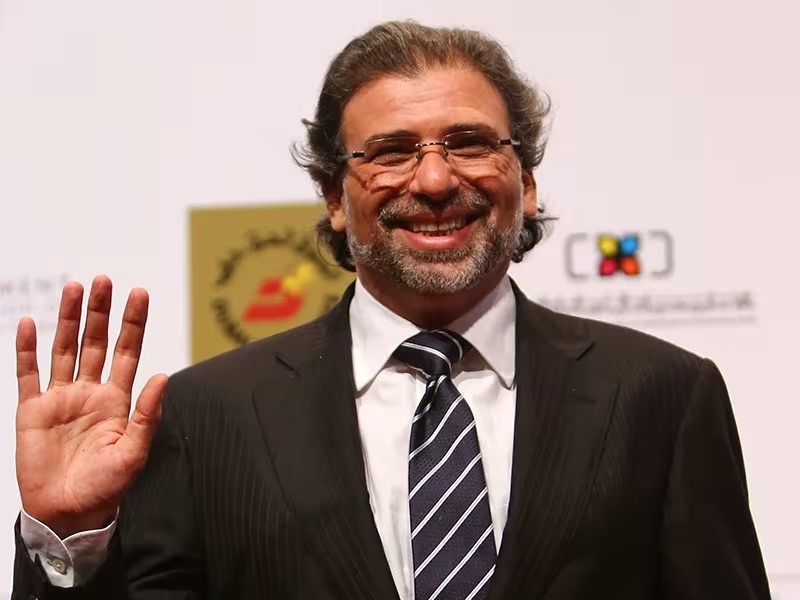
This is a contrast to Harvey Weinstein's case notorious and infamous case.
Both situations involved powerful men in film, aspiring actresses, alleged exchanges of sexual compliance for career opportunities, and intimate material that eventually became public.
Weinstein faced criminal trials, convictions for rape and sexual assault, and prison time, while the broader #MeToo movement used social media to amplify survivors' accounts and pressure institutions.
In the Egyptian episode the legal machinery pointed primarily at the women who appeared in the videos.
Their presence in the circulating footage itself became the basis for criminal charges under morality statutes, while the person alleged to hold greater structural power largely avoided equivalent public accountability.
The internet did not create the underlying power dynamic, but it determined how the evidence traveled and whose bodies were treated as the visible offense.
Following the virality of the videos, a petition was created to call on Pornhub to remove the videos, arguing they were shared against the women’s will and that the women were suffering severe social and legal consequences in Egypt while the director faced less immediate accountability.
It gathered nearly tens of thousands of verified signatures.
Years later the digital afterlife of the scandal continued.
Mona Farouk remained active on TikTok, where she built a sizable following. In late 2024 she faced a separate case after a live stream in which she discussed personal matters and made references that courts linked back to the earlier videos.
An economic court sentenced her to three years in prison and a fine for assaulting family values under cybercrime provisions, with the judgment explicitly citing the 2019 case.
The episode illustrated how material that surfaces online can reopen old wounds and generate new legal consequences long after the original events.
What lingers is a reminder that the internet does not distribute accountability evenly.
Once intimate recordings leave private control, the original imbalance of power is often replaced by a new one between those who appear in the material and those who control its circulation or the legal response to it.
Different societies apply different rules to the same digital evidence.
In some places the focus falls on coercion and non-consensual distribution. In others the mere existence of sexual content online can itself become the crime.
The Egyptian case sits at that intersection, showing how quickly a closed industry arrangement can turn into a public spectacle and how unevenly the consequences can fall once the files begin to move.
Further reading: From Miss Universe To Unstoppable: How Anya Ayoung-Chee Rose Above Her Viral Sex Tape Scandal

















































































































































































































































































