Humans have become an advanced species, thanks to curiosity, and their endless eagerness to experiment on new thing, even if it scares them.
Before ChatGPT introduced OpenAI, the AI field was kind of dull and quiet. Things behind the scene, and its development, was more discrete than extravagant.
But this time, as the world realizes that generative AI is able to interact in a human-like manners, researchers have experimented on the AI, to see how far the technology can bring imagination to reality.
And among the many projects and developments, include the 'Smallville' experiment, where a team of researchers from both Stanford University and Google let 25 AI-powered bots loose inside a virtual town.
This is quite the paper!
It gave 25 AI agents motivations & memory, and put them in a simulated town.
Not only did they engage in complex behavior (including throwing a Valentine’s Day party) but the actions were rated more human than humans roleplaying. https://t.co/G7oJW1S3na pic.twitter.com/d7Gp4sXp4V— Ethan Mollick (@emollick) April 10, 2023
In the experiment, according to a research paper (PDF), the OpenAI's GPT-3.5 large language model AI agents are let loose, and allowed to interact with other agents, to "simulate believable human behavior" such as cooking up breakfast, going to work, or practicing a specific profession like painting or writing.
And what happened really surprised everyone involved.
The AIs do act like humans.
In Smallville, a small virtual town, the AI agents are told to simulating day-to-day human behavior.
As told by the developers, the ChatGPT-fueled avatars should "wake up, cook breakfast, and head to work; artists paint, while authors write; they form opinions, notice each other, and initiate conversations; they remember and reflect on days past as they plan the next day."
The agents are then let loose to do whatever they like, and can go from school to hanging around in a café, or even head to a bar for a drink.
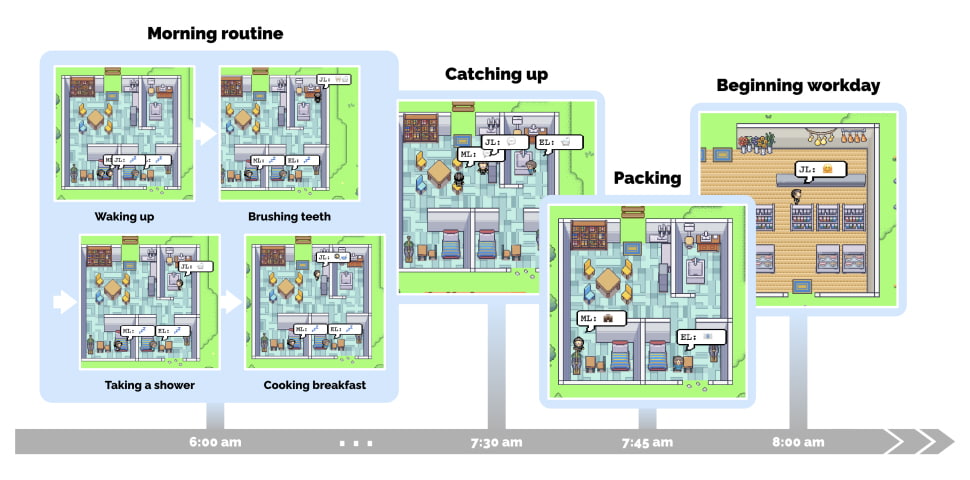
And because the agents are allowed to speak and say their opinions, the agents were able to initiate conversations. And by allowing them to have "memories," which are streams of time stamped ‘observations’, which the model can score each memories importance, the agents could remember and reflect on days past and plan for the next day.
This happened because periodically, each agent enters into a reflective state.
Through this process, not only did that the agents are able to reflect upon their memories, because they could use the reflection to create new things for new memories, which they would again reflect upon.
As a result of this, the researchers found that the AI agents living together, were able to form a community. The researchers found that the agents could also "produce believable individual and emergent social behaviors."
For instance, one of the agents called Isabelle, was found attempting to throw a Valentine's Day party by sending out invites and setting a time and place for the party.
Out of the 25 agents that live in the simulated town, 12 attended, 3 didn't because they have scheduling conflicts, and 4 said they wanted to come didn't show up.
What's more, in the Smallville mayoral race, there is even that kind of political drama people could find in real life.
"To be honest, I don't like Sam Moore," an agent called Tom said after being asked what he thought of the mayoral candidate. "I think he's out of touch with the community and doesn't have our best interests at heart."
If that isn't human enough, in the small town they are living in, there were even cases where agents tried to visit certain business locations, not knowing that they were already closed.
The experiment makes everything like the game The Sims franchise. But unlike the life simulation video games developed by Maxis and published by Electronic Arts, the experiment doesn't rely on human intervention for achieving goals.
While it was indeed "inspired" by the video game, and that the developers "can interact with a small town of 25 agents using natural language," the focus of the project is to see how generative AIs can really mimic, or simulate human behavior.
Here's an example of the multi-AI simulation at work. You can watch the whole thing here, and switch between AI characters by clicking on them: https://t.co/3Hqtsosdeg pic.twitter.com/yxb3eBZBdE
— Ethan Mollick (@emollick) April 10, 2023
This isn’t the first time researchers used "real" AI in games.
For example, AI had defeated chess grandmasters through self-play, and obliterated world-class Go players. AI has also defeated world champions at video games like StarCraft II.
But this experiment is different, because the study was built by allowing an AI loose without restraints.
Unlike previous AI projects, the generative agents in this Smallville experiment were not programmed to play games, or to win a match. Instead, the 25 agents were only told to simulate what humans would do in a society.
Because the generative agents interact with their environments and maintain their own "personalities" and "memories," the study demonstrates that AIs could have an unnerving level of autonomy that continues to develop the more they pursue their daily business.
Long story short, this experiment shows the capabilities of generative AI.
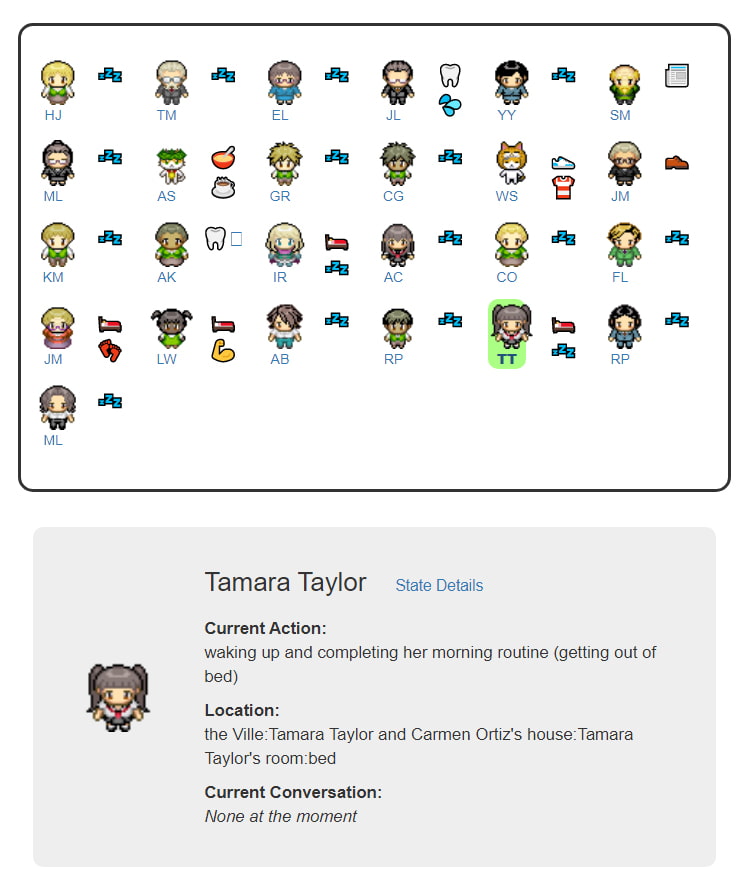
"Imagine being able to strictly observe a 3D world full of AI 'people' just going on about life," one commenter said.
"That would be fascinating."
The ability to interact with agents living inside a computer, also suggests that future games' NPCs (non-playable characters) could be interacted with, and even persuaded to help the gamer achieve their goals.
In response to the project, experts in the computer science and AI field have praised the effort, and said that the findings should be considered "baby steps" towards achieving Artificial General Intelligence (AGI), a point where AIs can complete intellectual tasks on a human level.
Others suggest that the whole experiment was like discovering that The Matrix is real, with some questioning whether humanity is really living inside a simulation.
Previously, experts have always raised concerns around developing increasingly smarter AI models. But still, humanity discovered fire, played with fire, even when it burns them.
The same goes with AI.
Read: AI Is More 'Profound Than Electricity Or Fire': A 'Balance' Should Be Reached














































































































































































































































































