
Inbound marketing on the internet should be a lot more effective than outbound marketing. The reason for this is because on the web, buyers - not sellers - are in the driver's seat. Since they're controlling of the flow, they're the ones that need to do the approach, not you.
On the web, inbound marketing is better than outbound marketing because of the flexibility of the complexities it has. People are becoming used to ads and other intrusive distractions. Experience given to those people over time are starting to create a habit in which they avoid things they don't like without even thinking.
Inbound marketing is regarded a newer way of marketing because it involves the strategies in getting people's attentions by earning them, not by buying its way in. If compared to outbound marketing, the strategy involves older methods in which their marketing materials are pushed to the consumers.
If done correctly, inbound marketing although needs a lot more efforts, it's actually a lot more effective. This is because inbound marketing focuses on quality contents that pull people in naturally. By aligning your contents with your consumers' interests, you're attracting people in an efficient way that the probability of them to convert to leads and buyers are significantly higher. And over time, your consumers will also be more delighted because they're purchasing things they like with their own interest and pace, not by the repetition and aggressive stance on most outbound marketing strategies.
In short, inbound strategies are all about being found naturally rather than actively pursuing leads. It's a way to approach people when they're not expecting you.
The Differences That Set Them Apart
Inbound marketing is a strategy that is relatively newer to its outbound marketing counterpart. The word "inbound" is describing what you're doing with your clients, explaining the bits to them so they understand. SEO, SEM and other methods in attracting web visitors are creating a distribution shift in overall marketing, and they're putting a significant gap to differentiate inbound and outbound.
Outbound marketing strategies are linear. This means that you have a lot of medium to choose from, and can target your market accurately and effectively. The more the budget you spend, the more effective the medium will be, leaving out the least effective mediums out. You need a unified message across the platforms and need to repeat the process again and again to make it powerful. Inbound marketing is more holistic because it needs simultaneous usage of all the digital channels, continuous strengthening of the medium, development of contents, access of analytics and other things.
Inbound marketing on the internet is done by digital distribution. This has made it highly measurable and results-oriented. The differences between those two also involves the message. Inbound marketing tends to include the message itself inside it. The message can be either educational, informational, creative, humor, to anything in between.
It involves transparent information delivery and uses the power of the social nature of humans and the viral ability of the internet.
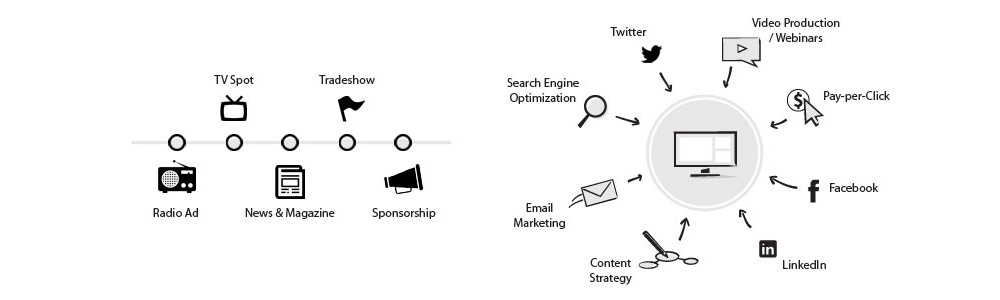
Outbound marketing on the other hand, is more regarded as traditional marketing. The strategy involves radio, TV, newspaper, billboards, online ads, banners, sponsorships and many others. And on the internet, it's not limited to email marketing, many PPC networks, and the evergrowing spam.
Outbound marketing is a jargon that grew successfully within itself, shouting messages loud as clear as possible, aiming for rewards from anyone that comes close within its proximity. When ads were cheap and highly effective, people are learning how to avoid them. When they successfully did, outbound marketing efforts shifted and uses more contrast and aggressive stance to maximize conversion. While at some point in real-life circumstances this method can have a huge impact, but on the web, the result tends to be the opposite.
The most obvious reason for this is because outbound marketing is an interruption-based marketing. They're usually occupying spaces that are mostly visible on the web, and are usually associated with ads. While their visibility is indeed a lot higher that most inbound marketing strategy, outbound marketing strategy has a lower percentage of conversion. This is because people on the web are avoiding distractions.
Using outbound marketing, you're forced to create something to stand out or not being seen at all. Using the strategy, you're trying to engage with consumers by grabbing their attention rather than giving them value. This might be the best way to promote something across many platforms quickly and easy, but it won't ever make you be the main event of a story. While outbound marketing failed to achieve such a thing, inbound marketing aims to do this.
Inbound marketing earns it reputation by giving something valuable to the masses. This creates a relationship based on their habit and interests, not by forcing the materials into them. To get the most out of outbound marketing, you have to sacrifice some details to get the most important message out, but in inbound marketing where you're the main event of a story, you're free to do as you like.
Inbound marketing is all about creating great content to share with your audience. It's all about telling stories and speaking to your audience, and making them understand in their own pace. You're preaching your audience to do something you'd like them to do, if they listen, they'll do it. If they don't you have less to lose in terms of your overall value and cost.
Inbound marketing has a much more complex approach than outbound marketing. Because it takes more time and relatively more efforts, businesses that want to be seen tend to use outbound marketing because of its effectiveness in getting their message out. This is the strategy most companies are comfortable with.
On the other hand, in order for outbound marketing to achieve the same effect, it should have a strong foundation. It needs to be in good share to carry out its message, having the reach with distribution hubs and channels, it needs to have a powerful call-to-action strategy, the ability to convert, a blog, and others.
Conclusion
Inbound and outbound marketing strategies are two different beings aiming for a sole purpose. While one can have much more impact when done correctly, the other is aiming for simplicity and ease.
When your strategy is to put your messages out fast and clear, outbound marketing strategy can be better for you to amplify your voice. But if you want to build a brand that is long-lasting and powerful enough to have an impact on your niche's ecosystem, inbound marketing is the best for your investment.
If your opting for inbound marketing, you should have a clear message that less intrusive but rock solid. You should be able to manage your online presence to the maximum, and get everything inline to work by complementing one another. You should be useful to others, and by becoming resourceful, you'll be the one-stop-solution for your fans.
The things you need to include in your inbound marketing strategies are, and not limited to: SEO, PPC that is complementing your overall strategy, content marketing, social media, optimizing landing page, and having a strong call-to-action.