 The worldwide smartphone market reached another milestone. For the first time in history, more than 1 billion smartphones were shipped worldwide in 2013. The figure represents smartphone for roughly one out of every seven people on the planet. This is impressive with a massive increase over 2012 that had total shipment of 725 million.
It took 16 years for smartphones to reach the 1 billion mark. Since the introduction of mobile internet in 1996 by Nokia Communicator, smartphone sales increased at an immense rate.
According to the International Data Corporation (IDC) Worldwide Quarterly Mobile Phone Tracker, vendors shipped a total of 1,009.6 million smartphones worldwide, a 39.2 percent increase from 2012. Smartphones accounted for 55.1 percent of all mobile phone shipments in 2013, up from the 41.7 percent of all mobile phone shipments in 2012. In the fourth quarter of 2013 (4Q13), vendors shipped a total of 284.4 million smartphones worldwide, up 24.2 percent from the 229.0 million units shipped in 4Q12.
"The sheer volume and strong growth attest to the smartphone's continued popularity in 2013," said Ramon Llamas, Research Manager with IDC's Mobile Phone team. "Total smartphone shipments reached 494.4 million units worldwide in 2011, and doubling that volume in just two years demonstrates strong end-user demand and vendor strategies to highlight smartphones."
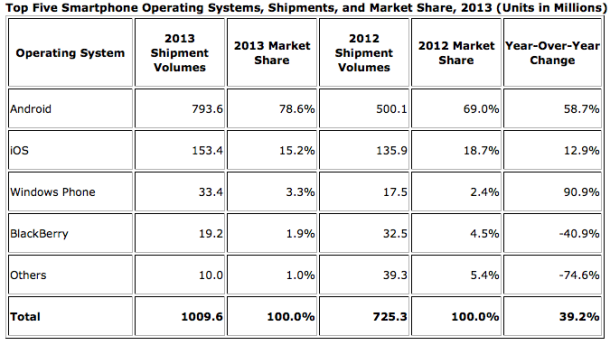
New data from IDC shows that Android stayed strong throughout the year reaching a total of 793.6 million shipments with 78.6 percent market share. While Apple's iOS held a steady second place with 153.4 million shipments or 15.2 percent market share, an increase of 13 percent on the previous year. Accumulating both operating system, they accounted for 95.7 percent of all smartphone shipments in the fourth quarter of 2013. A staggering 93.8 percent in 2013.
Despite Apple's lost in numbers compared to Android, it isn't as bad as it seems. The company managed that market share from a handful of phones that are generally the most expensive on sale in any market.
The IDC numbers contained some good news for Microsoft. Windows Phone shipments rose to 33 million, just under double what they had in 2012. BlackBerry OS saw its market slide by 40 percent to 10 million handsets.
"Clearly, there was strong end-user demand for both Android and iOS products during the quarter and the year," said Ramon Llamas. "What stands out are the different routes Android and Apple took to meet this demand. Android relied on its long list of OEM partners, a broad and deep collection of devices, and price points that appealed to nearly every market segment. Apple's iOS, on the other hand, relied on nearly the opposite approach: a limited selection of Apple-only devices, whose prices trended higher than most."
Looking at the numbers from 2013, one can see that Android's market share grew by 9.6 percent from 2012, and Apple's share fell by 3.5 percent. Windows Phone market share grew by about 1 percent, but its actual shipments nearly doubled from 17.5 million to 33.4 million. BlackBerry continued its downward slide, losing 2.6 percent market share and nearly cutting its shipments in half.
Although headlines worldwide focus of flagship phones, notably the latest iPhone, Samsung's Galaxy series, and HTC Ones - the phone vendors expect to see cheaper handsets to keep the market expanding. The massive growth of smartphone demands doesn't come from high-end devices, it's coming from handsets that cost below $150, especially in emerging markets.
"In 2013 we saw the sub-$200 smartphone market grow to 42.6 percent of global volume, or 430 million units," IDC's Worldwide Quarterly Mobile Phone Tracker program director Ryan Reith said. "While the market moves downstream to cheaper products it makes sense for Samsung and others to continue their marketing investments geared toward high-end products. These efforts build crucial brand perception while having less expensive alternatives that closely relate to these top products helps to close the deal."
Ryan Reith noted that the top two trends driving smartphone growth are large screen devices and low-cost, with the latter being "the key difference maker."
"Cheap devices are not the attractive segment that normally grabs headlines, but IDC data shows this is the portion of the market that is driving volume. Markets like China and India are quickly moving toward a point where sub-$150 smartphones are the majority of shipments, bringing a solid computing experience to the hands of many."
This is why Android shines. Many of those phones run on Android operating system. The operating system offered by Google as an open-source has made it popular with companies producing low-cost handsets.
Vendor Highlights
Samsung ended the quarter the same way it began the year: as the leader. But even with steady demand for Galaxy S 4, as well as its various selections of mid-range and entry-level models, Samsung as the leader for Android's success realized a decline compared to the previous quarter.
Apple posted its record shipment volume during 4Q13, driven primarily by the addition of multiple countries offering the iPhone 5S and 5C, and sustained demand from its initial markets that saw these models launch at the end of 3Q13. However, Apple had the lowest year-on-year increase of all the leading vendors.
Huawei has maintained the number three position throughout the year. It attained the highest year-on-year increase among other leading vendors, and raised its brand profile with a higher proportion of self-branded units compared to the ODM work it had done for other companies.
Lenovo ended the quarter in the fourth position. Despite having no presence in North America nor Western Europe, the company has shown its strength by having a strong presence within key emerging markets and a well-segmented product portfolio that spans from simple, affordable smartphones to full-featured 5" screen models.
LG edged out ZTE for the number five position by just five million units difference. At the same time, its year-on-year improvement put the company neck and neck with Huawei and Lenovo with market beating growth. LG's success was attributed to its revived portfolio which featured more large-screen and high-end models.






















































































































































































































































































