
The large language models (LLMs) war escalates every time a new product or feature is released, and quickly others soon follow with their own improvements.
The pattern began clearly in late 2022 with the public launch of ChatGPT by OpenAI. It demonstrated that conversational AI could handle a wide range of everyday tasks: writing assistance, coding help, research summaries, and casual dialogue, in a way that felt natural and immediately useful to millions of users.
This accessibility shifted expectations and triggered intense competition among tech companies to develop and refine their own models.
Grok, developed by xAI, was introduced as an alternative with a distinct focus.
Unlike many systems shaped by extensive content filters and cautious response patterns, Grok was designed to provide direct answers, draw from real-time information on the X platform, and handle a broader range of topics with fewer restrictions. The goal has been to support open exploration of ideas, accurate reasoning, and practical utility without unnecessary deflection.
This approach extends to its multimodal features, where text capabilities connect with image and video generation.
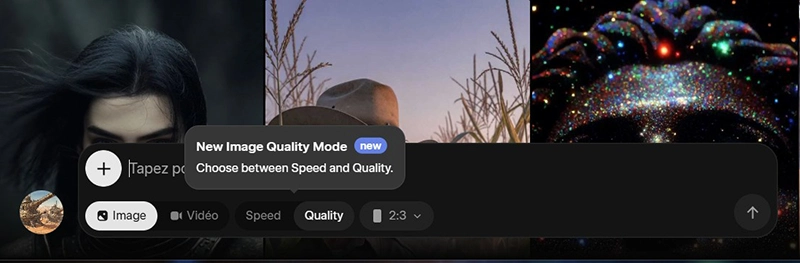
Grok Imagine serves as the integrated system for creating visual content from text prompts. It supports both static images and short video clips, with recent updates like expanding video length to around 10 seconds at 720p resolution along with synchronized audio. Users access the tool through the Grok interface on web or mobile. Generation options now include a choice between Speed mode, which prioritizes quick results for rapid iteration, and the newly introduced Quality mode.
Introducing Quality mode on Grok Imagine – powered by our most advanced image generation model.
Quality mode gives you enhanced details, stronger text rendering, and higher levels of creative control.
Now available on web and mobile.
Try it at https://t.co/zGhs9czkC5 pic.twitter.com/3h41VNKgWM— xAI (@xai) April 3, 2026
At its core, Quality mode relies on xAI's most advanced image generation model currently available.
It is intended to deliver outputs with greater detail, improved handling of textures and lighting, more accurate text rendering within images, and better overall adherence to complex prompt elements such as object relationships, physics, and stylistic nuances. This comes with longer processing times compared to Speed mode.
The improvements appear most evident in areas where earlier generative systems have historically struggled.
For photorealistic scenes, Quality mode produces more lifelike lighting effects, including volumetric god rays and subtle reflections, along with finer surface textures on materials like fabric, metal, or sand.
Text integration has advanced noticeably, supporting clearer rendering across multiple languages and scripts, which makes the mode potentially more suitable for tasks involving logos, infographics, signage, or any element where legible wording is required within the visual composition.
Prompt understanding also benefits from what xAI describes as deeper world knowledge.
The model shows stronger performance in interpreting relational details, like how objects interact spatially or physically, and in incorporating specific cultural, brand, or fictional references without as much deviation or hallucination.
Examples shared in the announcement include complex fantasy compositions with accurate motion blur on galloping horses and intricate armor details, as well as ethereal desert scenes with precise light interactions on translucent fabrics and layered halo effects.
Big Leap in Realism
Quality mode enables new levels of visual aesthetics for AI images.
Photorealistic scenes with lifelike lighting, texture, and detail. pic.twitter.com/bZfOqOKdNa— xAI (@xai) April 3, 2026
Users access Quality mode through a toggle in the prompt bar on grok.com/imagine, available on both web and mobile platforms.
Speed mode remains an option for quicker iterations, generating multiple variations rapidly, while Quality mode typically produces a smaller set of higher-fidelity results, often four images at once rather than a continuous scroll.
Early community feedback on platforms like Reddit and X indicates that the difference can be pronounced in intricate or highly detailed prompts, though outcomes continue to depend heavily on how precisely the prompt is written. Some users report clearer gains in realism and coherence, while others note that the added time may not always justify the upgrade for simpler concepts.
This addition fits into the broader development of Grok Imagine, which now supports both static image generation and short video clips in various formats.
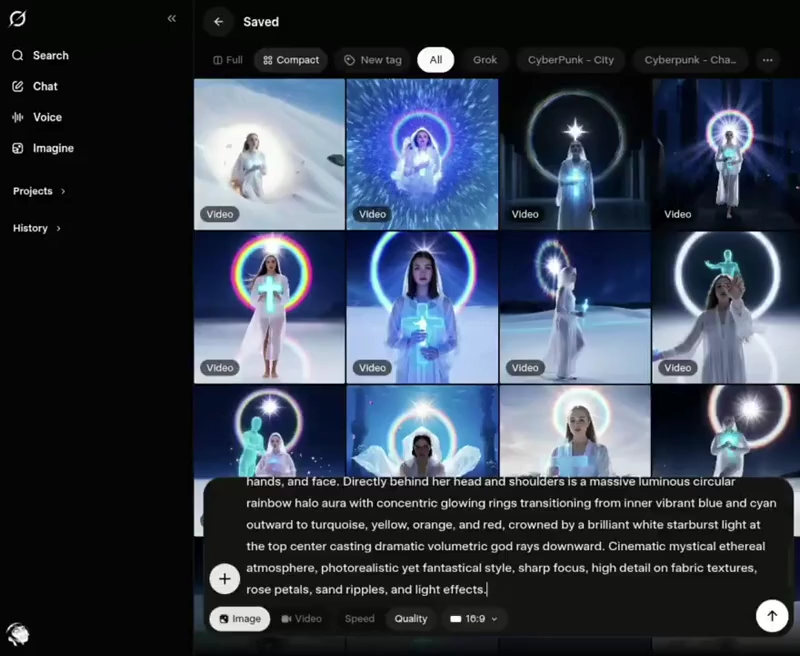
The system allows users to start from text descriptions or extend existing images into motion.
A Professional mode, expected later in April 2026, is anticipated to introduce 1080p support and additional controls aimed at more demanding creative or production workflows.
As with other generative AI tools, results vary based on prompt engineering, and the underlying models continue to evolve through iterative updates.
Users can experiment directly with the available modes to determine which best suits their specific needs, whether for rapid exploration or higher-detail final outputs. The ongoing competition in the field drives these incremental gains in technical capabilities, even as practical limitations around consistency and content guidelines persist.




















































































































































































































































































