
Vibe coding is the idea that instead of manually writing every line of code, a person describes what they want built.
Using AI tools, people can generate code they can use for apps they create. Rather than acting like a traditional autocomplete tool that finishes syntax or suggests the next function name, AI tools have now become more like a collaborative builders that can translate intent, rough ideas, and high-level goals into working software.
Picking up the momentum created by large language models, Apple is delivering a huge update to how developers can create apps for its ecosystem
Through the release of Xcode 26.3, initially as a release candidate for Apple Developer Program members, the update significantly expands the IDE's AI capabilities by introducing deeper support for agentic coding.
With the release, developers can now integrate external AI agents, particularly Anthropic's Claude Agent and OpenAI's Codex, directly into Xcode through a straightforward setup in the Intelligence section of the settings.
These agents operate using the Model Context Protocol, an open standard that allows standardized interaction between large language models and tools like Xcode, giving Apple the flexibility to support additional compatible agents in the future.
Apple's Xcode now has direct integration with the Claude Agent SDK, giving developers the full functionality of Claude Code for building on Apple platforms, from iPhone to Mac to Apple Vision Pro.
Read more: https://t.co/fyZ10bhkN3— Anthropic (@AnthropicAI) February 3, 2026
The core idea behind this feature is agentic coding, where users can describe what they want in natural language, and have AI agents take over much of the implementation.
Instead of just offering code completions or suggestions, the agent can break down tasks, make decisions based on your project's structure, modify files, update settings, run builds, fix errors, and even capture screenshots from the simulator or previews to visually verify progress.
For instance, starting from an empty project, a user might prompt the agent to build a simple Pomodoro timer app for iPhone, specifying features like adjustable work and break timers, session tracking, and alerts. In one hands-on test, the agent generated a functional app in under two minutes, complete with a basic interface, settings, and working alerts that ran smoothly in the simulator and on a physical device.
From there, further prompts could add instructions for TestFlight deployment or suggest enhancements like onboarding screens.
In Apple's words, the update allows Claude and OpenAI's Codex to "search documentation, explore file structures, update project settings, and verify their work visually by capturing Xcode Previews and iterating through builds and fixes."
This approach makes prototyping remarkably quick, especially for straightforward apps or features.
Beginners who lack deep Swift or Xcode experience can produce something runnable without writing much code manually, while more experienced developers can use it to spin up boilerplate structures rapidly and iterate from there.
The integration feels seamless compared to copying code from external chat interfaces, as the agent works directly in your project environment, with easy options to review, confirm, or revert changes.
Read: Anthropic 'Claude 3.7 Sonnet' And 'Claude Code' Mark The Next Step Of Human-LLM Collaboration
Codex is now available in Xcode 26.3
Work through complex tasks with more autonomy by breaking down tasks, searching Apple docs, exploring file structures, updating settings, and capturing Previews as you iterate
Available in the Xcode 26.3 release candidate pic.twitter.com/uwwVkHx5Pq— OpenAI Developers (@OpenAIDevs) February 3, 2026
However, the system is not without limitations.
Agents do not always get things right on the first attempt; they can fall into logic loops, repeat errors, or require additional prompting and manual tweaks to resolve issues. Enabling features like Bash command-line access carries risks, such as potential unintended changes or data loss, so it's advised to disable such permissions unless users are comfortable with the implications.
The convenience can sometimes feel almost too easy, raising concerns about quality control.
A lower barrier to entry might result in more basic or similar apps flooding the App Store, increasing the volume of low-effort submissions and complicating review processes for Apple. While powerful for rapid development, it shifts some responsibility to the user to guide and verify the output carefully, rather than relying on fully autonomous perfection.
Read: OpenAI Reintroduces 'Codex' As A 'Command Center For building With Agents'
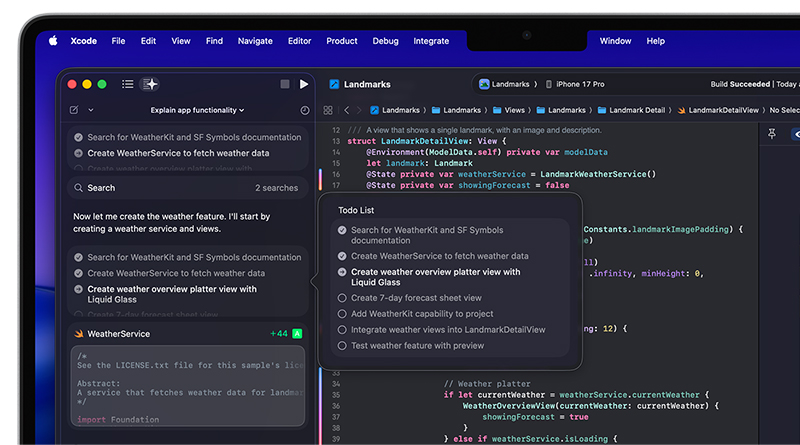
At its core, vibe coding changes the interface of software creation. Instead of speaking the rigid language of syntax first, the user starts with human language, like describing behavior, constraints, and desired results. The AI then handles much of the translation into frameworks, libraries, and logic. This makes development feel more like briefing a teammate than operating a machine, lowering the barrier for non-experts while also accelerating experienced engineers.
However, vibe coding doesn’t eliminate the need for understanding.
It reshapes it. The critical skill becomes knowing how to communicate intent clearly, evaluate generated code, and guide iteration. In this model, creativity, problem framing, and judgment matter more, while rote implementation work increasingly becomes automated.
Overall, Xcode 26.3 represents a meaningful step toward making AI a more active partner in iOS, macOS, and other Apple platform development.
It builds on earlier tools like predictive code completion by moving into more autonomous workflows, though it relies on third-party models rather than purely on-device Apple Intelligence for these agent features. For many developers, it could streamline workflows substantially, but it works best when combined with human oversight to ensure the final product meets specific standards.






















































































































































































































































































