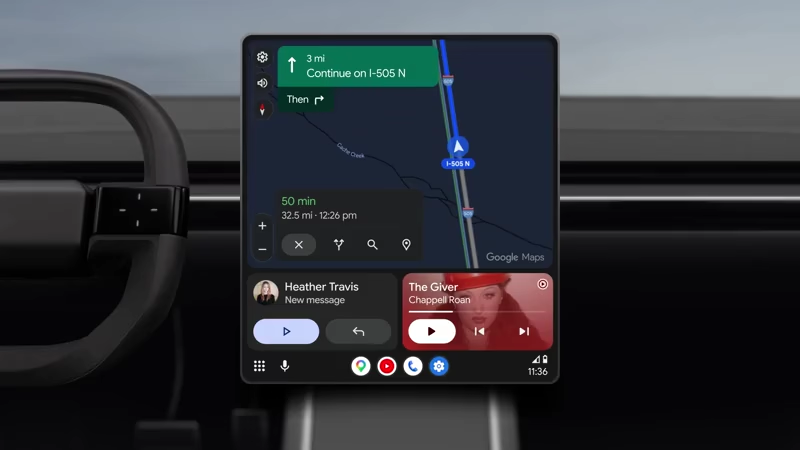
For as long as modern infotainment systems have occupied cars' dashboard, drivers have dealt with a frustrating paradox.
Vehicles are packed with massive computational power, yet the digital assistants built into them often feel oddly isolated, functioning more like a rigid remote control than an intuitive companion.
Asking a car to adjust the climate control or find a nearby gas station works well enough, but the moment a request requires understanding a broader human context, like knowing where the car was driven last week, or which restaurant was saved for the next weekend trip, or how a flight delay impacts an evening pickup schedule, or others similar.
These kind of things typically make the system hit a wall.
They don't understand these kind of queries because they have their access is strictly limited.
To bridge that gap, the system requires a significant pivot. And when AI is involved, it needs to be able to handle personal data across devices.
Google has a solution.
Instead of forcing users to manually input addresses, copy confirmation codes, or switch between multiple navigation apps while driving, recent integration efforts from Google announced that it is putting its personal intelligence framework directly into Android Auto and connected vehicle displays.
By extending the assistant's ability to reference emails, documents, calendars, and mapping history into the automotive environment, the technology shifts from reactive command-and-response to proactive contextual awareness.
The practical mechanics of this integration rely on connecting previously siloed data streams.
When a driver asks for a tailored recommendation after a series of meetings, the underlying system can cross-reference the location of the final calendar appointment with a personal list of saved restaurants on Google Maps, bypassing the need for manual browsing on a touchscreen while operating a vehicle.
Similarly, travel itineraries and flight confirmations buried in an email inbox can be surfaced naturally through voice prompts on the dashboard, making in-car assistance feel less like a novelty and more like a seamless extension of the phone sitting in a pocket.
This crossover points to a broader convergence in consumer technology, where the boundary between personal devices and automotive hardware continues to dissolve.
As vehicles adopt the same contextual memory and intelligence layers found on desktop and mobile platforms, the car cabin is gradually transforming from a standalone transit zone into a fully integrated node of an individual's digital life.
While questions around data privacy and distraction management will inevitably follow these features onto the road, the underlying shift toward a more unified digital assistant environment is already well underway.






















































































































































































































































































