The large language models (LLMs) war has reshaped the tech landscape faster than any platform shift in the last decade.
What started in late 2022 with ChatGPT’s explosive rise sparked an industry-wide scramble: tech giants, startups, and creative software makers all racing to claim territory inside a world increasingly defined by conversational interfaces.
ChatGPT didn’t just introduce a new way to interact with computers; it created an entirely new marketplace. One where instead of clicking through menus, users simply interact with an app directly, where AI agents become the operators of users' tasks. One where software companies don’t just release apps and instead, they plug themselves into the LLMs millions of people already use daily.
In this landscape, Adobe’s latest move is both inevitable.
While Google, Meta, Anthropic, and OpenAI compete to build the smartest large language models, Adobe is playing a different but equally strategic game: embedding industry-defining creative tools directly inside the AI platforms that are winning user attention.
And now, Adobe has made its most aggressive, consumer-friendly play yet.
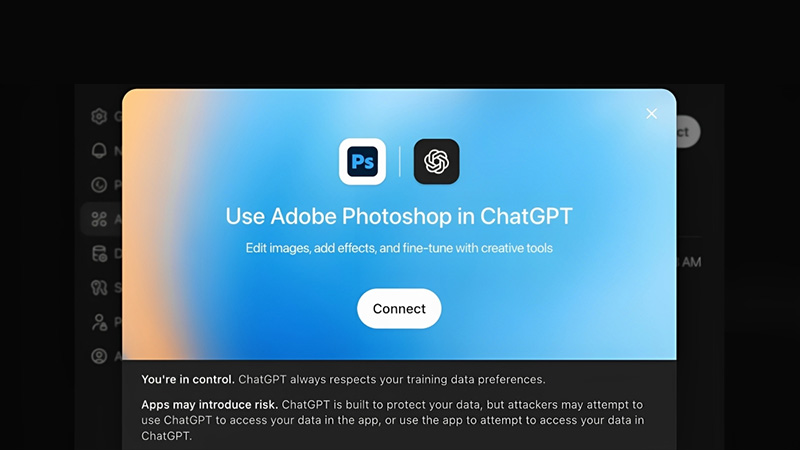
And that is by bringing Photoshop, Adobe Express, and Acrobat into ChatGPT, and offer the feature for free.
Edit designs, images, and documents. Adobe Express, Photoshop, and Acrobat are now in ChatGPT. https://t.co/N7rjkhqkJt pic.twitter.com/S9Hm2GRqQi
— Adobe (@Adobe) December 10, 2025
Adobe has announced that Photoshop, Adobe Express, and Adobe Acrobat are now built directly into ChatGPT, instantly accessible to over 800 million weekly users.
This gives everyday people the ability to edit photos, design graphics, and manage PDFs through simple conversation, all with Adobe’s engine powering it behind the scenes.
It’s the creative company’s clearest acknowledgement that the future of software is agentic, conversational, and embedded, not always standalone.
While OpenAI is trying to turn ChatGPT into the "new operating system of the web," Adobe is ensuring its tools stay relevant inside this emerging ecosystem, rather than outside it. And the timing couldn’t be better.
Adobe has spent decades building unmatched creative software, but it has also spent decades fighting a reputation for being powerful yet intimidating. For millions of people, Photoshop feels like expertise-only territory.
ChatGPT, on the other hand, is approachable. Friendly. Immediate. People ask it questions the moment they have a thought.
Adobe realized that if ChatGPT is becoming the first stop for creativity, productivity, and ideation… then Adobe tools need to live where the ideas start.

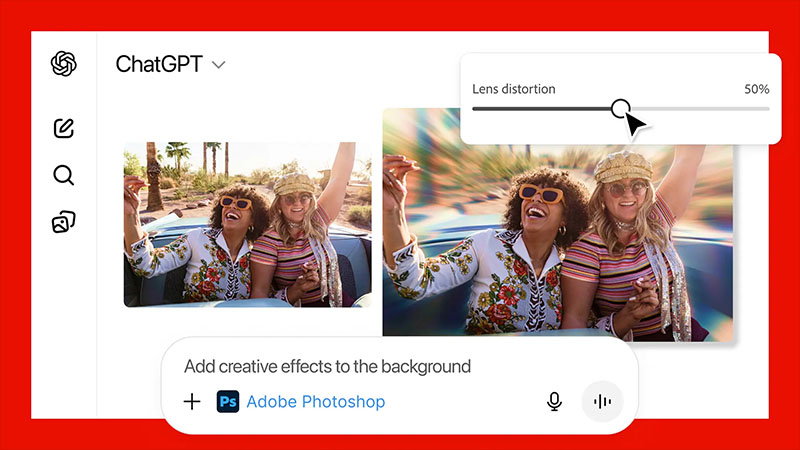
Integrating directly into ChatGPT lets Adobe bring Photoshop-level power to people who would never open Photoshop. Users can, for example, say: "Adobe Photoshop, make the background warmer and brighten my face."
Since its LLM, users can make follow up requests, and let ChatGPT command the integrated Photoshop to do its thing.
Another example, is the ability to create invitation with Adobe Express. They can tell ChatGPT things like "Adobe Express, help me create an invitation for my dance party," choose a template, update the copy to match their event, replace background, and more.
Users can also ask ChatGPT to update their resume, like by asking Adobe Acrobat in ChatGPT to help them create a curated job application package. Here, users can simply upload their resume, cover letter, and references to ChatGPT, and ask ChatGPT things like "Adobe Acrobat, combine my documents into a single file." They can then edit the cover letter, adapting it to each company they're applying to, and more.

By partnering with what ChatGPT, Adobe doesn't need to reinvent the wheel or do anything phenomenal. With the integration of ChatGPT, Adobe is literally riding the wave the OpenAI tool had created.
In a blink of an eye, 800 million weekly users becomes an audience Adobe could never reach inside its apps alone.
This is Adobe surfing the AI platform shift, not fighting it.
By bringing Photoshop, Adobe Express, and Acrobat into ChatGPT for free, Adobe is doing more than making its tools more accessible. It's redefining how creativity happens, who gets to participate, and how much skill is required to bring an idea to life.
In the age of LLMs, the winners won't be the companies with the biggest apps.
They'll be the companies whose capabilities show up exactly where users are already thinking, creating, and asking for help.
And today, that place is ChatGPT.






















































































































































































































































































