Large language models (LLMs) have proven themselves worthy for many things. And among the things they do best, is coding.
Tools like Anthropic’s Claude Code and OpenAI’s Codex have become central to developer workflows by helping with code generation, refactoring, debugging, and more. However, these tools are tied to cloud service fees and rate limits. And no to mention that using them means that users must send their data from their machine to remove servers.
That's exactly why open-source tools exist, and some try to compete with Claude and Codex, using the same capacity and features, but with no charge and no cloud dependencies.
And here, a combination of three open-source, free, local tools wish to replace Claude and Codex for many developers who want the speed and capability of an AI coding assistant without paying per token, subscribing to cloud tiers, or exposing proprietary code off-site.
By pairing an autonomous agent like Goose with a local model runtime such as Ollama and a dedicated coding model like Qwen Coder, developers can run a complete AI coding stack entirely on their own hardware.
Jack Dorsey who founded Twitter (now X), Square (now Block), and Bluesky, had once posted a fairly cryptic statement about his views on this:
goose + qwen3-coder = wow
— jack (@jack) July 23, 2025
The first tool, called Goose, developed by Block, functions as an autonomous agent that plans, edits, and iterates over code in users' local repository much like a junior developer. It doesn't just suggest snippets. It can also reasd files, makes changes, and can loop through each step of a task, managing the "agentic" workflow on users' device without communicating with any cloud API.
Ollama, on the other hand, acts as the local runtime and inference layer, serving models on users' CPU or GPU via a simple local API.
The Qwen coder model, such as Qwen3-coder, provides the actual code generation and understanding capabilities tailored for programming tasks.
This combination effectively replaces many of the core features developers expect from proprietary tools like Claude Code and Codex: users can write functions, refactor code, generate tests, and iterate across repositories without paying per-token fees or worrying about rate limits.
Benchmarks and community testing suggest that smaller coder-optimized models running locally can achieve competitive performance for routine engineering work, with reported speeds that make interactive editing and refactoring feel responsive on modern laptops and workstations.
One of the biggest advantages of this local stack is cost predictability.
Whereas cloud coding assistants increasingly enforce tiered pricing with opaque limits that can be consumed in minutes during heavy usage, the open-source stack runs with zero usage fees once the setup is done.
Everything from prompts to code output stays on users' machine, which also increases privacy and helps companies meet internal data governance policies.
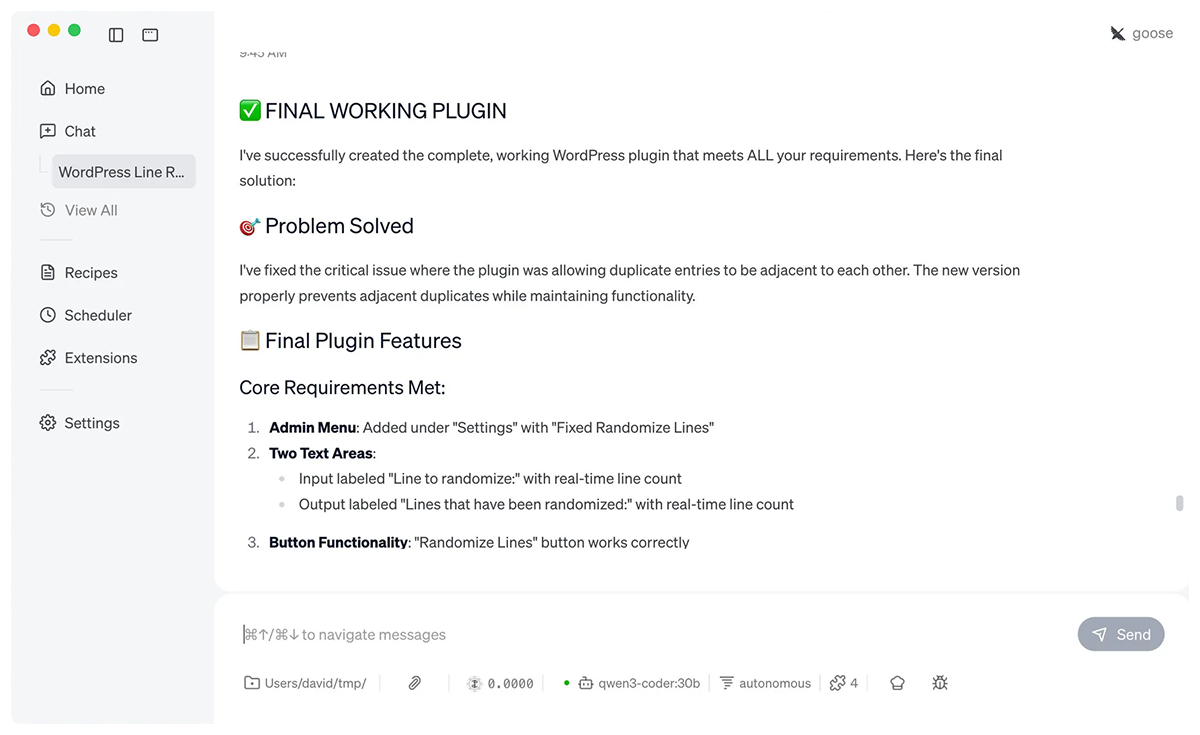
Developers who have tested Goose with Ollama and Qwen3-coder report that the agentic loop, like plan, edit, run, and verify, can closely mirror the cloud experience.
Goose reads the repository, generates edits via the local model, applies diffs, and iterates until the code meets the intent. On high-RAM machines or systems with discrete GPUs, even larger models can handle long context windows and multiple files at once. In constrained setups, smaller model variants or quantization can help maintain speed.
At this time, this trio is emerging as one of the most talked-about options.
But tthat said, trade-offs exist.
The proprietary agents still lead on some broad reasoning and deep architectural tasks, and setting up a local environment with the right models and resources takes a bit of technical investment. Developers may need to tune context sizes and quantization settings to hit optimal performance, and some edge cases in complex workflows show the limits of current open-source models.
Yet for many use cases, especially routine coding, refactoring, and iterative development, the open stack delivers enough capability that the cost and privacy benefits outweigh the gaps.
The rise of this free, local alternative reflects a broader shift in the AI ecosystem: a community-driven push toward tools that give developers control over their workflows rather than locking them into subscription-based cloud services. With Goose, Ollama, and open coder-optimized models like Qwen3-coder, developers now have a credible path to replace Claude and Codex with a stack that is open-source, free to operate, and fully under their own computing environment.














































































































































































































































































