 The internet is known to be a place where people are connected. However, since it can't be totally governed and controlled, censorship became a popular method to limit access to certain places on the web. Censorship-free internet is a priority for most people, and that include for emerging countries, according to a new report released in 19 March 2014.
Pew Research Center conducted face-to-face interview with nearly 21,847 people in 24 emerging and developing countries between 3 March and 1 May 2013, asking them "How important is it to you that people have access to the internet without government censorship?"
In 22 of those 24 countries, the majority of respondents think "it is important that people have access to the internet without government censorship."
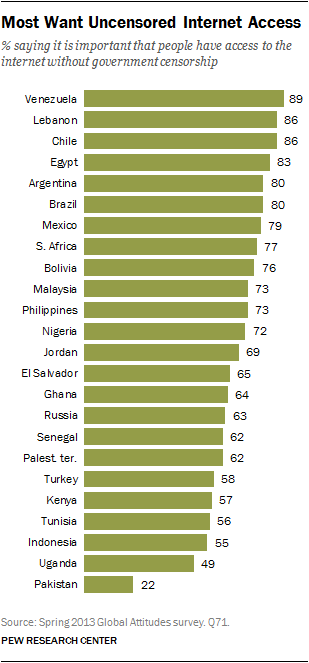 The 22 countries where a majority of people surveyed agreed that uncensored internet access is important range from Indonesia (55 percent) up to Venezuela (89 percent). Only Uganda (49 percent) and Pakistan (22 percent) fell below the 50 percent mark, meaning that a majority don't see internet censorship as an important issue.
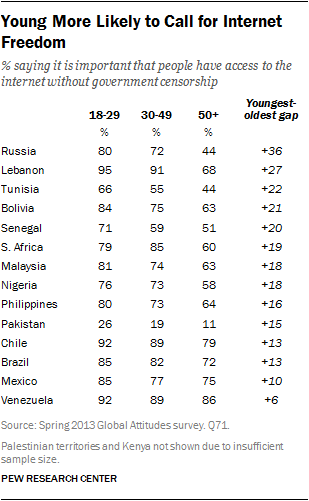
Age is also a major factor: In 14 of the 24 countries surveyed, people ages 18-29 are more likely than those 50 or older to think a free internet is important. In nations including Russia and Lebanon, that age gap came in at 20 percentage points or more.
And beside people with young age that prefer their internet not restricted, wealthier and well-educated people also tended to favor unrestricted access more strongly than those with lesser economy and less formal schooling.
"These age differences suggest that support for internet freedom will only become more widespread with the passage of time," Pew said in its report.
"Opposition to government restrictions on the internet is especially common in several of the Latin American nations surveyed, including Venezuela, Chile, Argentina, Brazil, Mexico and Bolivia," claims the report. "It is also widespread in the Middle Eastern nations of Lebanon and Egypt."
According to Pew, support for a censorship-free internet tended to be higher in countries with more general access to the internet - limited access in countries like Uganda and Pakistan is reflected in their lower support numbers, which were 49 percent and 22 percent respectively.
"Age gaps of 20 percentage points or more are found in Russia, Lebanon, Tunisia, Bolivia and Senegal. These age differences suggest that support for internet freedom will only become more widespread with the passage of time."
The margin of error for this report ranged from 3.5 percentage points in Venezuela to 7.7 points in Turkey, with most of the national surveys between four and five percentage points.
 The report comes days after the U.S. government announced it was loosening its grip and giving up its key role in charge of the internet’s technical operations, handing over those functions to "the global multistakeholder community."
While U.S. officials said they would work to maintain a free and open internet, critics of the decision said the move opens the door to other countries to impose new controls on online activity.
Some countries, of course were exceptions. Pew said that Venezuela and Egypt both showed more hostility to censorship than their usage numbers might have suggested, while internet-savvy Russia's mark of 63 percent was surprisingly low.
The study notes that "other Pew Research surveys have also found relatively low support for democratic rights and institutions in Russia and Pakistan."
It seems reasonable to expect these numbers to grow as younger internet users mature and internet penetration reaches more of the world's population.
Currently, 80 percent the world's population lives on less than $10 a day and in countries with widening income differentials. If that trend continues, it’s likely to give more trouble for a free, unrestricted internet.






















































































































































































































































































