
 When 'smart' mobile devices are used by more and more people, their popularity precedes most people's expectations. And when it does, more developers are trying to create more useful apps by the end of each day. Mobile device usage in developed countries is already a common thing, and things are about to change.
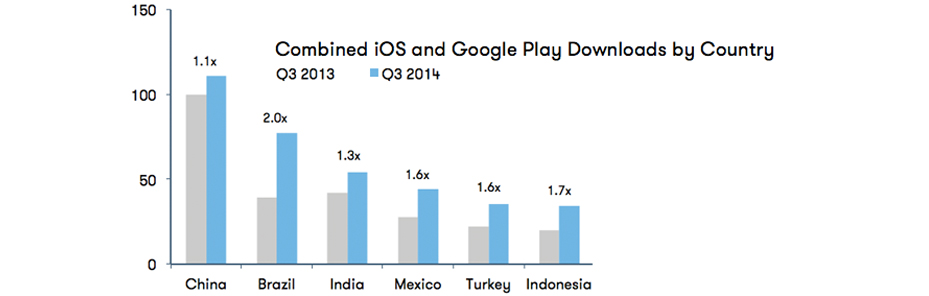
A report from App Annie, a mobile app analytics firm, and MEF, a mobile content and commerce association, has identified that some of the largest developing nations are becoming the next growth for app publishers. In countries like Brazil, Indonesia, Mexico, Turkey and India, the rates of app downloads are growing substantially between Q3 2013 and Q3 2014.
Brazil topped the list for app download growth, with 100 percent growth; followed by Indonesia with 70 percent growth; Mexico and Turkey each with 60 percent increase; and India with 30 percent. China that is identified as the largest nation in terms of populations and growth markets, grew by only 10 percent during this period.
The increasing rates of app downloads in these emerging markets where low-end Android-powered mobile devices have gained popularity, has contributed to a strong global app download growth to Google Play. The report said that Google's Play store has a 60 percent higher app downloads if compared to Apple's App Store.
Read: The Growing App Universe
Despite losing to Android in emerging markets, Apple's App Store in this period is still dominating when it comes to app revenue, growing about 60 percent higher than in 2013.
The type of apps that is popular among emerging markets is free apps. Those that among them are Google's apps, Facebook, WhatsApp, and others.
Despite the lack of established infrastructure, people in developing nations are more 'picky'. The last this they want is to have a network that they can't use. But these countries have overcome this issue by widening their network range, thus increase the chances of mobile device adoptions and internet connections to places that were unreachable.
Developers Targeting More Nations
The face of the global mobile device market is changing rapidly. The number of users was about a billion in 2012, this year, the number almost doubled. And this has some consequences.
The adoption of mobile devices in developed countries is already wide. But in less developed worlds where most of the world's population settles, the adoption is not yet widespread if compared to its counterpart. To reach more of those people, developers that wish to profit from this gigantic customer base, need to understand how people select apps, how they intend to pay, and how they prefer to use them.
The main differences between developed nations and emerging markets are affordability and usage patterns. Despite early adopters in developed nations does not translate to the experience of less wealthy, people are very enthusiastic.
In much of the emerging worlds and for the vast majority of its mobile device owners, credit-card penetration is very low. In these places, people are used to the prepaid scenario where they buy "credits" to top off their account in advance for calls and data plans. And most people in these nations tend to use modest Android devices that predominate Apple's products by a wide margin. Moreover, people usually download a lot of free apps and are rarely pay for premium ones, nor make in-app purchases.
Early in 2014, App Annie Index statistics revealed that the U.S. was the only country to outperform Brazil, Russia, South Korea and India in the number of apps downloaded on Google Play. In terms of app revenue on Google Play for the same period, the top five countries are Japan, U.S., South Korea, Germany and the United Kingdom. Brazil, Russia and India didn't make the list.
Apps developers have penetrated this emerging nations because they have different strategy to reach this huge market. Some of the ways developers have done are:
- Shrinking app size. Since connectivity is relatively more expensive in developing nations, most people still rely on Wi-Fi or low speed data connections. Users are more benefited by smaller size downloads.
- Using free app stores. Some carriers preload onto phones app stores that provide downloads with no data-usage fees. By being able to distribute apps without users having an active data plan improves the chance of the app being downloaded.
- Localize. Localized apps are much more preferred. Translated contents, as well as themes and music, and other look and feel interface.
- Subscription bundling. Subscription-based apps increase the number of trials. This overcomes the initial cost barrier. Developers also have given low subscription fees that are based or daily or weekly cycles.
- Partnering with local carriers. Since many users have no access to electronic payment, carriers are increasingly finding it valuable to partner with specialized local app stores that want to leverage their distribution and prepaid billing capabilities.
- Changing distribution models. Because carriers are more open to specialized local app stores, the number of these stores are growing fast. Despite Google Play and Apple's App Store dominate app distribution, there are still many people that rely on local app store.
Beside the almost equal two-person battle, Apple's products are not that much popular in developing nations. Apple that is known to release high-end devices that have lesser types to choose and more expensive, is still yet to see a chance to compete against Google's Android powered devices in these countries.