

The competition in the large language model (LLM) space has intensified sharply over the past few years.
OpenAI, Anthropic, and a growing number of startups have rolled out conversational tools that many people now use as their primary way to find information, answer questions, or complete tasks. Google Search nevertheless remains the undisputed leader in online queries, processing billions of searches daily and retaining its position as the default starting point for most internet users worldwide.
Even so, a noticeable shift is underway.
Users who once typed short keywords into the classic search box are increasingly experimenting with full-sentence prompts and autonomous agents elsewhere, treating traditional search as something to be supplemented or even replaced when a more proactive AI feels more natural.
Google has responded directly to this evolution.
At its I/O 2026 event, the company announced the most substantial redesign of its search interface in more than 25 years.
The familiar rectangular box that has defined the Google homepage since 2001 is now being replaced by an intelligent, dynamically expanding input field.
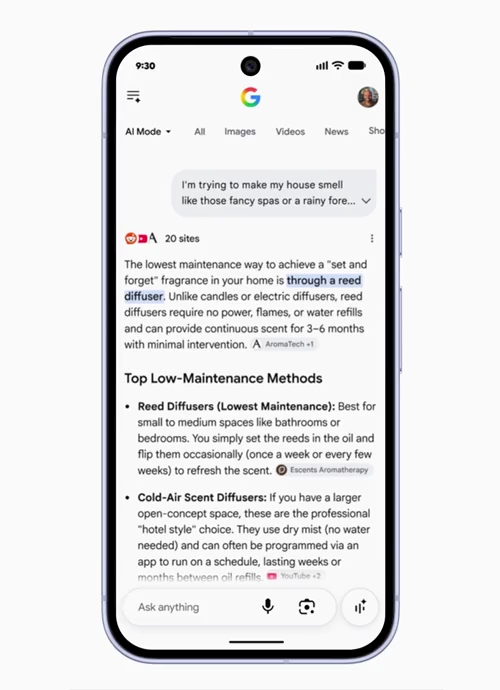
In the announcement, under the AI Search section, Google said that:
"Today we're launching the biggest upgrade to our Search box in over 25 years — a new, intelligent Search box, now completely reimagined with AI. You can search using text, images, files, videos and Chrome tabs and Search reasons across them all. You’ll continue to get a range of results from Search, just like you do today."
"We're also making it even easier to continue the conversation with Search, bringing AI Overviews and AI Mode into one, seamless AI Search experience. You can flow effortlessly from your question, to a search results page with an AI Overview, to a follow-up in AI Mode, all with links to learn more."
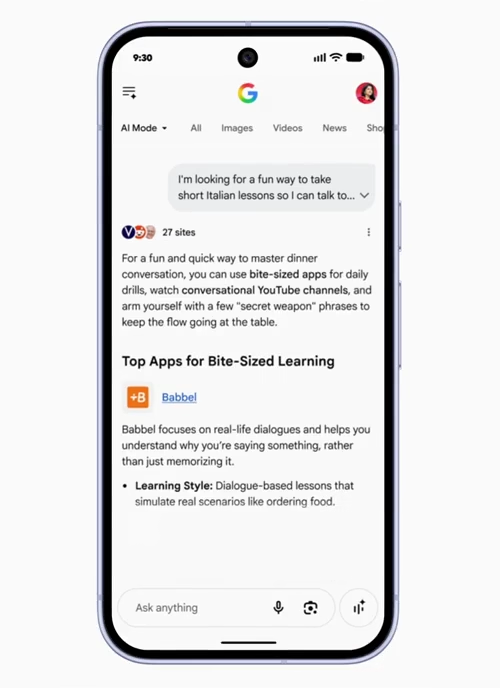
In other words, Google Search's search bar can now comfortably handles longer, conversational queries and accepts a wide range of inputs including images, videos, files, and even open Chrome tabs.
Powered by the new Gemini 3.5 Flash model as the default for AI Mode, the updated search experience merges previous features such as AI Overviews and AI Mode into a single seamless flow. Traditional blue-link results remain visible, but the emphasis moves toward richer, more interactive responses that better match how people already talk to modern AI systems.
Beyond the visual and input changes, the update introduces persistent information agents that users can create simply by asking.
These agents operate in the background, continuously monitoring topics and delivering updates without repeated manual searches. Someone researching apartment rentals, for example, can set an agent to track new listings and notify them in real time. Similar capabilities extend to tracking product releases, sports news, stock movements, or any other ongoing interest.
The system can also generate custom visuals, interactive dashboards, trackers, or small applications on the fly, pulling in real-time data such as location or weather to create tailored mini-experiences directly within search.
Complementing these search-side agents is Gemini Spark, a new mode within the Gemini app designed for truly autonomous background work.
Gemini Spark is your new 24/7 personal AI agent.
Give it a task and it works autonomously in the background, even if your phone and laptop are turned off. You choose to turn it on and it's designed to check with you before taking major actions. #GoogleIO— Google Gemini (@GeminiApp) May 19, 2026
Spark can scan emails, documents, credit card statements, or other connected sources to surface important updates, compile summaries, or maintain to-do lists even when devices are offline or locked. It runs on cloud infrastructure, continuing its tasks independently and prompting users only when confirmation is needed for actions like spending money or sending messages.
This capability reflects a broader push toward agentic AI that does not require constant user prompting, addressing one of the limitations that has kept many people toggling between traditional search and dedicated AI assistants.
On the commercial front, Google is simultaneously updating its advertising ecosystem to fit the new conversational environment.
New formats built with Gemini include conversational discovery ads and highlighted answers that provide personalized guidance and transparent recommendations during a user's research process. AI-powered shopping experiences aim to turn longer, context-rich queries into smoother paths toward purchase, with expanded direct-offer options and native checkout in select categories.
These changes allow brands to participate more naturally in the dialogue rather than appearing as isolated sponsored links, aligning advertising with the same agentic and multimodal shift happening in search itself.
Gemini 3.5 Flash is starting to roll out to everyone globally, free of charge.
Try it by selecting “3.5 Flash” from the model dropdown menu at https://t.co/382WL5xSvc or in the app.— Google Gemini (@GeminiApp) May 20, 2026
Taken together, the announcements show Google attempting to bridge two worlds. It is reinforcing the enormous reach and reliability of its core search product while infusing it with the proactive, conversational, and autonomous qualities that have drawn users toward newer AI tools.
By expanding the search bar, enabling background agents, and evolving ad formats accordingly, the company hopes to keep people inside its ecosystem longer instead of sending them to separate chatbots or specialized apps.
Whether this strategy fully counters the appeal of competitors or simply slows the migration remains uncertain, Google is kind of . What is clear is that Google is treating the redesign as a foundational step rather than an incremental tweak, acknowledging that the way people search is changing and that its flagship product must change with them.