Google has been improving its Search, and here it's rolling out 'multifaceted featured snippets' which surface answers from queries that are broad enough to allow more than one interpretation of what was submitted.
Featured snippets are those boxed results that Google puts at the top of the page, based on algorithmic determination of the best answer to a query. Previously, Google can only return one featured snippet (which hopefully addressed the question).
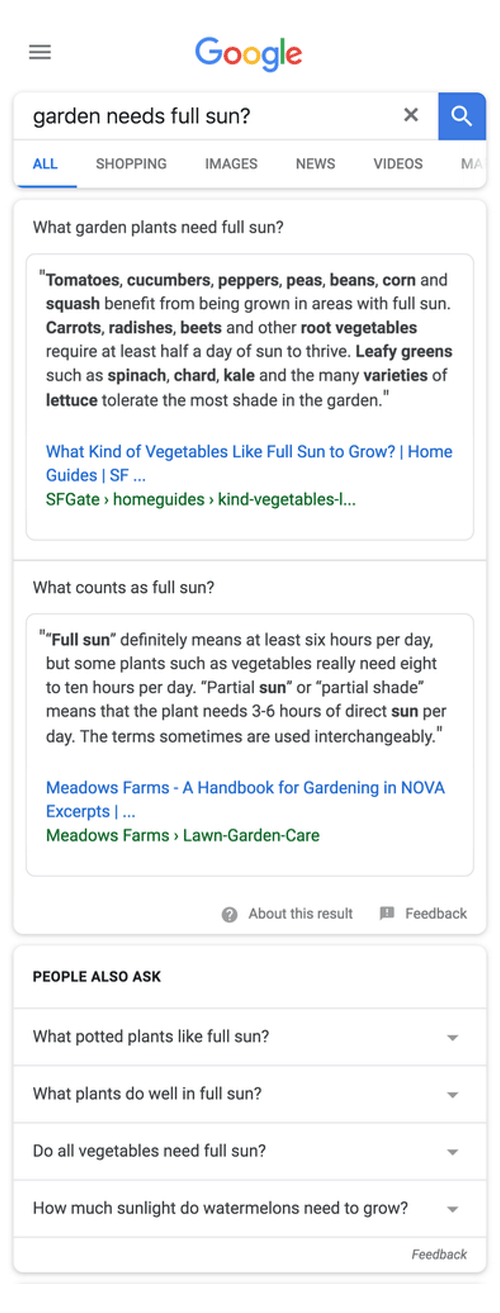
With the update, Google's SERP can show more than one featured snippet for "queries that have several potential intentions or purposes associated," Google said.
In a blog post, Google explained that Search can show multifaceted answers because the question inside the query can mean different things. Like "garden needs full sun?" could mean "what garden plants need full sun?" or "what counts as full sun?"
The company first announced that it was working on delivering multiple snippets in early 2018.
The feature has had its own controversies in the past, since Google is known to show inaccurate and offensive snippets from time to time as a result of the PageRank algorithm, which was created to show the most popular results for any search regardless of accuracy or truthfulness.
After perfecting its feature snippets, Google has plans to include what it calls 'guidance-seeking' queries in the future. This is to show questions that have many facets, all bundled into one.
While the updated snippets technology first coming to mobile searches, the long-term push is into voice.
For example, when a user asks Google Home smart speaker a question, the Assistant can pull an answer directly from snippets or is Knowledge Graph (the database of facts that Google has built from trusted sources, like Wikipedia).
Google Home competes with the likes of Amazon's Echo and Apple's HomePod. And here, Google needs to be more precise because Google's answer to a person voice search query won't show any blue links to click on. Google is just trying to give the best answer quickly, even if it's not exactly sure what users are asking.
"Obviously voice is a very important surface for us," said Emily Moxley, the director of product management for featured snippets, in an interview. "It's the reason why we're doubling down on making sure that we're providing high-quality, authoritative answers from Knowledge Graph as well as featured snippets."
To make this happen, Google is investing heavily in natural language processing and machine learning into action.
"This was something that we spotted as an opportunity early on as we were developing featured snippets, but we only now have the technology to actually be able to do address those sorts of questions," continued Moxley. "The actual ability to take a specific query, understand that there are specific sub-topics that a user might be interested in, and then find high-enough quality passages that help the user understand those topics is new."




















































































































































































































































































