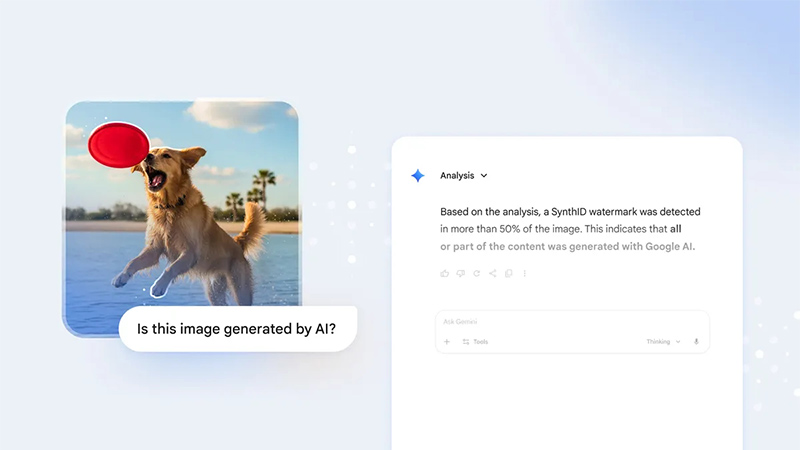
The AI war has become a full-scale arms race, with every major lab pushing out newer, sharper, more realistic models at breakneck speed.
Now, Google’s latest salvo, Gemini 3 and its image model Nano Banana Pro, lands right as the internet drowns in deepfakes so convincing that even experts have trouble separating truth from synthetic fiction.
But in a twist of irony, the same company accelerating the realism of AI imagery is also trying to build the tools that help us detect it. Google is literally giving the internet both the problem and, at least in part, the solution.
The difficulty of telling what’s real online is no longer an abstract, future-tense concern.
Ask any AI model today whether an image is genuine and people will get a wild range of answers, often contradictory from one attempt to the next. One day ChatGPT will insist a picture is real; another day it’ll just as confidently claim it’s fake. Claude, Gemini Flash, or any of the other fast-response models often miss obvious clues, especially when the generation is high quality.
Even human eyes aren’t much better, as studies routinely show that people identify synthetic images correctly only slightly more than half the time.
That's essentially a coin flip.
Google’s newest effort to fix this starts with a quiet but powerful feature in the Gemini app.
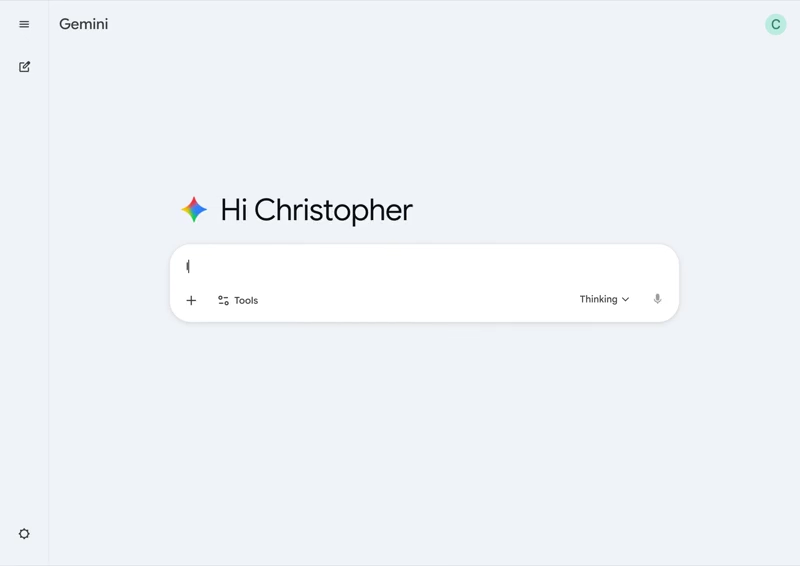
All users have to do, is upload an image, ask whether it’s AI-generated, and Gemini deterine whether it's real or a fake.
Behind this ability, is SynthID, which is Google’s invisible watermark woven directly into the pixels of any image created by its models. SynthID shows no visible mark and no metadata. It can survive compression, resizing, and even heavy edits. In that narrow domain, detecting Google-made images,Gemini is surprisingly reliable.
It can even flag cases where only parts of an image have been manipulated, which matters now that AI editing tools can surgically alter segments of a photo while leaving the rest untouched.
But beyond that limited scope, things get messy.
Just like previously said, Gemini's ability to detect AI-made images, is because Google is giving it the ability to detect SynthID patterns.
What this means, when an image comes from any other generator, like Midjourney, DALL-E, Stable Diffusion, or any other, it comes without SynthID. What this means, Gemini cannot fully comprehend the image.
As a result, Gemini, like every other chatbot, reverts to guesswork.
If an image has no SynthID in it, and that it's told to determine whether it's fake or not, the feature, which is powered by the same Gemini 3, will scan for the usual "tells": warped text, mismatched lighting, impossible reflections.
Sometimes it catches them. Sometimes it doesn’t.
Because of this particular issue, Google has another trick under its sleeves. Alongside SynthID, the company is beginning to embed C2PA metadata, which is a cryptographically signed provenance standard supported by Adobe, Microsoft, OpenAI, Meta, the BBC, and others.
Unlike watermarks tied to a specific company, C2PA aims to be universal: a chain of custody for digital media that persists across platforms and tools. With that, an image could travel from Google to Adobe to X to TikTok without losing its provenance.
And in the future, chatbots, search engines, and social platforms could read that metadata automatically and label AI-generated content without relying on pattern-spotting or speculation.
The shift to a dual system, which comes from pixel-level watermarking plus industry-wide metadata, signals a recognition that no single method is enough. Visual watermarks can be cropped out. Metadata can be stripped. Invisible watermarks can be weakened by adversarial attacks. But together, they form a layered defense that’s stronger than any single approach.
Google is now applying both SynthID and C2PA to every image created through Gemini, Nano Banana Pro, Google Ads, Vertex AI, and more.
As Nano Banana Pro continues gaining traction, a lot of new AI-made images should be created, adding on top of the existing tens of billions of images already carrying SynthID. In other words, that number will multiply rapidly.
Google’s approach doesn’t fix everything. It can only confirm Google-made content for now, and watermarking won’t magically stop bad actors from using tools designed to avoid detection. But embedding transparent provenance into billions of AI images, and giving ordinary users a quick way to check it, is a necessary step toward rebuilding credibility in what we see online.
The real test will be whether other companies adopt similar transparency and whether platforms enforce it automatically instead of leaving responsibility solely to users.
For now, the best advice is simple: if you can check, check. The deepfakes aren’t slowing down, and the margins for error are shrinking. AI helped create this problem, and ironically, AI might be the only thing that can scale fast enough to help us navigate it.
Read: SynthID Watermark Google Gemini Uses Allegedly Extracted: Consequences Will Follow




















































































































































































































































































