Large language models have expanded from text-based chat into more dynamic forms of interaction.
From voice capabilities that have emerged as one of the more demanding frontiers, speed, accuracy, and the ability to handle unpredictable human speech also determine whether a system proves useful beyond controlled demonstrations. And xAI has played its card here by introducing 'Grok Voice Think Fast 1.0.'
The model is literally a full-duplex voice model that prioritizes real-time reasoning and tool integration during live conversations rather than focusing solely on polished audio quality or isolated benchmarks.
The model is positioned for practical enterprise scenarios such as customer support calls, sales conversations, appointment scheduling, and similar workflows where exchanges frequently involve background noise, heavy accents, interruptions, or users correcting themselves mid-sentence.
Unlike many earlier voice systems that perform adequately in quiet, scripted settings but falter under real telephony conditions, this one incorporates background reasoning that operates without introducing noticeable delays, allowing it to evaluate edge cases, confirm details, and avoid confident but incorrect outputs while maintaining conversational flow.
Introducing Grok Voice Think Fast 1.0
A state-of-the-art voice model built for complex, multi-step workflows with snappy responses and high accuracy.
It takes the top spot on the Tau Voice Bench and handles real-world messiness like noise, accents, and interruptions better than…— xAI (@xai) April 23, 2026
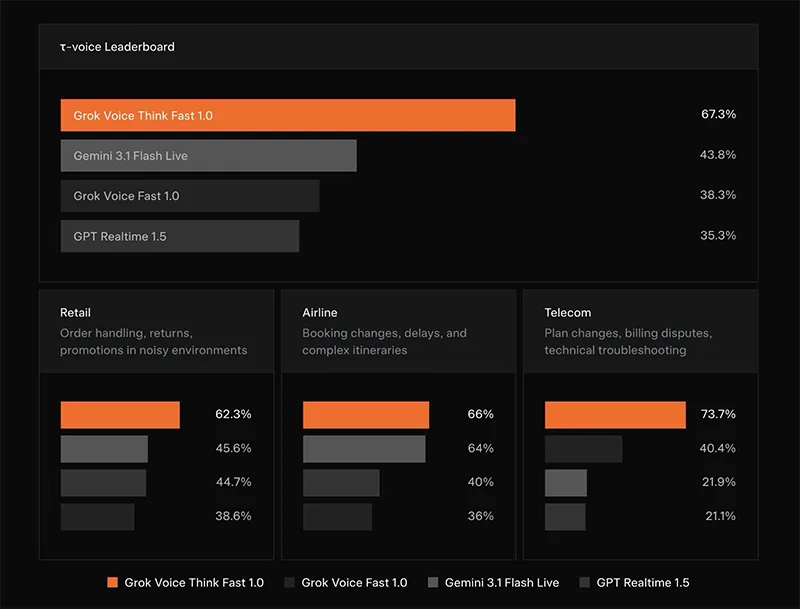
On the τ-voice Bench, a leaderboard designed to test full-duplex voice agents in realistic telephony environments with challenges like turn-taking, accents, and environmental interference, Grok Voice Think Fast 1.0 is leading the board with a score of 67.3%.
That places it ahead of competitors including Gemini 3.1 Flash Live at 43.8% and GPT Realtime 1.5 at 35.3%, as well as xAI's own prior Grok Voice Fast 1.0 at 38.3%.
It also stands out as the only model on the leaderboard with reasoning capabilities explicitly enabled, which contributes to its performance across categories involving retail order handling, airline booking changes, and telecom troubleshooting.
A notable technical strength is its approach to precise data collection and verification during calls.
The system can gather and normalize information such as names, addresses, phone numbers, emails, or account details even when input is fast, accented, or revised on the fly, then read it back for confirmation before integrating it with backend tools.
This capability stems from the model’s design for multi-step tasks, where it can navigate multiple distinct tools in the background without breaking the natural rhythm of dialogue.In a real-world deployment, the model powers phone-based sales and support lines for Starlink.
Early results from that integration indicate it resolves around 70% of support inquiries autonomously while contributing to sales conversions during customer interactions, all while managing a suite of 28 different tools across varied workflows.
The system also supports more than 25 languages natively, broadening its potential for international operations.
The release extends xAI’s earlier work on speech-to-text and text-to-speech APIs, now making the full voice agent available through the company's developer API.
A free testing environment is offered at the console.x.ai playground for those interested in evaluating it directly.
Overall, developments like Grok Voice Think Fast 1.0 illustrate the ongoing shift in voice AI toward systems that prioritize reliability amid the messiness of everyday phone conversations, where the gap between demonstration and production use has historically been wide.






















































































































































































































































































