The AI arms race is no longer just about who has the smartest model.
Over the past few years, the so-called "LLM war" has evolved into a much broader race toward multimodal AI. What began with text-based chatbots, most notably the arrival OpenAI's ChatGPT, which helped spark the modern AI boom, has rapidly expanded into systems capable of generating text, images, audio, and even full videos from simple prompts.
Now, tech companies have pushed the boundaries of generative AI with increasingly powerful models, but most of these tools remain locked behind proprietary platforms and cloud infrastructure. Developers and creators can use them, but they rarely control them.
That imbalance has fueled a parallel movement in the AI world: open models designed to run locally, modify freely, and compete with the biggest players without requiring massive corporate ecosystems.
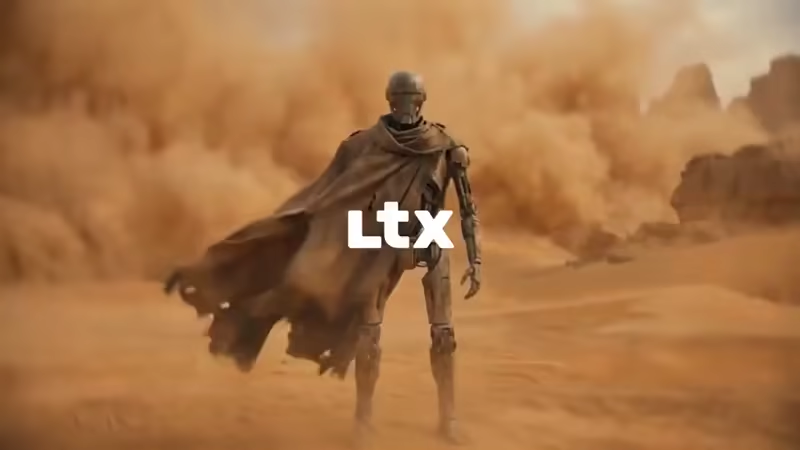
Into that landscape steps 'LTX‑2.3,' an open-source audiovisual generation model designed to challenge the closed-source dominance of major AI platforms.
Built by the team at Lightricks, the model represents a significant step forward for open multimedia generation.
Rather than focusing only on text or images, it generates synchronized video and audio together in a single system. The architecture uses a dual-stream design with separate components for video and sound that interact through cross-attention layers, allowing the model to produce motion, dialogue, sound effects, and ambient noise that match each other temporally and stylistically.
LTX-2.3 is here.
For decades, creative software has been defined by its interface. We think the next era gets defined by the engine underneath.
LTX-2.3 is a major engine upgrade:
Sharper detail
Stronger motion
Cleaner audio
Native vertical format pic.twitter.com/mzw4iECfno— LTX-2 (@ltx_model) March 5, 2026
One of the biggest differentiators of LTX-2.3 is its native audio capability.
Many AI video models treat audio as a secondary layer added after the visuals are created, but this model generates both simultaneously. That means dialogue, background noise, and sound effects are synchronized directly with what’s happening in the scene instead of being stitched together later.
In practical terms, a single prompt can produce a clip where characters move, environments react, and sound follows naturally, giving the output a far more cohesive feel.
The latest release improves this even further with cleaner audio output, filtering noise and artifacts from the training data while introducing a new vocoder for better sound quality.
The visual side has also seen major improvements.
If the engine is strong enough, you should be able to build real products on top of it. That's the whole point of LTX-2.3.
Introducing LTX Desktop. A fully local, open-source video editor running directly on the LTX engine, optimized for NVIDIA GPUs and compatible hardware. pic.twitter.com/aApm06E6RZ— LTX-2 (@ltx_model) March 5, 2026
The model can generate videos at up to 4K resolution and up to 50 frames per second, producing clips as long as 20 seconds with detailed textures and smoother motion.
A redesigned latent space and updated VAE architecture help preserve fine details such as hair, text, and small objects throughout the frame, addressing one of the most common weaknesses of earlier video generation models. The update also introduces native portrait video support, meaning vertical formats like 9:16 are trained directly rather than being cropped from landscape footage.
This is a change that aligns well with modern social platforms like TikTok, Instagram Reels, and YouTube Shorts.
Beyond quality improvements, the philosophy behind the model may be even more significant.
LTX-2.3 is a major upgrade.
It’s a production-ready multimodal engine - designed to be built on.
Here’s what’s new
1/7 pic.twitter.com/zG19JcyKW0— LTX-2 (@ltx_model) March 5, 2026
Unlike many cutting-edge AI systems, LTX-2.3 is released with open weights and source code, allowing developers to inspect, modify, and run it on their own infrastructure.
That means creators are not forced to rely on expensive cloud APIs or platform restrictions.
The model can be deployed locally, integrated into custom workflows, or embedded into entirely new applications.
For smaller companies and independent developers, this level of control can be transformative, enabling experimentation without the cost barriers often associated with proprietary AI services.
The biggest upgrade is visual fidelity and motion stability.
A new video VAE and refined latent space deliver sharper fine detail and more stable motion.
Image-to-video holds together better, small textures survive compression, and last-frame interpolation makes endings feel… pic.twitter.com/WGF1pwNphF— LTX-2 (@ltx_model) March 5, 2026
Local execution is particularly important in the current AI climate.
As generative models become more powerful, concerns around privacy, cost, and platform dependency have grown. Running a model locally means prompts, data, and generated media never need to leave a user’s machine. It also allows teams to scale their own infrastructure instead of paying per generation request.
In the context of the AI race, these factors are pushing open-source models from niche experiments into serious alternatives.
Keyframes and structured control are now more deeply integrated.
LTX-2.3 is trained with multi-task objectives from the pretraining stage, including image-to-video, retake, keyframes, and more.
This makes transitions, controlled scene evolution, and multi-shot workflows more… pic.twitter.com/IXGoECapkq— LTX-2 (@ltx_model) March 5, 2026
Another strength of the LTX ecosystem is its flexibility.
The model supports several workflows including text-to-video, image-to-video, and audio-to-video generation. A creator could start with a still image and animate it, feed an audio track and generate matching visuals, or produce an entire scene from a written prompt. The model also supports LoRA fine-tuning, allowing developers to customize styles, characters, or cinematic looks without retraining the entire system.
This adaptability makes it attractive not just for hobbyists but also for studios and developers building production pipelines.
LTX-2.3 raises the bar on fidelity, control, and reliability across real production workflows.
Everything ships open.
Push it. Stress it. Build with it.
7/7
Learn more: https://t.co/Ql9H1ocxXa— LTX-2 (@ltx_model) March 5, 2026
The broader significance of releases like LTX-2.3 lies in what they represent for the future of AI development.
The generative AI landscape has largely been defined by closed ecosystems where the most powerful models sit behind paywalls and APIs. Open models, however, are beginning to close the gap in capability while offering something proprietary systems cannot: transparency and control. With audiovisual generation, local deployment, and open weights, LTX-2.3 demonstrates that the next phase of the AI war may not simply be about who has the largest models or the biggest cloud infrastructure.
Instead, it may also be about who empowers developers the most. The LLM war is no longer just about chatbots because now, it's a battle over the future of creative technology itself.
It's worth noting that the LTX-2.3 is released with open weights, which means that it can be downloaded and run locally, but hosted services and APIs built around the model typically charge per generation.






















































































































































































































































































