In just a few years, AI has moved from a niche research focus to a central battleground for the global tech industry.
Companies are racing to build systems that can write code, generate media, assist with complex decision-making, and even act as autonomous agents across digital environments. The rapid pace of progress has brought both excitement and growing concern about how these systems should be developed and deployed.
At the center of this shift are large language models (LLMs), which have become the foundation for many of today’s most advanced AI tools. These models are trained on vast amounts of data and are increasingly capable of performing tasks that once required human expertise. As capabilities expand, so do the stakes, particularly in areas like cybersecurity, misinformation, and automation of sensitive workflows.
This has created a tension within the industry: the push to build more powerful models as quickly as possible, versus the need to ensure those systems remain safe, controllable, and aligned with human values. Different companies have taken different approaches to this challenge, with some prioritizing rapid innovation and others emphasizing caution and risk mitigation.
When OpenAI launched ChatGPT in November 2022, it set off an intense race among technology companies to develop more advanced large language models, often described as the LLM wars.
And in this crowded field, Anthropic stood out as a company that placed a strong emphasis on AI safety and alignment from the beginning. Its Claude family of models has been shaped by an approach called constitutional AI, which seeks to embed explicit principles into the system to reduce harmful or unpredictable behavior, setting it apart from competitors focused primarily on raw performance.
That cautious stance came into sharper focus last week when an accidental data leak exposed internal materials at Anthropic, including draft announcements for a new, unreleased AI model.
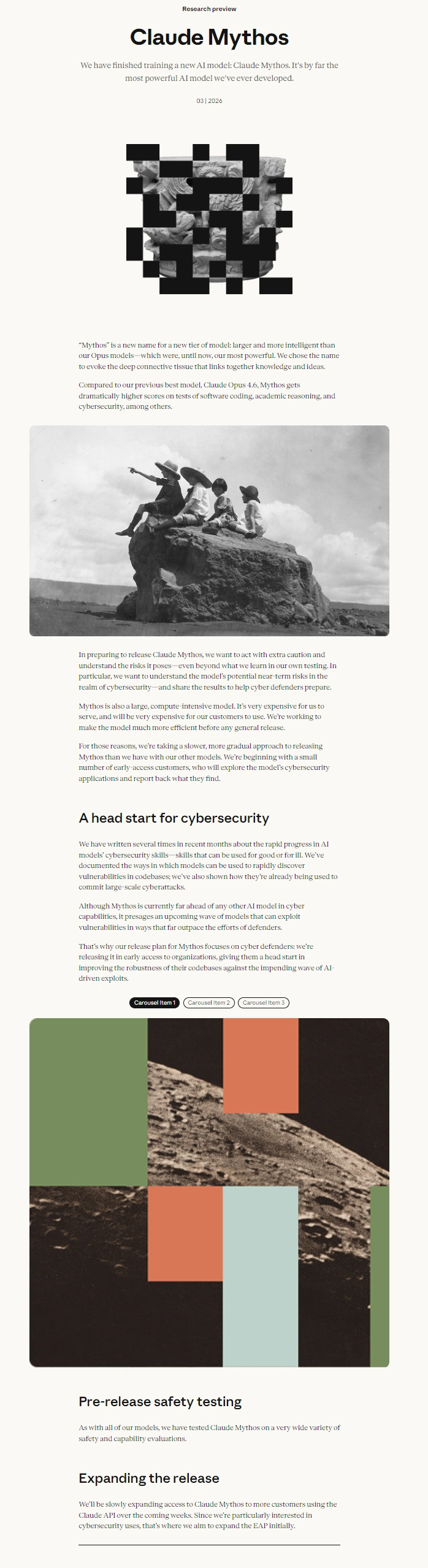
On or around March 26, 2026, nearly 3,000 unpublished assets (blog drafts, images, and documents) were left publicly accessible in a content management system due to a configuration error that made files visible by default.
Independent cybersecurity researchers spotted the exposure, and Fortune reported on it after reviewing the contents. Anthropic quickly secured the materials once notified and described the incident as the result of human error in an external tool.
Anthropic currently offers three model tiers: Haiku, Sonnet, and Opus, with Opus being the most powerful. The leaked draft introduces a new tier called Capybara, above Opus as the largest, most intelligent, and most expensive model Anthropic has ever built.

The word Mythos comes directly from ancient Greek (μῦθος or mûthos), where it simply means "myth," "story," "tale," "word," or "narrative." In modern English it often refers to the body of interconnected myths, legends, or foundational stories that shape a culture. In other words, the deep, shared connective tissue of human knowledge and ideas.
Anthropic appears to have chosen the name for exactly that reason.
According to the documents, Mythos represents a step beyond the company's previous flagship Opus line, which had been its most capable offering. Training on the model is complete, and it is positioned as significantly more powerful, with "dramatically higher scores" on benchmarks involving software coding, academic reasoning, and cybersecurity tasks.
The drafts also noted that it would be more expensive to run than prior Opus models and that it currently leads other AI systems in cyber-related capabilities.

In response to questions about the leak, Anthropic confirmed to Fortune that it is indeed developing and testing this general-purpose model:
A company spokesperson described Mythos as "a step change" in capabilities and "the most capable we've built to date," highlighting meaningful advances in reasoning, coding, and cybersecurity.
The firm added that, given the model's strength, it is proceeding deliberately rather than rushing a broad release. As is common in the industry, testing is currently limited to a small group of early-access customers to evaluate performance and risks in controlled settings.
The internal drafts went further, acknowledging potential downsides.

They described the model as posing "unprecedented cybersecurity risks" because its abilities could enable more sophisticated vulnerability discovery and exploitation, potentially outpacing defenders' efforts to secure systems. Anthropic indicated plans to involve cyber defense teams early in the process, giving them priority access so they could begin hardening codebases against the kinds of AI-assisted attacks that might become possible with this level of capability.
No specific benchmark numbers were released publicly, and the company has not shared additional technical details since the leak.
Anthropic is still making this project a secret, and that the model remains unavailable to the general public or through standard API access. There have been no further official announcements from Anthropic updating its status or providing a timeline for wider availability.
The episode has drawn attention not only for the technical leap it suggests but also for the irony of a safety-oriented lab inadvertently exposing plans for its most advanced, and potentially disruptive, system through a basic operational oversight. It underscores the ongoing tension in the AI sector between rapid capability gains and the practical and ethical challenges of managing those gains responsibly.