Large Language Models (LLMs) are neural networks designed to understand and generate human language.
Since OpenAI introduced ChatGPT, LLMs have captured the world’s attention—fueling innovation across industries, from customer service to content creation. However, their brilliance in grasping grammar, context, meaning, and even a surprising degree of real-world knowledge, comes at a cost.
They need to train on enormous datasets, and as a result, running these models demand immense computing power, making them expensive, energy-hungry, and often slower than ideal, especially in real-time applications.
While reasoning models—designed for logic, problem-solving, or arithmetic—consume fewer resources than LLMs, they can still be computationally demanding depending on the complexity of the task.
The emerging solution? Miniaturized AI models that strike a balance between performance and efficiency.
One such innovation is Microsoft’s 'Phi'.
One year ago, Microsoft introduced small language models with the release of Phi-3 on Azure AI Foundry.
Now, we're introducing Phi-4-reasoning, Phi-4-reasoning-plus, and Phi-4-mini-reasoning—pushing what's possible with AI. Read the blog: https://t.co/Mnt1dPK14V— Microsoft Azure (@Azure) May 1, 2025
According to Microsoft, Phi, which is the Microsoft family of small language models (SLMs), "offer cost-effective, high-performance AI solutions at the edge, pushing the boundaries of generative AI."
What this means, these models were created "to give developers tools to implement AI directly on a device."
This is possible because Phi is compact, and designed with reasoning and language abilities, but without the heavy computational burden. These small-scale models are designed to run faster, cheaper, and more sustainably—making AI more accessible for everyday use.
And this time, Microsoft announces 'Phi-4.'
The AI marks a significant advancement in compact AI models, delivering reasoning capabilities while maintaining efficiency. These models are designed to perform complex tasks without the extensive computational demands typical of larger language models.
In a blog post, Microsoft said that:
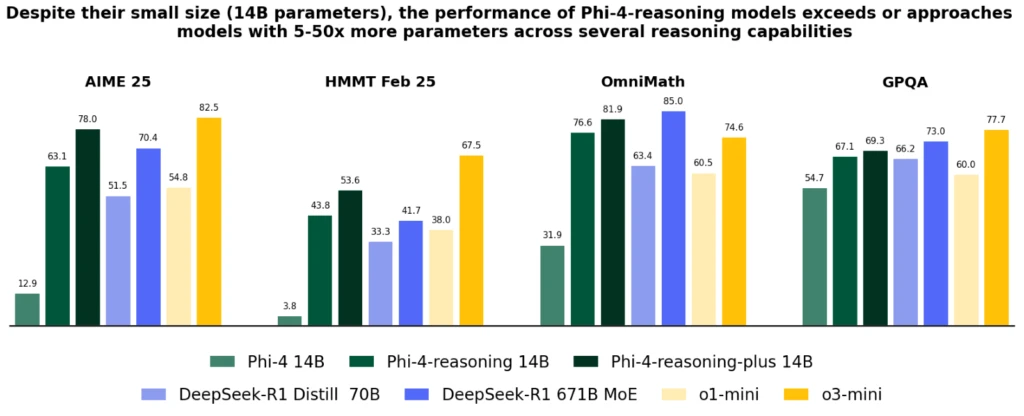
The base model, Phi-4, is a 14-billion-parameter language model that excels in complex reasoning tasks, particularly in mathematics and programming.
Despite its relatively small size, Phi-4 outperforms larger models in various benchmarks, thanks to its training on high-quality synthetic and curated datasets.
Building upon Phi-4, is Phi-4 Reasoning Plus, which integrates supervised fine-tuning and reinforcement learning to enhance performance in tasks requiring deep, structured reasoning.
This model processes 1.5 times more tokens than the base model, is able to show improved accuracy in mathematics, science, coding, and logic-based tasks, rivaling larger models like OpenAI o3-mini, while remaining comparable to larger models, like DeepSeek-R1-Distill.
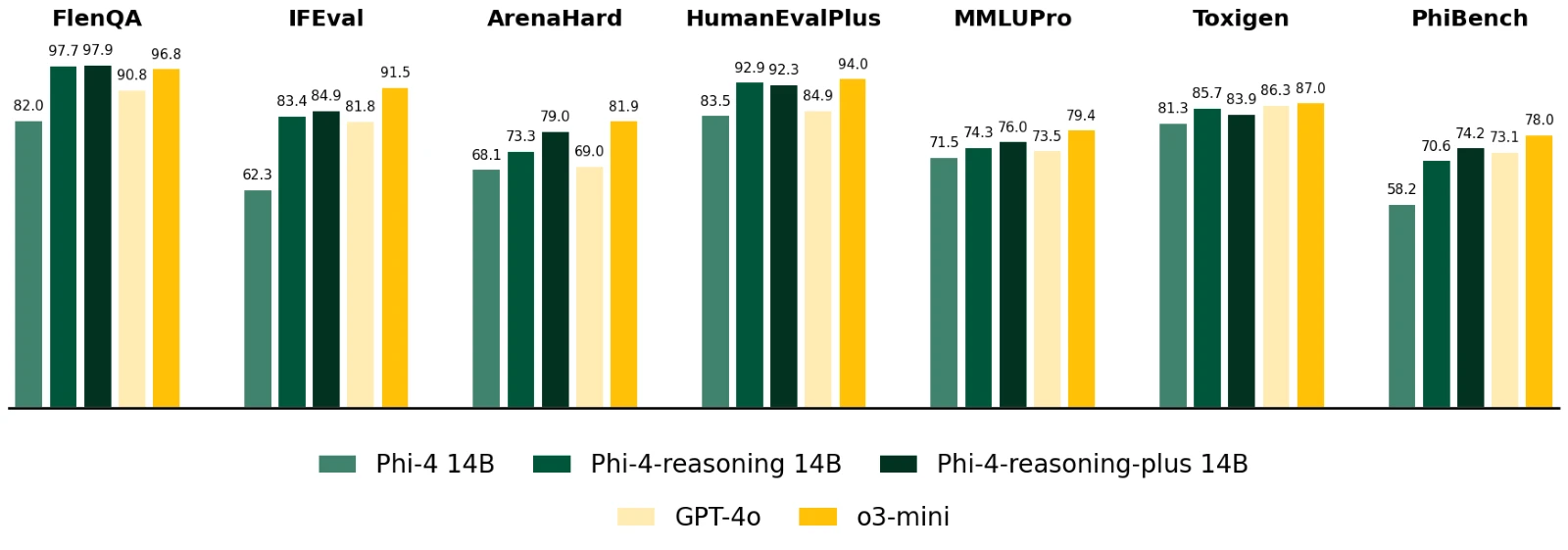
The downside of this higher accuracy is increased response time and computational cost.
This is Phi-4 Mini Reasoning shines.

It offers a lightweight solution, at only 3.8 billion parameters.
This particular model is optimized for multi-step, logic-intensive mathematical problem-solving tasks. It delivers high-quality, step-by-step problem-solving, making it ideal for educational applications and deployment on edge or mobile systems.






















































































































































































































































































