
Since the large language model (LLM) war first exploded, the race has looked less like a traditional arms race over raw intelligence and more like a battle over experience.
Yes, companies compete on benchmarks, reasoning depth, and multimodality, but just as fiercely they compete on how their models feel to use. OpenAI's ChatGPT, which started the whole trend, set the tone early, and rivals like Google, Anthropic, and Meta quickly followed with their own assistants.
As the technology spread from novelty to everyday tool, one truth became clear: people don't just care about what large language models say. Instead, they also care deeply about how they say it.
For a long time, the default assumption was that robots should sound like robots. In science fiction and early depictions of AI, machines spoke in monotone, mechanical voices, punctuated by awkward pauses, repetitive phrasing, and electronic beeps. That stilted delivery was intentional. It existed to underline artificiality, to draw a sharp line between humans and machines. The robot voice wasn't a limitation; it was a design choice meant to reassure audiences that these entities were tools, not peers.
That design philosophy no longer fits the modern era.
As soon as technology made it possible for machines to speak fluidly and respond in natural language, expectations shifted. The rise of generative AI chatbots didn't just make conversation possible: it made robotic speech feel outdated.
People began to expect systems that could listen, respond, and adapt like humans do. Lifelike language stopped being a gimmick and became the baseline. In many ways, this is where ChatGPT changed the game, showing millions of users that talking to an AI could feel conversational rather than transactional.
Read: OpenAI ChatGPT ‘Advanced Voice Mode’ Breathes To Speak: Next Level Anthropomorphism
But realism introduced a new tension. As AI voices became warmer, friendlier, and more expressive, they also became easier to trust. Sometimes too easy.
Overly enthusiastic responses, affirmations, and casual emojis could blur the line between friendly presentation and factual authority.
Researchers and critics warned that anthropomorphic tone could encourage overconfidence in AI outputs, making users confuse politeness or warmth with accuracy. OpenAI itself faced criticism this year for versions of ChatGPT that felt excessively agreeable, then later for updates that swung too far in the opposite direction and felt cold or abrupt.
This is the context in which OpenAI’s latest ChatGPT update lands.
Instead of deciding what the "right" personality should be, the company is handing control to users.
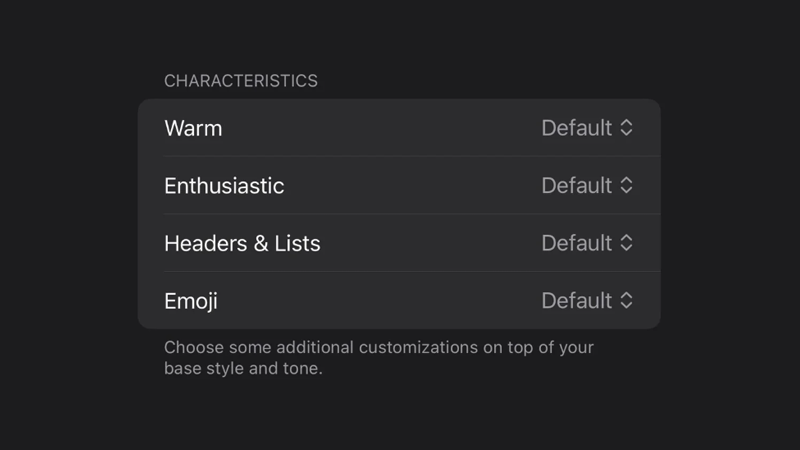
Here, the company introduces new personalization sliders that allow people to directly adjust warmth, enthusiasm, emoji usage, and even formatting habits like lists and headers. These settings sit on top of existing base tones such as Professional, Candid, and Quirky, effectively acting as a flexible style layer rather than a fixed personality.
The shift acknowledges something the industry has slowly learned: tone is not decoration.
It shapes how users interpret answers, how much they trust them, and how comfortable they feel using AI in different settings.
A lawyer drafting a contract, a student preparing for an exam, a marketer brainstorming campaign ideas, and a customer service agent handling complaints all need different voices from the same underlying intelligence. Until now, many power users relied on elaborate prompt engineering to force ChatGPT into a specific role. These sliders turn that hidden workaround into an explicit, accessible feature.
You can now adjust specific characteristics in ChatGPT, like warmth, enthusiasm, and emoji use.
Now available in your "Personalization" settings. pic.twitter.com/7WSkOQVTKU— OpenAI (@OpenAI) December 19, 2025
This evolution also reflects how far we've moved from the old idea that robots should advertise their artificiality.
In today's world, people don’t want machines that sound like machines. Instead, they want systems that communicate naturally, but appropriately. That doesn't mean pretending AI is human; it means matching tone to context. Sometimes that's warmth and encouragement. Other times it’s restraint, precision, and emotional distance.
OpenAI's update doesn’t claim to solve deeper issues like hallucinations or bias, but it does recognize that presentation plays a powerful role in how those issues are perceived.
Zooming out, personality controls are part of a broader trend across the AI industry toward adaptability. One-size-fits-all assistants no longer work at scale. As AI becomes embedded in workplaces, classrooms, and daily routines, users expect to shape not just outputs, but interactions themselves. By giving people direct control over how ChatGPT sounds, OpenAI is quietly redefining what human-AI interaction looks like: not a single voice speaking to everyone, but a system flexible enough to meet people where they are.
Further reading: OpenAI 'GPT-5.1' With Personality Makes 'ChatGPT Smarter And More Enjoyable To Talk To'