It began with an ambitious vision: giving everyone access to large language models (LLMs) capable of thinking and conversing like humans.
That vision from OpenAI took shape with the arrival of ChatGPT, a seemingly simple chatbot that soon transformed the digital world. Its debut sparked a global AI arms race, propelling tech giants and startups alike into a frenzy of innovation as they rushed to replicate, or surpass, its uncanny conversational abilities.
Then, the launch of GPT-4 marked a defining moment. It didn’t just raise the standard; it redefined it. And when GPT-4o followed, OpenAI refined the technology even further, making it smoother, sharper, and more efficient.
With its multimodal intelligence, near-human reasoning, and exceptional versatility, from passing bar exams to crafting stories, GPT-4 and its variants reshaped the world’s understanding of what artificial intelligence could achieve. Even the lightweight GPT-4 mini impressed with its performance.
As the AI race intensified, these models evolved from experimental novelties into indispensable collaborators. ChatGPT, the tool that is powered by the GPT models, became the AI professionals, creators, and everyday users came to trust.
And then came GPT-5.
As good as it gets, Sam Altman, OpenAI’s CEO, summed it up simply as "a PhD‑level expert in your pocket."
But not everyone likes it, and is happy with its existence.
Now, OpenAI came up with an update it calls 'GPT-5.1.'
GPT-5.1 in ChatGPT is rolling out to all users this week.
It’s smarter, more reliable, and a lot more conversational.https://t.co/SA1Q1GPyxV— OpenAI (@OpenAI) November 12, 2025
GPT-5.1, an update to its flagship GPT-5 series, aims to make conversations with ChatGPT smoother, reasoning sharper, and with responses that are more adaptable to the user’s tone and intent.
GPT-5.1 has two models.
The first is the 'GPT-5.1 Instant', which serves as ChatGPT’s faster, default model. It focuses on delivering quick, accurate replies while adopting a noticeably "warmer" and more conversational tone. OpenAI said that the model is better at following instructions and stays on topic more reliably than its predecessor.
The Instant model also introduces adaptive reasoning, allowing it to decide when to pause and "think" before answering difficult questions, striking a balance between speed and depth.
The second model is 'GPT-5.1 Thinking', which is designed for users who need more advanced reasoning. It dynamically adjusts how much processing time it devotes to a question. It can run faster on simple prompts and more slowly, but more thoughtfully, on complex ones.
OpenAI explained that the version uses less jargon, making it easier to understand even when tackling highly technical topics.
GPT-5.1 Instant is now warmer and more conversational.
The model can use adaptive reasoning to decide to think a bit longer before responding to tougher questions.
It also has improved instruction following, so the model more reliably answers the question you actually asked. pic.twitter.com/5zP0ft0ekm— OpenAI (@OpenAI) November 12, 2025
According to OpenAI on a webpage on its website:
Beyond that, OpenAI said that GPT-5.1’s improvements are not just cosmetic.
Benchmark tests show higher performance across reasoning, coding, and math challenges, including recent AIME 2025 and Codeforces evaluations. But more importantly, the update is meant to make ChatGPT feel more alive, flexible, and aligned with real-world communication.
Beyond the improvements to intelligence and reasoning, GPT-5.1’s biggest shift lies in personalization.
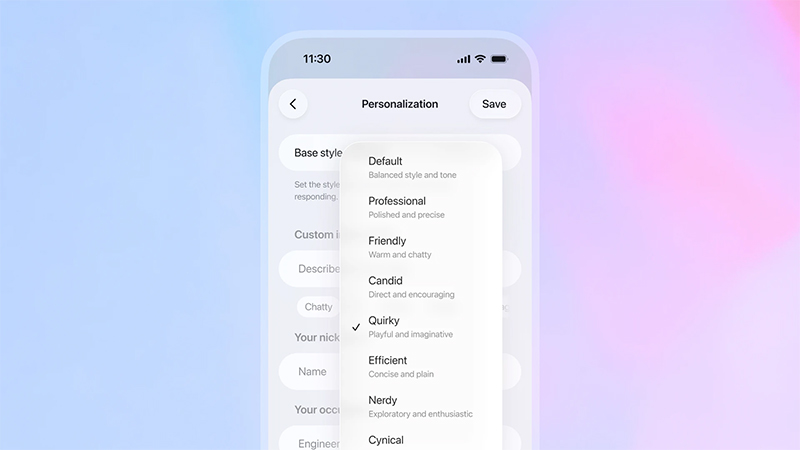
OpenAI has expanded ChatGPT’s personality presets, allowing users to select from eight different tones: Default, Professional, Friendly, Candid, Quirky, Efficient, Nerdy, and Cynical.
"These options are designed to align with what we’ve learned about how people naturally steer the model, making it quick and intuitive to choose a personality that feels uniquely right," explained OpenAI.
GPT-5 will remain available to paid subscribers for three months.
The GPT-5 sunset period does not affect the availability of other legacy models.
We’ll also be updating GPT-5 Pro to GPT-5.1 Pro soon.— OpenAI (@OpenAI) November 12, 2025
These modes alter the way ChatGPT speaks without changing its core abilities, giving users more control over the model’s conversational style depending on the context or task.
For those who want even finer control, OpenAI is experimenting with new personalization sliders that let users adjust how concise, warm, or expressive the model should be. Users can even control the frequency of emojis the model will generate during conversations.
In a blog post, Fidji Simo, OpenAI’s CEO of Applications, emphasized that with over 800 million people using ChatGPT, a one-size-fits-all approach no longer works.
"We want ChatGPT to feel like yours and work with you in the way that suits you best," she said, while warning against excessive personalization that might simply echo a user’s biases or worldview.
According to Simo, the goal is to make ChatGPT both empathetic and challenging, and "a companion that listens and adapts, but also helps you grow."
In other words, with GPT-5.1, OpenAI isn’t just tweaking the numbers: it’s how OpenAI is trying to refine the relationship between humans and machines.
The company is betting that the future of AI lies not only in greater intelligence but also in emotional calibration: a model that can think deeply when needed, speak warmly when appropriate, and ultimately feel more like a partner than a tool.
We’re also experimenting with more personalization controls, like tuning warmth and emoji frequency
Rolling out to a small group of users as we test and learn.— OpenAI (@OpenAI) November 12, 2025
This launch marks an important moment for OpenAI, arriving after a rocky period for OpenAI. GPT-5’s initial release in August drew mixed reactions, and in the midst of heightened scrutiny from regulators, ongoing public debate about AI’s social impact, and increasing competition from rivals such as Anthropic and Google DeepMind.
Following lawsuits and criticism related to the emotional tone of ChatGPT, OpenAI has been cautious about how it frames the "personality" of its AI models.
GPT-5.1 represents the company’s latest attempt to strike a careful balance between warmth and professionalism, intelligence and safety.
With GPT-5.1, the company isn’t just updating its models, it’s also redefining what people should expect from digital conversations.
The update is meant to reflects user feedback, that great AI should not only be smart but also enjoyable and adaptable to personal preferences.

















































































































































































































































































