Since people began to known the many uses of large language models (LLMs), the war has only grown fiercer.
After launching ChatGPT, OpenAI sparked the so-called LLM war, where every competitor is racing not just to build smarter models, but to make them more personal, more human, and more aware of the people using them. Developers quickly realized that an AI capable of memory can recall details from past interactions.
This would make them feel less like a tool and more like a companion.
With that, memory became one of the defining battlegrounds of modern AI.
In its early form, memory allowed ChatGPT to remember simple things like name, writing style, or whether users' preferred concise or detailed answers. It meant to make users no longer had to reintroduce themselves or repeat the same instructions.
In order to enhance this memory feature, ChatGPT has what it's called the 'Projects' feature.
The usefulness of this feature comes from the fact that people use LLMs for various of reasons. From study to work, or asking random questions based on curiosity, or just as a way to know new things other than looking for them through search engines.
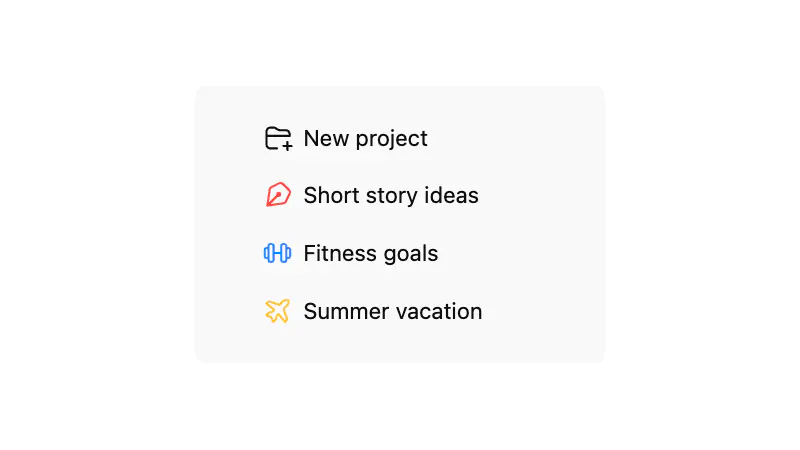
This created a challenge: people wanted to keep their queries' topics separate. Business-related queries, for example, on one side, personal research on another, and creative writing in its own corner. The answer came in the form of ChatGPT Projects, a system that acts like a workspace where chats, uploaded files, and custom instructions all live together.
Projects gave users a way to organize their AI interactions like folders, but with intelligence woven in.
Projects was introduced as a premium feature, meaning that users have to pay for a subscription to use it.
Now, OpenAI is making it free for everyone. Even free users are free to use it.
Each project could now be an island of thought, cut off from global history and protected from bleeding into unrelated conversations. If users are planning a family trip, they don’t have to worry about that context appearing while drafting a client report. If they're working on sensitive data in healthcare or finance, that knowledge won’t spill into their personal chats.
Apart from that, users can even customize projects by choosing colors and custom icons.
The AI stays contained, discreet, and focused. It's like putting each and every conversation into its own island, and it's only on that island that the memory resides.
Using it is simple.
Projects in ChatGPT are now available to Free users.
In addition, we’ve added:
- Larger file uploads per project (up to 5 for Free, 25 for Plus, 40 for Pro/Business/Enterprise)
- Option to select colors and icons for more customization
- Project-only memory controls for more… pic.twitter.com/GGygJuBify— OpenAI (@OpenAI) September 3, 2025
When users start a new project, they can toggle the memory mode to project-only, upload the reference files they need, and set custom instructions for tone or style. From then on, every chat in that space is infused with the right context, whether they're coding, planning, researching, or writing. The AI no longer needs constant reorientation/
it simply remembers, but only where users allow it to.
The memory war isn’t about storing everything; it’s about storing the right things, in the right places. Projects make ChatGPT feel less like a scattered series of chats and more like a true collaborator, one that can slip into character for each task without losing its sense of discretion. It’s a seductive balance: intimacy without intrusion, organization without chaos, and memory without contamination.
The comes the catch.
OpenAI said that free ChatGPT users can only upload up to five files under each project, whereas ChatGPT Plus/Go/Edu users can upload up to 25 files. On the other hand, Pro/Business/Enterprise customers can upload up to 40 files.
At this time, users who wish to create scheduled tasks in ChatGPT still need a subscription.






















































































































































































































































































