The competition among large language models (LLMs) shifted markedly once the initial wave of conversational systems gave way to sustained multi-step performance.
ChatGPT first appeared as a conversational interface yet quickly showed wider strengths in reasoning, writing and code generation, drawing heavy attention and capital. Other organizations soon entered, and successive releases delivered steady gains in reasoning depth, context length and tool use.
By mid-2026 the frontier had moved toward agentic systems able to carry out extended work rather than single-turn replies.
In that setting, Anthropic's Claude Fable 5 and its related variants recorded strong results on independent benchmarks focused on long-horizon coding, repository-level software engineering and certain agentic workflows. Leaderboards and third-party evaluations often placed those models at or near the top in overall quality and specialized coding tasks in the preceding months.
OpenAI answered in late June 2026 with a preview of its GPT-5.6 family and a broader rollout in July.
The family offered three variants aimed at different trade-offs: Sol as the highest-capability flagship, Terra as a balanced everyday option, and Luna as a lower-cost model suited to high-volume use.
Now, OpenAI released further refinements to how these models appear inside ChatGPT.
First off, GPT-5.6 Sol, the most powerful model out of the three GPT-5.6 variants, now powers both the Instant and deeper-reasoning modes for Plus and Pro subscribers, producing a single consistent experience rather than separate model switches.
Internal evaluations covering finance, medicine and law found that the updated Sol generated 68 percent fewer responses containing factual errors than the preceding GPT-5.5 Instant.
The same users also received a simple slider that lets them decide how much reasoning effort each reply should receive, keeping answers short for routine questions or expanding them for planning, research, writing or coding.
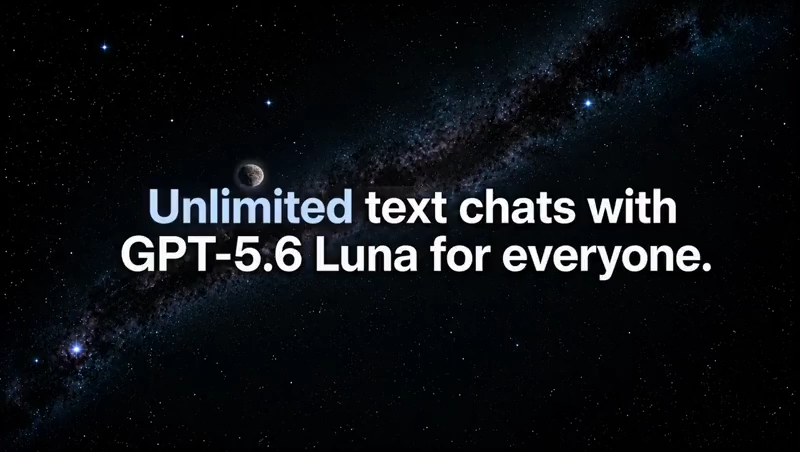
Free and Go users gained unlimited text chats with GPT-5.6 Luna, which itself showed a 62% reduction in factual errors relative to the earlier Instant model.
They also get a new 'Think' button that unlocks higher reasoning on harder queries.
The Sol update is limited to the standard ChatGPT conversation interface; the versions that drive Work and Codex remain unchanged.
These adjustments address the bulk of everyday interaction rather than peak agentic or coding workloads.
Most ChatGPT usage consists of quick factual queries, light planning and advice rather than multi-hour repository work, so tightening factual reliability and giving users explicit control over depth may improve the quality of the majority of conversations.
Expanding Luna to unlimited free text chats lowers the barrier to a more capable default model and could increase daily active use among non-paying users, while the Think button gives free users a low-friction path to deeper computation when needed.
The effect is a clearer separation between the high-end Sol experience reserved for paid subscribers and a strengthened free tier that still narrows the capability gap for ordinary tasks.
Competitors that have emphasized long-horizon coding or agentic benchmarks may feel less immediate pressure on those specialized metrics, yet the broader accessibility of reduced-error responses could shift user expectations around everyday reliability and force similar tuning on free and mid-tier offerings across the field.






















































































































































































































































































