
For years, more RAM has been one of the easiest ways for smartphone makers to communicate progress. More memory meant more room for apps to remain active, better multitasking and fewer interruptions when moving between applications.
As phones became more capable, however, software also became more demanding, and the assumption that every new generation would simply arrive with more memory is becoming harder to maintain.
That is happening at a time when the memory industry is dealing with another major source of demand.
The expansion of AI infrastructure has increased the need for high-performance memory, contributing to broader pressure on memory supply and pricing.
The effects are beginning to reach consumer hardware, where manufacturers have to account for the availability and cost of memory when designing new devices. Google has now acknowledged that these hardware constraints are affecting memory availability across the Android ecosystem.
Android 17 is one of the clearest signs that the situation is beginning to influence software as well.
Google introduced per-app memory limits in Android 17, initially on Pixel devices, with the system able to restrict applications that consume excessive amounts of memory.
According to Google, an application that exceeds its limit can be slowed down or terminated rather than being allowed to continue consuming resources indefinitely.
The change is now moving beyond the operating system itself.
Google Play is establishing performance thresholds covering dynamic memory usage, bitmap memory and optimized DEX code. The requirements are intended to discourage applications from holding unnecessary data in memory, retaining large images while running in the background or shipping code that has not been sufficiently optimized.
One particularly notable requirement concerns optimization.
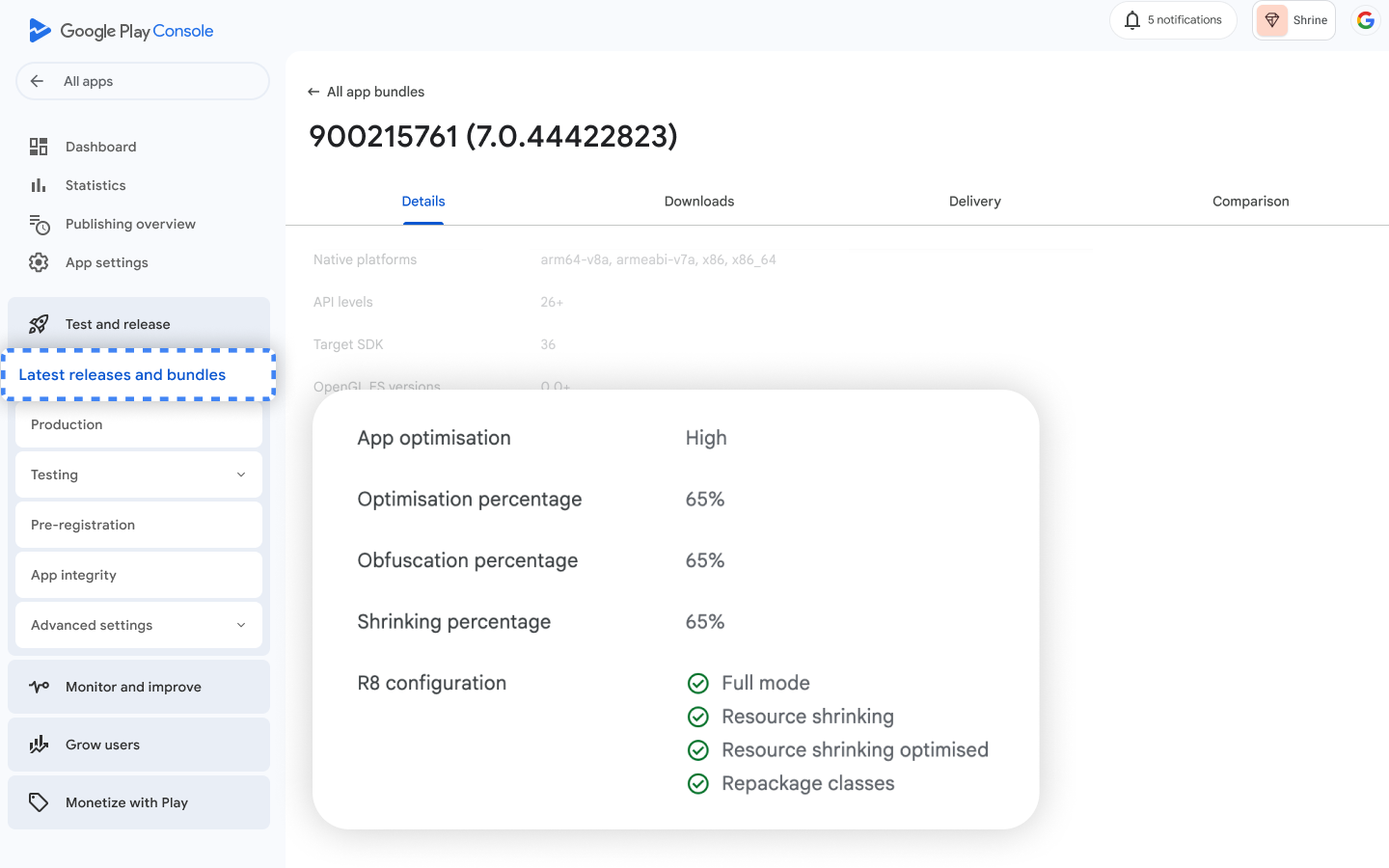
Google says Play Store applications will need to reach at least 25% coverage across optimization, shrinking and obfuscation using tools such as R8 or another shrinking system.
The objective is not only to reduce the size of an application package, but also to reduce its memory footprint and improve runtime behavior.
This could become more significant for applications that already place heavy demands on a phone.
Games are being given more relaxed limits than ordinary applications, but there are still questions about how the rules will affect increasingly demanding software, including applications that run AI models locally. Android Authority notes that the exact impact on these heavier workloads is not yet clear.
For developers, this is more than a recommendation to make applications run a little more efficiently.
Google says enforcement of the new thresholds will begin in February 2027. Applications and games that fail to meet them could face reduced visibility and publishing capabilities on Google Play.
Google is also providing developers with tools through Play Console to monitor memory usage and identify problems before enforcement begins.
The timing makes the change particularly interesting.
The same industry that is pushing demand for increasingly powerful AI systems is also putting pressure on one of the basic components those systems and smartphones depend on.
As memory becomes more constrained, the solution cannot always be to put more of it into every device.
Google is therefore moving some of that pressure onto software. Instead of assuming that Android phones will continually receive more memory to accommodate increasingly demanding applications, the platform is beginning to place clearer limits on how much an individual app can consume.
That does not mean Android phones are suddenly going to have less RAM, nor does it mean every large application will be affected. Google describes the initial limits as a way to target excessive memory use and outliers that can cause system-wide slowdowns, battery drain and application termination.
The company expects the limits to expand across manufacturers and device configurations ranging from 4GB to more than 16GB of RAM over the coming year.
The broader change is in the assumption behind Android development. Memory has traditionally been treated as a resource developers could use as devices became more capable.
Google is now treating it more explicitly as a resource that needs to be managed, measured and kept within defined boundaries.
That could prove increasingly important if the memory supply situation remains tight. AI may be driving the demand at the infrastructure level, but the consequences are no longer confined to data centers. They are beginning to influence the software rules governing the phones people carry every day.






















































































































































































































































































