TikTok, the short-form video platform that has captivated audiences worldwide.
Launched in September 2016 by Chinese tech company ByteDance, TikTok began as Douyin for the Chinese market. In 2017, ByteDance acquired the lip-syncing app Musical.ly and merged it with TikTok in 2018, propelling its popularity, especially among younger demographics.
The app's algorithm-driven content discovery and emphasis on short-form videos have set it apart from competitors, leading to over 4.5 billion downloads globally.
In response, competitors have introduced similar features, such as Instagram Reels and YouTube Shorts, to retain user attention. Despite these efforts, TikTok's unique content discovery and user engagement continue to set it apart .
In other words, it redefined social media with its meteoric that disrupted the social media hierarchy, challenging established platforms like Instagram and YouTube.
This time, it embraces the AI trend with what it calls 'AI Live.'
In a newsroom post, TikTok said that:
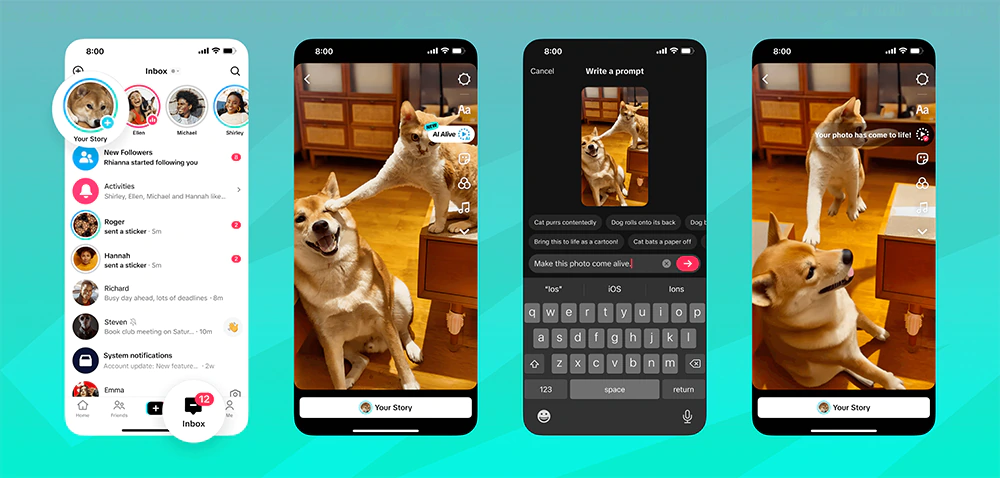
This AI-powered feature can be used to transform static photos into dynamic short-form videos. To use it, users can:
- Open Story Camera by tapping the blue “+” icon on the top of the Inbox or Profile page.
- Select a single photo from their Story Album.
- The AI Alive icon will appear on the right-side toolbar in the photo editing screen.
- After creating and posting an AI Alive Story, it will appear in the For You feed, visible in the Following feed, and showcased on users' Profile Page.
Users can input descriptive prompts, and the AI adds motion and effects to bring images to life.
In order to ensure safety and transparency in this AI feature, TikTok said that every step of content creation—starting from the uploaded photo and prompt to the final video—is reviewed by moderation technology to ensure it aligns with community guidelines.
"A final safety check happens once a creator decides to post to their Story. Just like other content, people can report videos they think may break our rules," TikTok said.
And to further enhance transparency, AI Alive stories are clearly labeled as AI-generated, and include C2PA metadata—a digital signature that helps verify AI origin, even when content is shared outside the platform.
Users can also report AI Alive videos, just like any other content, if they believe it violates TikTok’s rules.
TikTok's foray into AI signifies its commitment to staying at the forefront of technological innovation.
By continuously evolving and embracing new technologies, TikTok not only maintains its competitive edge but also sets new standards in the social media landscape.
The launch of this image-to-video feature builds on its earlier in-app text-to-image AI generator.
While platforms like Instagram and Snapchat also offer AI tools for creating images, TikTok is taking the lead by enabling users to transform photos into dynamic videos. Notably, Snapchat has announced similar plans to support AI-generated videos from images, but TikTok is already ahead in bringing that capability to creators.

















































































































































































































































































