 Facebook and other social network account to billions of users exchanging almost countless of data each day throughout their corresponding networks and the web. But that 'countless data' is outpaced three-to-one by a phenomenon called the "Dark Social".
Dark Social accounts for twice the sharing that occurs on Facebook, and more than 90 percent of people use it regularly. It's a place where people share content online through private digital communications, like using email, instant messaging, and within forums. Unlike social media sites, Dark Social that doesn't carry metadata, is not capable to be attributed to a source, so it couldn't be analyzed by analytics.
The study was made by RadiumOne: The Light and Dark of Social Sharing by surveying 9,000 people from around the world, as well as analytics on one month's worth of data on global and regional sharing gathered from more than 900 million web users.
RadiumOne, the enterprise advertising platform based in the U.S., said that the Dark social which doesn't come from sharing mechanisms on a web page, have outpaced social media networks by a significant margin that marketers need to may attention to such behavior to have better insight into their total audiences.
Dark social is "one of the most valuable sources of data insights," said RadiumOne CEO Bill Lonergan, and it has "the potential to give brands a huge competitive edge."
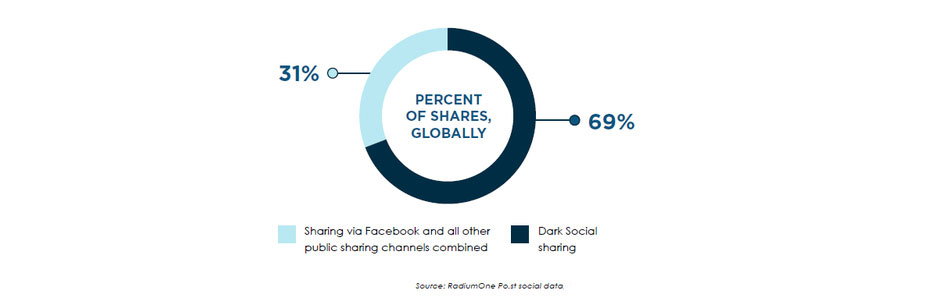
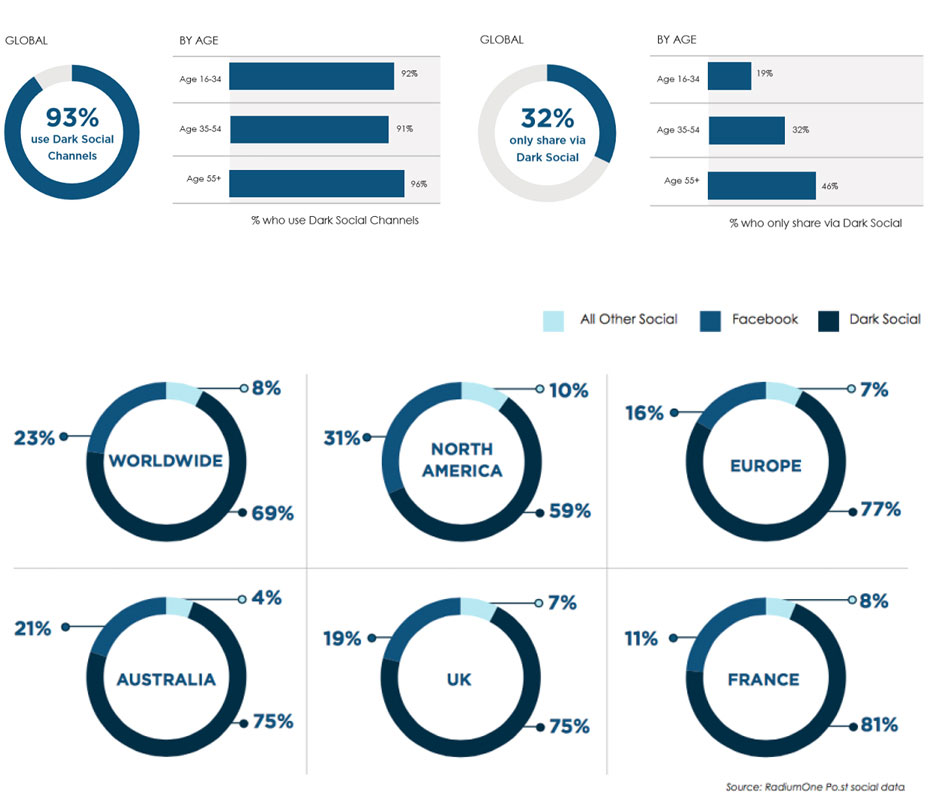
Among consumers who do share content, 93 percent of them tend to use Dark Social channels. And 69 percent of all sharing activity online takes place through it, compared to the 23 percent of content posted on Facebook. The other eight percent rests on all other social sharing platforms combined.
Some of the top content categories being shared through Dark Social are related to arts and entertainment (80 percent), careers (78 percent), and travel (78 percent). "Conversely, the topics most discussed via social channels are more one-to-many such as pets (84 percent), family and parenting (63 percent) and real estate (55 percent)," said RadiumOne in a statement.
People are comfortable in sharing things through these 'dark' mediums because they feel more at ease with sharing what they want to share to few trusted people. Since social media networks are popular because posts can be broadcasted to people even beyond normal reach, the Dark Social is just meant to do otherwise. It ties closely to privacy, a thing that no social media have in common.
Not limited to desktop, Dark Social has come to mobile devices as they're important to consumers and advertisers. More users are sharing content through Dark Social on their mobile devices, with 36 percent of them doing this globally.
According to the report, the "honesty" of Dark Social data means that it can provide valuable insights and provide brands and businesses with an "incredibly accurate picture" of a user's interest and, therefore, intent to purchase.
"Dark Social is simply too big to ignore; sharing in the dark outstrips Facebook and all other social channels combined by three-to-one, yet many brands are currently unable to understand this untapped audience," said Rupert Staines, MD Europe at RadiumOne. "Acting on Dark Social presents a huge opportunity for brands to improve their ROI from their social media and digital marketing investments."
Despite being 'dark', the Dark Social isn't necessarily a threat to advertisers, according to the authors of the report. They can use Dark Social to track what readers are doing within, and while it may not be as complete a picture as social sharing, it can still be useful.
For example, despite having no metadata, one thing that Dark Social will generate is clickback data, which is basically when someone clicks on a shared link. By accounting for clickback data, advertisers and marketers can plan ahead in their social campaigns.
The authors also suggested that advertisers and publishers to implement short URL sharing which can help readers to trim down links. These links can be tracked, and can work flawlessly if shared through social posts, emails, blogs, video embedding, text messages, press releases, and so on.
The History of the Web Wrong
The credit for terming 'Dark Social' goes to Alexis Madrigal, an editor at The Atlantic. In a 2012 post explaining dark social, he reported that 56.5 percent of the website's traffic came from Dark Social channels, with the next biggest channel being Facebook.
"There are a couple of really interesting ramifications of this data. First, on the operational side, if you think optimizing your Facebook page and Tweets is 'optimizing for social,' you're only halfway (or maybe 30 percent) correct. The only real way to optimize for social spread is in the nature of the content itself. There's no way to game email or people's instant messages. There's no power users you can contact. There's no algorithms to understand. This is pure social, uncut," wrote Madrigal.
According to him, most people think that first there was the internet. Then after a decade or so, social media rise to make sharing links possible. This is what made the history of the web wrong. People have always, and continue to share links through email and instant messages. This was as 'social' as it can be before Facebook, Twitter and others were born. Even when billions of people are using social media networks, the Dark Social continues to dominate "social" media with 69 percent of referrals to websites come from Dark Social versus about 20 percent from Facebook and 6 percent from Twitter.
And because it doesn't get that much attention and very much overlooked, it's 'silent' movement has made it difficult to track.






















































































































































































































































































