It was on November 15th 2018, when one of the most contentious hard forks in cryptocurrency happened. At that time, a chain split of Bitcoin Cash occurred between two rival factions called Bitcoin ABC and Bitcoin SV (BSV).
The split originated from what was described as a "civil war" in two competing Bitcoin cash camps. And the "SV" that was born (which stands for "Satoshi Vision'), was meant to represent the core question at the heart of not only the Bitcoin Cash fork, but also the 2017 Bitcoin fork that created Bitcoin Cash in the first place.
And here, the integrity of BSV remains in question, as one group of cryptocurrency miners approaches control of the network‘s hash rate.
It is Calvin Ayre’s CoinGeek that has become BSV’s primary mining pool, by controlling more than 50 percent of the total computing power on the network, and having mined 52 percent of BSV blocks over the past day.
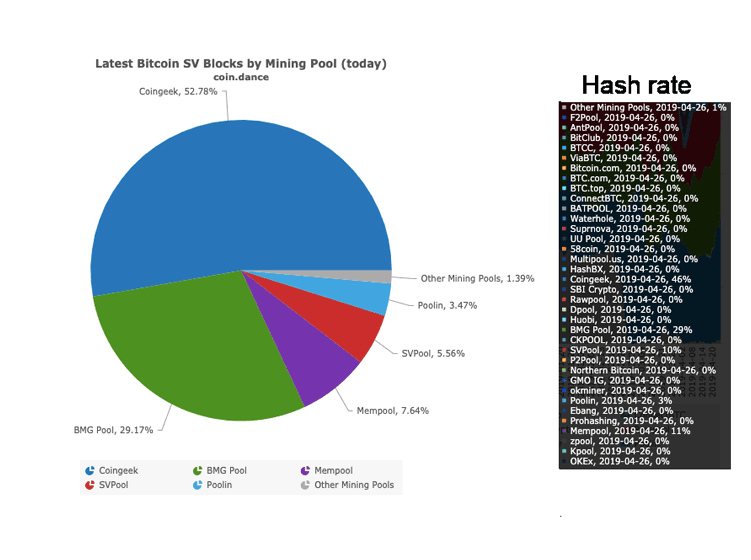
What happened here is that, when one entity (alone or group) controls more than 51 percent of a blockchain's hash rate, they alone will be the decision maker of what transactions can be accepted or rejected by the network.
In this case, it essentially makes CoinGeek can make BSV a centralized network, deriving it away from its original aim.
Here, CoinGeek in becoming the dominant player in the network, can force all network participants to trust its centralized group. This condition is considered an extreme security risk.
Hash rate majority also allows the dominant player to ‘double-spend.‘ What this means, the dominant player can stop transactions before they are confirmed.
A more serious threat to BSV could come when its miner that controls over half of the hash rate of a particular network, can effectively rewrite the blockchain and 'forge' tokens, stealing a potentially huge amount of funds before being found out.
Examples of 51-percent attacks suffered by blockchains, include the Ethereum Classic incident that saw $1.1 million worth of cryptocurrency double-spent by malicious miners.
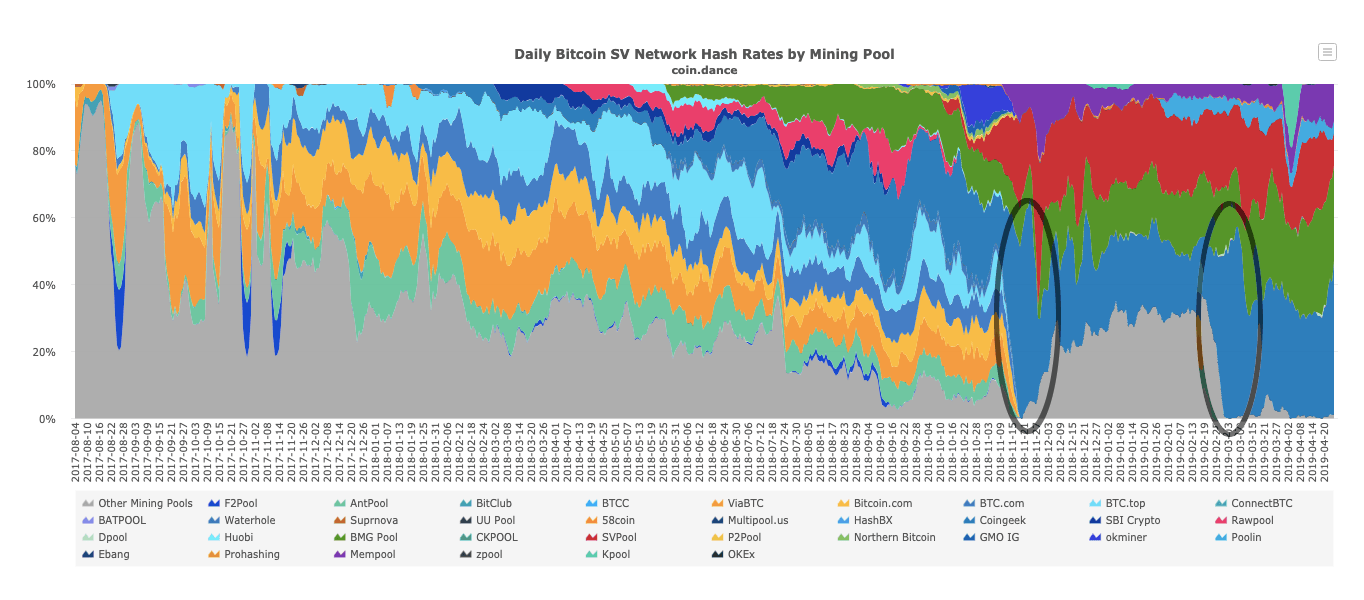
Previously, CoinGeek’s miners controlled over 51 percent of BSV’s hash rate for a full week (November 18 to 25, 2018).
The most CoinGeek managed, was on November 24, when it controlled 61 percent. The same happened from March 2 to 8, when CoinGeek operated more than 51 percent of BSV’s mining, often for days at a time.
In the past, Bitcoin SV was never a major cryptocurrency, mostly because it was seen as a less powerful version of the original Bitcoin. But unlike the original Bitcoin, it has a larger block size limit and lacks certain smart contract functionalities.
Controversies on BSV started when its creator, Craig Wright, claimed to be Satoshi Nakamoto, the creator of the original Bitcoin. Initially, the claim was seen as nothing much, that until things got serious when Wright began taking legal action against those who called him out for his claim, and put a $5,000 bounty on the identity of Twitter user 'Holdonaut'.
As a result, Wright received intense retaliation from powerful figures in the cryptocurrency industry.
The first of these to speak out was Changpeng Zhao, the CEO of Binance. Zhao was quick to remove the token from the Binance platform and soon after, many other exchanges such as Shapeshift Kraken and Bitlite followed.
At first glance, Bitcoin SV might seem like just a fork. However, its community behaved much more like trying to compel adoption of its preferred vision by force. BSV has made aggressive and overt attempts to effectively wipe out Bitcoin Cash by taking all of its hash power.
Calvin Ayre, owner of CoinGeek, wrote on November 20th that CoinGeek intended to “continue voting with our sustained hash power until the rented hash [i.e. Bitcoin Cash's hash] is gone."
The hash war ceased when Bitcoin Cash and BSV implemented replay protection, and permanently split from one another. This essentially showed that both were already having sufficient community to sustain themselves without annihilating each other

























































































































































































































































































