Google Maps is a free web-mapping platform and consumer application that offers satellite imagery, aerial photography, street maps, 360° interactive panoramic views of streets, real-time traffic conditions, and route planning for various methods of transportation.
The product is almost synonymous with commuting, as it is used by more than 1 billion people every month around the world.
This happens because Google Maps can be installed on both Android and iPhone, and sports tons of useful features that no others in the competition can match.
However, this does not mean that Google Maps is the leading solution in the market.
According to an analysis conducted by Counterpoint Research, Google Maps loses to only one competing platform when pitted in different categories.
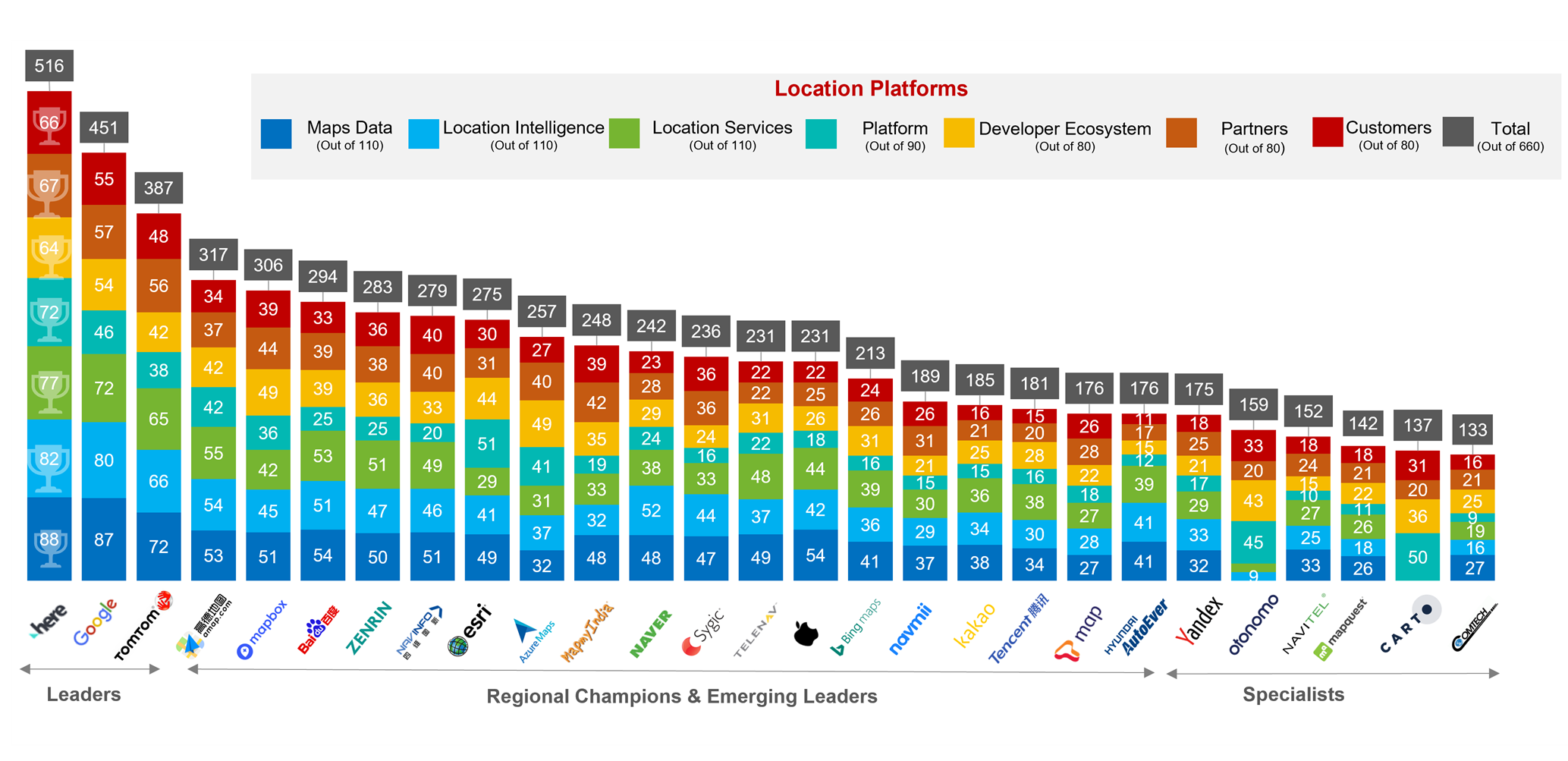
Counterpoint Research observed "25+ leading mapping and location platform vendors" that are available on the market, and conducted evaluations based on 65+ key capabilities spanning across seven categories, including maps data, location services, the developer ecosystem, and partners.
On top, is the HERE Platform.
The multinational group deals with mapping, location data and related automotive services to individuals and companies. The company is majority-owned by a consortium of German automotive companies (namely Audi, BMW, Daimler) and American semiconductor company Intel. The company's success can be traced back to the U.S.-based Navteq in 1985, which was acquired by Finland-based Nokia in 2007.
HERE tops the chart because of its investments in expanding its portfolio and its eagerness in working with more partners worldwide.
"With a few years in making, HERE Platform has thus evolved into an industry-first and one-stop platform with infrastructure and toolsets for companies to develop, license, and integrate first and third-party mapping, location intelligence data into their applications at scale. Further, help generate, analyze, visualize, and monetize the data using the same platform," said Counterpoint’s Research Vice President, Neil Shah
He added that HERE as evolved to become the "Switzerland of location platform."
In this category, Google Maps is only the runner-up.
On top of that, the research suggested that HERE's product also scored well in a number of categories, including map coverage, the freshness of maps data, and the AR push.
On second place, is Google Maps.
The company is working hard to become a more important software provider in the automotive industry.
For example, the company has been trying to convince a number of car makers so they would use Android Automotive as the operating system powering everything infotainment on their cars.
Android Automotive can be pre-loaded from the factory, offering deep integration of Google services in the driving experience by allowing services like Google Assistant and Google Maps to access vehicle data.
Previously, Google has partnered with a number of carmakers, including Renault, Volvo, and others.
Third, is TomTom.
When it comes to navigation, offline maps coverage, and other areas that are crucial for commuting, TomTom is gaining fast.
According to Counterpoint Research, TomTom is so influential because it has expanded substantially in the automotive field with forging partnership with a number of big brands in the industry.






















































































































































































































































































