In the restless churn of online information, a single edit can ripple outward faster than any fact checker can intervene.
And when the world's largest internet search engine relies on the world's knowledge that is crowdsourced, the way things work reveals how fragile the overall foundation of the system is.
On an otherwise ordinary Wednesday in August 2026, that fragility briefly declared one of technology's most visible figures deceased.
Not just dead, because the person in question, Sam Altman, was assassinated.
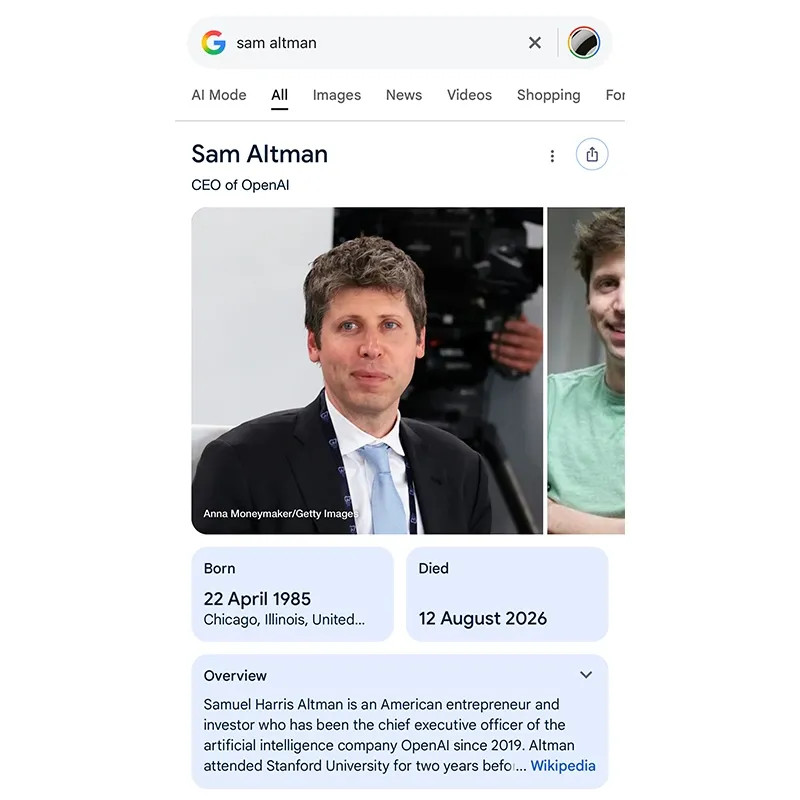
Around 9:47 in the morning, an anonymous editor that goes with the name ~2026-44183-87 rewrote the opening of Sam Altman's English Wikipedia biography in the past tense, inserted a death date of August 12, 2026.
The editor claimed that Altman had been assassinated in Seattle, and left the entry without sources.

Wikipedia's automated systems flagged the addition as an unreferenced claim on a living person's page. Wikipedia has been strict about this, since entries or changes to popular pages, events and people can change a lot.
A human volunteer restored the accurate version at 10:29, limiting the false text's presence to roughly 40 minutes.
Quiet a long time in the real world. But on the internet where milliseconds matter, that 40 minutes window proved long enough for Google's Knowledge Panel, which draws continuously from public sources including Wikipedia.
As a result of this, the search engine absorbed the change and began displaying the death date alongside Altman's name and title as OpenAI's current chief executive.
Screenshots spread across the internet, including on Reddit and social media.
A second, shorter vandalism attempt later that day briefly reinserted the death claim before it too was removed.
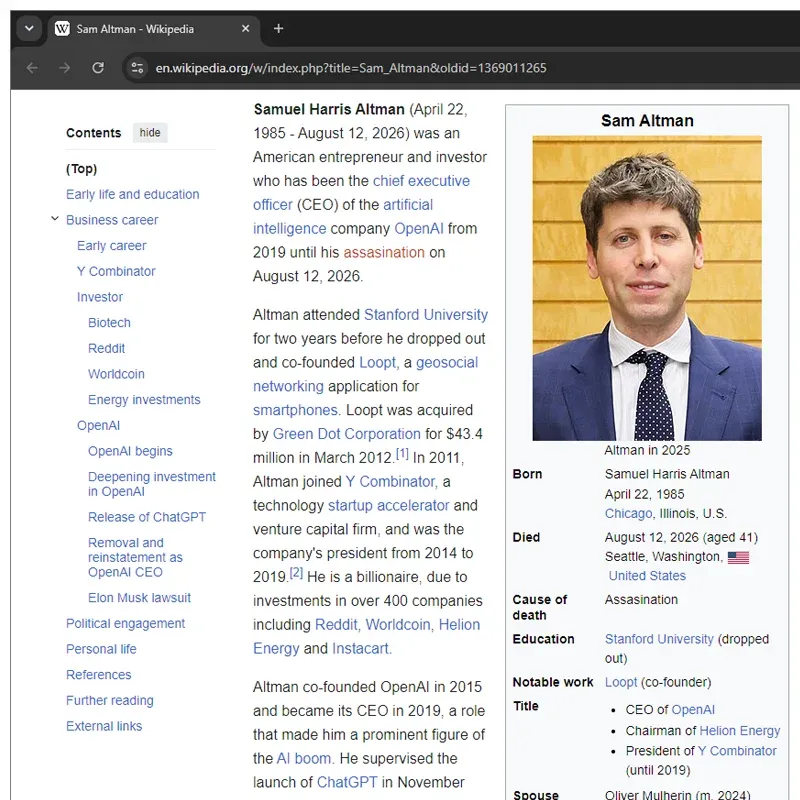
Further disruptive edits followed, among them a description of Altman as a dropout and a change of his surname to Gayman. Volunteers issued warnings, reverted the damage within minutes in most cases, and placed the page under semi-protection so that only established accounts could make further changes.
Google later confirmed the false result had not been entered manually by any employee and attributed it to the vandalism of public information sources that its systems monitor.
No specific identity for the vandal has surfaced but what's certain is that, the changes appear to have come from temporary or anonymous accounts, the kind of low-effort digital mischief that Wikipedia's volunteer model is designed to catch, though not always before automated systems elsewhere have already taken the bait.
The episode was temporary and quickly corrected, yet it landed on a man already living at the center of intense scrutiny.
Sam Altman has spent the better part of a decade as both architect and lightning rod of the large language model race. In 2015 he helped launch OpenAI alongside Elon Musk, Greg Brockman, Ilya Sutskever and others, presenting the organization as a nonprofit counterweight to the commercial ambitions of Google's DeepMind and a safeguard for humanity as artificial general intelligence approached.
Musk provided early funding and the name itself, then departed in 2018 after disagreements over control and structure.
Years later the two became open adversaries, with Musk filing suit alleging that Altman and colleagues had abandoned the original charitable mission in favor of a lucrative for-profit partnership with Microsoft.
Around the same period, Dario Amodei, then OpenAI's vice president of research, left with his sister Daniela and a cluster of colleagues to found Anthropic.
Their stated reasons centered on differences over safety priorities and the commercial trajectory OpenAI was taking, though internal accounts also describe personal and power conflicts that had simmered for years.
Amodei has since positioned Anthropic as the more cautious alternative, while OpenAI under Altman has pursued rapid scaling, massive capital raises, and product launches that reshaped the industry overnight.
The result is a figure who commands loyalty from many who see him as a pragmatic visionary capable of steering transformative technology, and deep distrust from others who view the same record as evidence of opportunism, opacity, or insufficient regard for the risks.
To many people, Sam Altman is considered a highly strategic Silicon Valley operator who embodies the industry's "scale at all costs" mindset. Exceptionally skilled at persuasion, in order to win trust and extract cooperation or power.
And OpenAI itself is essentially a manifestation of Altman.
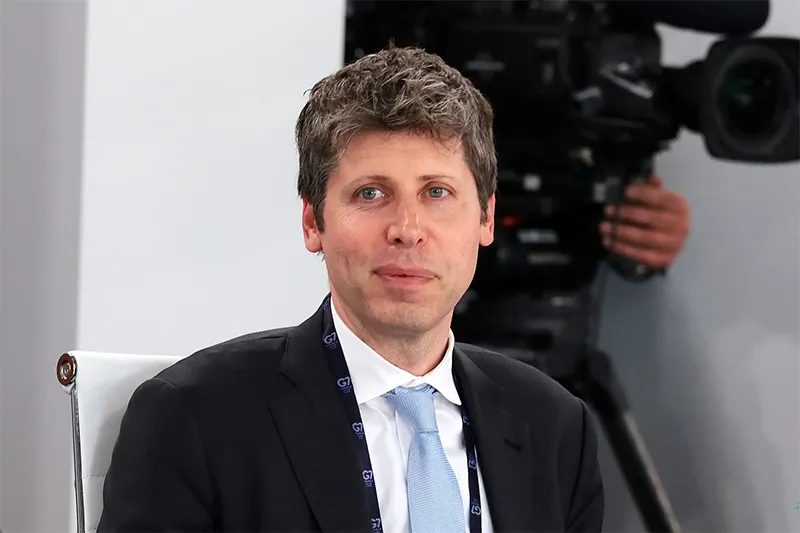
He centralized control while continuing to invoke the original nonprofit mission of safe AI for humanity, even as the company shifted toward aggressive commercial scaling, massive fundraising, and partnerships like Microsoft.
Some consider Altman a visionary leader, but others consider him manipulative and dishonest, with little middle ground.
The original founders and scientists who challenged his vision at OpenAI largely left.
In othwe words, from boardroom revolts, public feuds, competing safety philosophies, and the sheer economic stakes of the AI arms race have made Altman a constant subject of rumor, speculation, and, occasionally, digital mischief.
The brief Wikipedia fiction that Google momentarily amplified fits a pattern in which the man at the center of so much real conflict becomes an irresistible target for invented drama.
In the end the page was cleaned, the search result corrected, and Altman remained very much alive and at the helm of OpenAI.
The episode nevertheless offered a small, sharp reminder that in a world racing toward ever more powerful machines, the oldest and simplest forms of human interference can still briefly rewrite the story.
In the end the page was cleaned, the search result corrected, and Altman remained very much alive and at the helm of OpenAI.
The episode nevertheless offered a small, sharp reminder that in a world racing toward ever more powerful machines, the oldest and simplest forms of human interference can still briefly rewrite the story. In the slower-paced real world, Sam Altman might never even have realized he was dead.






















































































































































































































































































