AIs do get smarter.
Researchers have created AIs that can dream, to capable of coding, played Go and defeated a human champion, knows the concept of betrayal, and many more.
And here, the idea of "singularity" has been in the topic in artificial intelligence.
Singularity is best known in the realms of science fiction. It evolves around the concept that describes the moment AI exceeds beyond human control and rapidly transforms society.
Singularity is like saying the time when AI can self-improve, and with time, as each newer AI generation becomes smarter, this will cause an "explosion" in AI superintelligence that will eventually surpass human intelligence.
The tricky thing about AI singularity is that there is no metric to officially calculate that. This makes singularity difficult to predict.
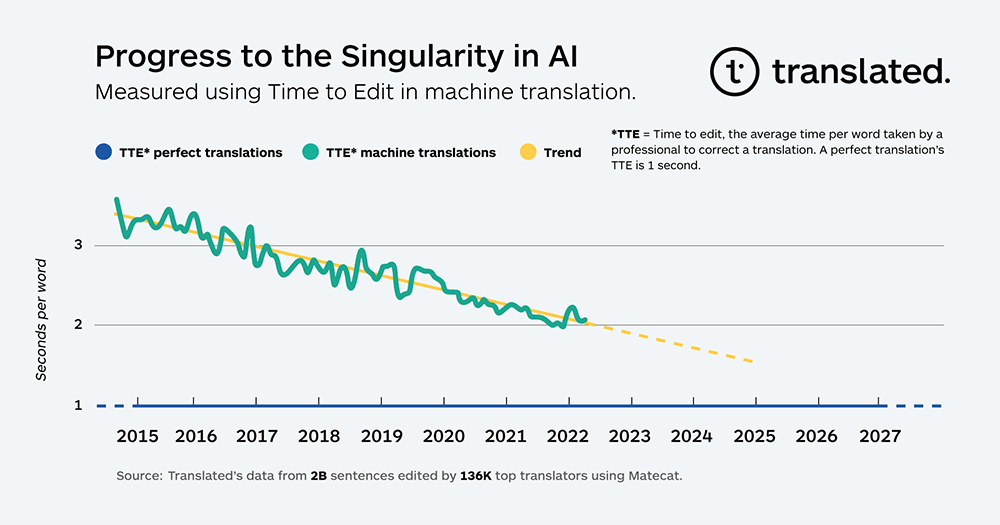
But according to Translated, an Italy-based translation company, singularity is maybe closer to reality than ever.
AI researchers are on the hunt for signs of reaching singularity measured by AI progress approaching the skills and ability comparable to a human, and Translated concluded that singularity in AI is maybe just around the corner, by calculating AI’s ability to translate speech at the accuracy of a human.
Its CEO, Marco Trombetti, said that language is one of the most difficult AI challenges, but a computer that could close that gap could theoretically show signs of Artificial General Intelligence (AGI).
"That’s because language is the most natural thing for humans," Marco Trombetti said at a conference in Orlando, Florida, in December. "Nonetheless, the data Translated collected clearly shows that machines are not that far from closing the gap."
To come to this conclusion, the company tracked its AI’s performance from 2014 to 2022 using a metric called 'Time to Edit,' or TTE, which calculates the time it takes for professional human editors to fix AI-generated translations compared to human ones.
"Time to Edit is calculated as the total time that a translator spends post-editing a segment of text divided by the number of words making up that segment. We consider TTE the best measure of translation quality as there is no concrete way to define it other than measuring the average time required to check and correct a translation in a real working scenario," the company explained in a website post.
During that period, the company analyzed over 2 billion post-edits.
Through the research, Translated’s AI showed that there is a slow, but undeniable improvement, as AI slowly closed the gap toward human-level translation quality.
On average, it takes a human translator roughly one second to edit each word of another human translator, according to Translated.
In 2015, it took professional editors approximately 3.5 seconds per word to check a machine-translated (MT) suggestion.
In 2023, that number is less than 2 seconds.
If the trend continues, AI can be as good as human-produced translation by the end of the decade, or maybe sooner.
"The change is so small that every single day you don’t perceive it, but when you see progress […] across 10 years, that is impressive," said Trombetti. "This is the first time ever that someone in the field of artificial intelligence did a prediction of the speed to singularity."
Although this is a novel approach to quantifying how close humanity is to approaching singularity, this definition of singularity runs into similar problems of identifying AGI in a broader term.
Read: Technological Singularity: How And When AI Can Be Considered 'Alive'
AI becomes smarter because they're trained with more, and better data, and with better hardware.
An analogy to Moore's Law suggests that if the first doubling of speed took 18 months, the second would take 18 subjective months; or 9 external months, and after that, four months, two months, and so on towards a speed singularity.
However, in the modern days of technology, chip densities are no longer doubling every two years, and this means that Moore's Law isn't happening anymore by its strictest definition. But regardless, Moore's Law is still delivering exponential improvements, albeit at a slower pace.
But in the end, some have suggested that there should be some upper limit on speed may eventually be reached.
If ever that limit is reached, then there would be no singularity.
Furthermore, it's difficult to directly compare the speed and efficiency of silicon-based hardware with neurons.
Regardless, Trombetti ensures that "machines won't ever replace humans."
Read: Paving The Roads To Artificial Intelligence: It's Either Us, Or Them














































































































































































































































































