When creating a brand name, whatever the name would be, it should be unique.
This is required in order for the brand to be able to distinguish itself from others. Allowing people to know that one product is different other products.
If more than one product uses a similar naming scheme, things can get confusing.
The ones affected, are the company behind the products, their customers and the products' potential audience.
And Crabhouse is one good example.
The Japanese app took the mobile world by storm, due to its similar naming to 'Clubhouse', the popular invite-only, audio-focused social media network.
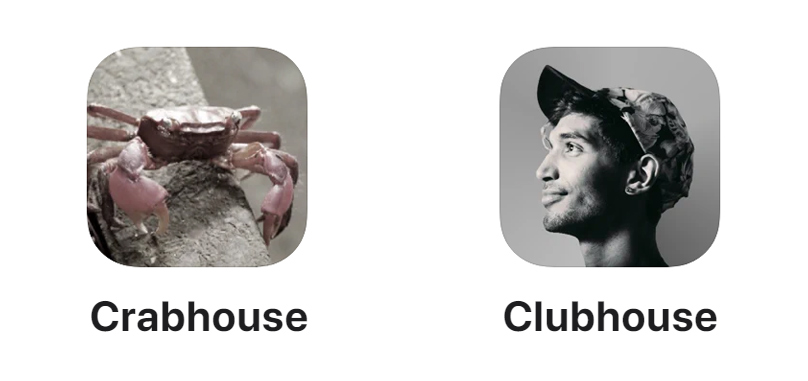
Crabhouse is a mobile app, where users can enter virtual rooms that are literally full of crabs.
By tapping the individual crustaceans, users can learn facts about the animal, or simply see what’s on their minds.
In other words, Crabhouse is an app that provides bite-sized information regarding the ten-legged, hard shelled creature.
Its developer, Ryota Ikegai, who goes online by the name 'Gai', said that he didn't know how to use Clubhouse, and decided to create Crabhouse.
He finished the project after only three days of work.
Clubhouseの使い方が全然わからないのでCrabhouseを3日で作りました。
誰かがゲーム起動するとカニが増えます。たまにしゃべります。それだけカニ。#Crabhousehttps://t.co/M5UCi1Ky3S pic.twitter.com/qxZPsL4rv1— GAI@トライバルデザイナー (@kamibukuro18) February 7, 2021
Following the launch of Crabhouse, Gai saw a rapidly growing number of people registering.
Not long after its initial launch, the app got more than a hundred thousand downloads and thousands of give-star reviews on Apple's App Store.
But things quickly went south after that.
First of as the most obvious, 'Crabhouse' and 'Clubhouse' look very similar. Between them, only two letters differentiate them. At a quick glance, people can easily mistake one with another.
Second, when pronounced, the differences between 'Crabhouse' and 'Clubouse' are clear. But this is only to English-speakers, and not necessarily the case for others speaking other languages.
For people in Japan for example, the country where the app comes from, the pronunciation of the letters “L” and “R” are largely interchangeable, as are the English vowels “A” and “U” in many cases. This is also the case with the word “crab” and “club.” And making things worse, the two words when rendered in Japanese katakana script, they will look identical: クラブハウス.
Because Crabhouse shares the same naming concept with Clubhouse, which was launched earlier, Apple sided with Clubhouse, and forces Gai to change the name of the app.
Apple however, didn’t ban Crabhouse.
The Cupertino-based company only prevented Gai from update the app, unless Gai renamed Crabhouse.
【HELP!】
CrabhouseのアプデかけてたらappStoreからリジェクトされました!
理由が「名前が紛らわしい」です!
いやいやwむしろまんま同じ名前のアプリもあるしすでにリリースしてあるのに紛らわしいもなにもw
というわけで、どうすれば覆せるか教えてください!エンジニアの皆様!#Crabhouse— GAI@トライバルデザイナー (@kamibukuro18) February 22, 2021
This was announced by Gai in a tweet.
He said that his Crabhouse update “was rejected by the App Store”. He also said that Apple mentioned the reason was because the app’s name was “confusing”.
“There are already other apps that go beyond that by having the exact same name as Clubhouse, so why is mine the ‘confusing’ one? How do I overturn this?! Engineers, help!” added Ikegai.
At first, Gai didn't comply and kept the naming.
But in March of 2021, Gai finally gave in.
In the app's version 1.3, which was released on March 10, updates include a name change from 'Crabhouse' to 'Crabhome.'
Gai however, only renamed the app for users on iOS.
As for the app on Android, it retains its 'Crabhouse' naming because Google is not bothered, at least at this time. Most likely, this is because Clubhouse has not yet been released on Android on Google Play Store.
It should be noted that Clubhouse has generated huge buzz on the web and beyond.
And this includes in Japan.
In the country, the social media app has been rendered as "kurabu hausu", where lots of Japanese gather to network. And when Crabhouse appeared, and people were actually liking it, many Japanese said “kani kani kani kani kani kani…” (Japanese word for “crab”), over and over again.
But the word "kani" does have some trivia.
For example, the word translates to crabs in English, but when that word is pronounced by people in Germany, that word will translate to "cancer."
Among others, the buzz has created discussions.
And also among other reasons, it has even attracted Chinese censors.




















































































































































































































































































