In its modern sense, banks started to evolve from the fourteenth century in the prosperous cities of Renaissance Italy, like Florence, Lucca, Siena, Venice and Genoa.
At that time, banks were in many ways, a continuation of ideas and concepts of credit and lending that had their roots in the ancient world, in which their concepts may have been borrowed from the ancient Assyria and Babylonia, with merchants offering loans of grain as collateral within a barter system.
As one of the oldest financial institution, banks accepts deposits and recurring accounts from customers, and with that, they can directly or indirectly affect the market through capital markets.
Due to their importance in the financial stability, banks are highly regulated in most countries.
While banks are still the institution for governments around the world to control money, people in the modern days of the internet and technology, are putting less and lesser trust in them.
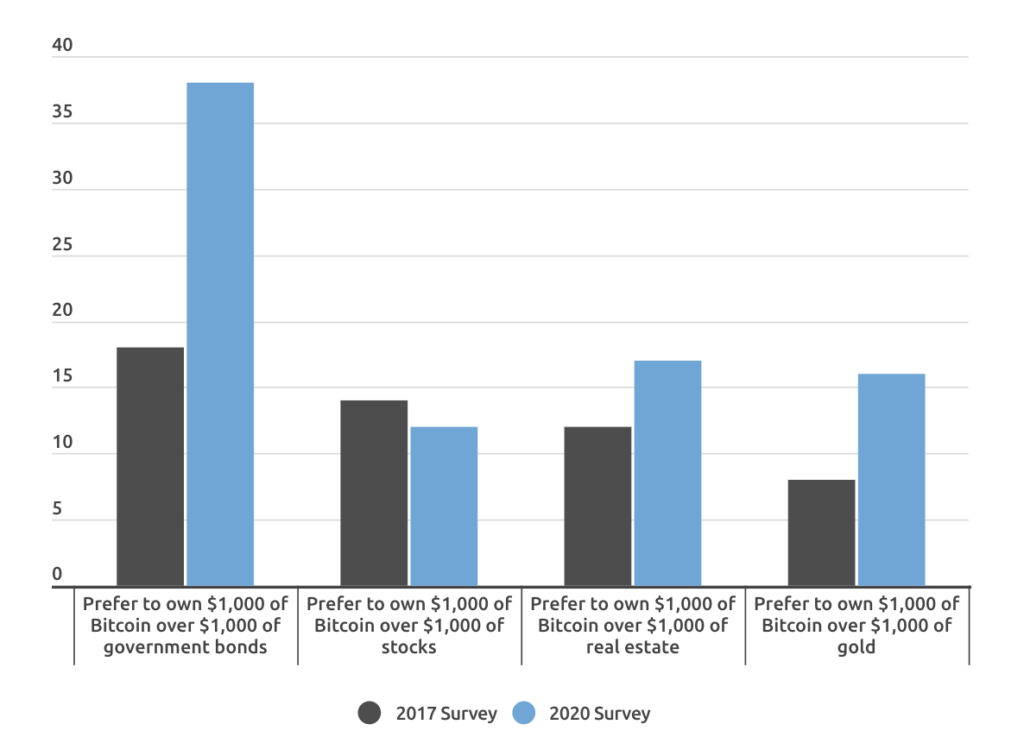
According to a survey conducted by fintech news site The Tokenist, 47% of the respondents trust Bitcoin over big banks, which is an increase of 29% in the past three years.
Mostly coming from millennials, the generation leads the adoption of Bitcoin, with 44% expecting to buy some in the next five years.
On The Tokenist's web page about the survey:
"These findings are likely the result of the rapidly increasing profile of BTC in the news media, and of the increased support for Bitcoin among retailers. The last three years have seen BTC being increasingly covered in the mainstream press, which remains the primary source of information for those over 65 years of age. Many retailers, and especially online retailers, have also moved to support Bitcoin payments, which may explain the increased adoption rates among millennials. "
In other words, the survey found that an increasing number of people are seeing Bitcoin as more trustworthy than big banks.
Millennials’ embrace of Bitcoin is partly down to increased familiarity.
In the survey, it was found that 78% of millennials are “somewhat” familiar with Bitcoin, versus 61% of total respondents, and 14% of them have owned Bitcoin.
"With confidence in traditional investment instruments decreasing, Bitcoin stands poised to offer investors an alternative, long-term store of value," the researchers said.
Bitcoin, or any other cryptocurrency for that matter, has been referred to as everything from rat poison to a Ponzi scheme. They have volatile price and market, with no governance.
But still, cryptocurrencies, or Bitcoin as the most notable, remained the leading alternative asset that preserve their original roots as a hedge against traditional financial markets. Over 45% of respondents preferred Bitcoin over stocks, or even real estate and gold.
This growing confidence is demonstrated by an enormous increase in public confidence towards Bitcoin as an asset class.
"These data indicate that Bitcoin has a bright future, and will likely benefit significantly from the current market crisis. With confidence in traditional investment instruments decreasing, Bitcoin stands poised to offer investors an alternative, long-term store of value," added the researchers.

People's faith in large financial institutions has been steadily waning for more than a decade. With the 'COVID-19' coronavirus pandemic, the crisis has only accelerated this process.
Introduced by Satoshi Nakamoto in a research paper called "Bitcoin: A Peer-to-Peer Electronic Cash System", Nakamoto implemented Bitcoin as open source code and released it in January 2009.
Bitcoin is an online payment system symbolized as "BTC".
It uses a peer-to-peer system where users can transact directly without the need of an intermediary.
As a cryptocurrency, Bitcoin is described as the first decentralized digital currency.
Bitcoin was developed in the years after the 2008 market crash as an alternative to traditional assets. Despite its volatile nature, Bitcoin uses blockchain technology that allows transparent but secure transactions, as well as anonymity.
Piggybacking the hype of the technology of interconnected world of peer-to-peer, Bitcoin is benefiting largely from its younger users, which are mostly and definitely more tech-minded. This is one of the reasons why the cryptocurrency is starting to show competitive advantages when challenging banks, its much older peer.
To come into this conclusion, The Tokenist survey polled 4,852 participants across 17 countries.






















































































































































































































































































