When war erupts, civilians seek shelter.
In the escalating conflict between Iran and Israel, where drones and missiles crisscross the skies in deadly trajectories, most people are urged to run, hide, or stay underground—doing anything to avoid becoming another casualty.
But Sahar Emami chose a different path.
On June 16, 2025, during a live broadcast in the evening from the headquarters of Islamic Republic of Iran Broadcasting (IRIB) in Tehran, a sudden Israeli airstrike disrupted the news—dust filled the studio, equipment rattled, and anchor Sahar Emami instinctively moved to safety, and ducked off camera.
The broadcast cut to pre-recorded content.
As a presenter at IRINN (Islamic Republic of Iran News Network), Sahar walked into work knowing full well the risks. The building she entered—headquarters of IRIB—is more than just a workplace. It’s the nerve center of Iran’s state-controlled media, holding a monopoly on domestic television and radio.
That makes it not just some building in Iran's capital city, but a potential target in the eyes of the Israeli.
Sahar was live on the television, even when dusts can be seen the air, and sounds of explosions heard in the background.
Then it happened.
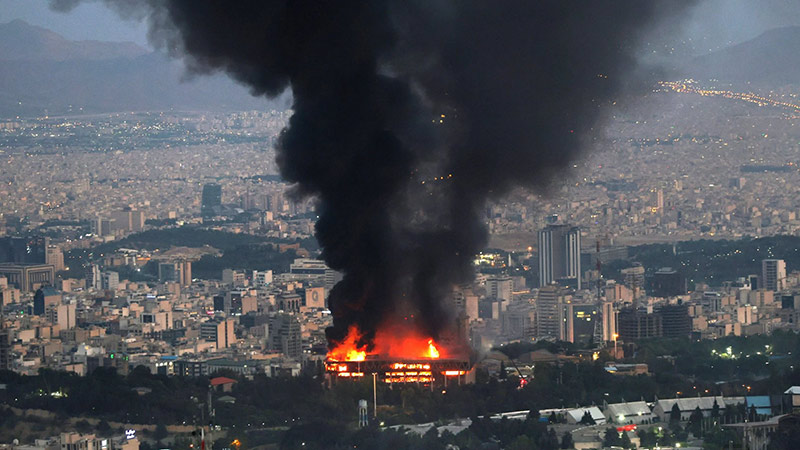
Not long after the Israeli army warned residents of Tehran's District 3 to evacuate, 4 missiles struck the glass-fronted IRIB building. With the deafening blasts that shook the whole building, equipment toppled, the ceiling flushed , and chaos ensued.
The attack killed at least three staffers—including producers and support personnel—and injuring others, Iranian officials confirmed.
The Israeli Defense Forces (IDF) later confirmed responsibility for the airstrike.
In a statement defending the action, Israeli Prime Minister Benjamin Netanyahu dismissed IRINN as a legitimate media organization, labeling it instead as “a tool of a totalitarian regime that hides the true reality from the citizens of Tehran and Iran.” He described the network as a propaganda arm of the Iranian government and added, “It’s constructive to block this propaganda channel and to enable Iranians to get true information.”
Read: Fearing Iran's Nuclear Capabilities, 'Israel Is Under Attack': The Internet Is Choosing Sides Again
Sahar in her 40s, holds a degree in Agricultural Engineering/Food Science, and joined IRIB in 2008, before becoming a familiar face on various television programs.
In her appearances, she's known for her calm presence and her authoritative on-air delivery.
After things settled, Sahar reappeared in another broadcast on that same day, still composed, delivering a statement in the aftermath. Despite just experiencing a direct bombing, her voice was steady and her words clear—defiant in the face of violence.
She said that the bombing wasn't just to target the building, but to silence the voices of men, women and children of Iran who were killed.
The "freedom of expression, the voices of truth" was the thing Israel tried to eliminate.
"If I die, others will take my place and reveal your crimes to the world."
Iran, just like most Islamic countries where women are given less contribution and rarely considered "heroes," Sahar is an exception.
Within hours, Sahar's image—finger raised, eyes of determination—went viral across TV and social media.
Her powerful pose while delivering the news went viral, sparking a wave of national admiration and dubbing her Iran’s "lioness"—a beast of courage.
Iran, just like most Islamic countries where women are given less contribution and rarely considered "heroes," Sahar is an exception.
President Masoud Pezeshkian referred to her as embodying resilience, steadfastness, and an unbreakable spirit, comparing her to Gordāfarīd, a legendary female warrior from the Persian literature Ferdowsi’s Shahnameh.
Foreign Minister Abbas Araghchi applauded her bravery, calling her "the voice of Iran," the courageous woman whose presence sent a message of defiance.
Not only that, because athletes have also dedicated their gold medals to her bravery.
Even a proposal emerged to create a “Courage in Journalism” award in her name.
State media that has turned Sahar into an emblem—broadcasting her clip repeatedly, uses her image to mock critics who had their journalists fleeing warzones and their broadcast.
A mural was unveiled in Tehran’s Vali‑e Asr Square depicting the moment—complete with a verse from Ferdowsi's epic Shahnameh poem, evoking pre-Islamic heroism and stirring nationalist pride often sidelined in state narratives.

Across platforms like X, Telegram, and Instagram, Sahar quickly became an internet sensation.
Hashtags, memes, and fan art flooded timelines, portraying her as a modern-day hero.
She trended widely in Iran, with many users praising her as a symbol of resistance and strength.
Some cheeky edits even placed her side-by-side with figures like Iran’s Supreme Leader Ali Khamenei and the late Lebanese Hezbollah leader Hassan Nasrallah—solidifying her image within the so-called "axis of resistance."


Criticism also turned sharply toward Western media, which many accused of ignoring or downplaying Sahar’s moment of bravery.
Netizens pointed out the double standards of international news outlets that often claim to support press freedom but failed to highlight this blatant attack on journalists and media infrastructure.
This incident has evolved into more than breaking footage—it’s being held up by Iranian authorities as a rallying point of national identity during the ongoing hostilities.
Further reading: Firepower And Firewall: How Israel And Iran Wage War Online In A Battle For Public Perception